



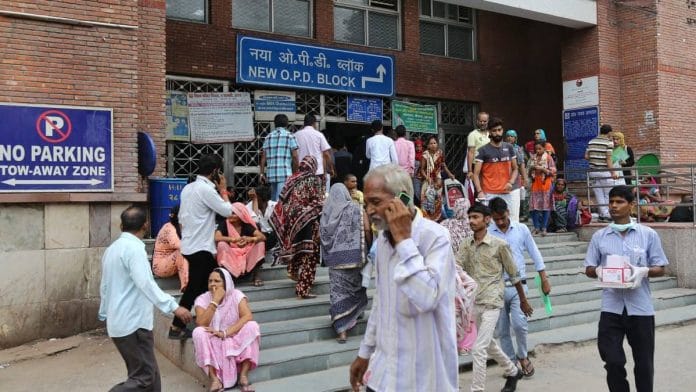
New Delhi: Highlighting severe systemic deficiencies across 38 government hospitals in the national capital, the Delhi High Court has issued a sweeping set of directives to restructure healthcare administration, eliminate recruitment bottlenecks and streamline emergency response systems.
The dedicated emergency helpline ‘102’, run by the Centralised Accident & Trauma Services (CATS) to track real-time ICU bed availability, receives approximately 2,200 calls daily. With only 30 phone lines and 30 operators, at least 500 calls get dropped every day without resolution, the court order reveals.
It also reveals that there has been no full-time medical superintendent at the Delhi State Cancer Institute since 2019, forcing the crucial oncology facility to operate without permanent leadership for over seven years.
The court has mandated that senior faculty members or senior doctors must be placed in charge of every hospital currently lacking a medical superintendent, managing director, or director within 15 days of a scheduled joint meeting.
The high court ruling in a suo motu case opens a window into the alarming operational figures governing healthcare access for millions in the capital. The court is evaluating the administrative and operational performance of 38 government-run hospitals, including eight society-run hospitals such as the Delhi State Cancer Institute.
To curb fatal transfer delays between facilities, all government hospitals must deploy at least three referral coordinators 24/7, the court has ruled.
The order, delivered on 18 September, by a division bench of Justices Prathiba M. Singh and Manmeet Pritam Singh Arora, confronts acute administrative failures ranging from unattended emergency helplines to chronic executive vacancies.
Bench slams ad-hoc staffing
A central theme in the ruling is the court addressing the government’s heavy reliance on temporary recruitment to handle critical personnel shortages. Examining status reports submitted by the Delhi Government (GNCTD), the court expressed complete dissatisfaction with current staffing methodologies.
“From the submissions made and from a perusal of the status report it becomes clear that government hospitals in Delhi are facing enormous difficulty in recruiting the necessary doctors and other necessary staff,” the bench observed, noting that “there is no uniform human resources policy of the Delhi government to take care of these recruitments”.
The court explicitly rejected stop-gap measures proposed by the Secretary of Health and Family Welfare, which permitted individual hospital heads to engage staff through ad-hoc arrangements.
Ordering a complete transition toward centralised and regular appointments, the court ruled: “In the opinion of this court, the Secretary, Health and Family Welfare, Government of National Capital Territory of Delhi (GNCTD) would have to deal with the issue of recruitment in a centralised manner, rather than allowing recruitment at the local level on a contractual basis… Under such circumstances, the filling up of vacancies from the top till the bottom of the pyramid has to be done in a manner so as to bring some consistency, clarity and permanency. Contractual employment cannot be the answer to all problems.”
Live court demonstration
The court’s scrutiny extended to patient-facing emergency infrastructure. Following an August 7 direction, the GNCTD integrated an online Intensive Care Unit (ICU) Dashboard into the CATS ‘102’ helpline on 2 September.
To verify functional efficacy during proceedings, live test calls were placed to the ‘102’ toll-free number directly from the courtroom. While the calls went unanswered during initial attempts, an operator eventually picked up and accessed the online dashboard to report ICU bed availability. The interaction confirmed severe scarcity in major medical centres.
“There is definitely a shortage of ICU beds, even in the leading government hospitals in Delhi, including Lok Nayak Jai Prakash (LNJP) Hospital and Deen Dayal Upadhyay (DDU) Hospital,” the court recorded.
To stop the 500-odd daily call drops, the Head of Office (CATS) was ordered to submit a month-long data mapping sheet tracking daily call volume and drops to rapidly expand lines and staffing.
Inter-hospital transfers, idle equipment
Addressing patient transit, the court highlighted that transfer delays between government facilities cause “severe trouble to the patient and their family, as also a loss of crucial time for these patients who require urgent attention”. Hospital authorities must maintain updated rosters of designated referral coordinators available round the clock to streamline admissions, the court has ordered.
Furthermore, following interactions with hospital administrators, including Dr Neelam Bharti, M.S. at Deep Chand Bandhu Hospital, the bench called out misleading reporting on diagnostic machinery such as Magnetic Resonance Imaging (MRI), Computed Tomography (CT) Scan, Positron Emission Tomography (PET) Scan, and ultrasonography (USG) machines.
“While giving these details, use by consultants on a random basis shall not be constituted as use of equipment. Any equipment which is not available for use of patients on a daily basis with proper manpower shall be treated to be unused equipment,” the bench noted, issuing a clear standard for upcoming audits.
Demanding direct accountability, the court directed that no top post at 38 government hospitals be left vacant. Heads of Delhi’s five largest facilities— LNJP Hospital, GTB Hospital, DDU Hospital, G.B. Pant Hospital, and Sanjay Gandhi Hospital—have been ordered to appear physically in court alongside the Secretary of Health and Family Welfare, when the matter is heard again on 10 October.
(Edited Nardeep Singh Dahiya)
Also Read: Why Delhi HC quashed man’s life term in POCSO case, backing call for ‘Romeo-Juliet’ clause