





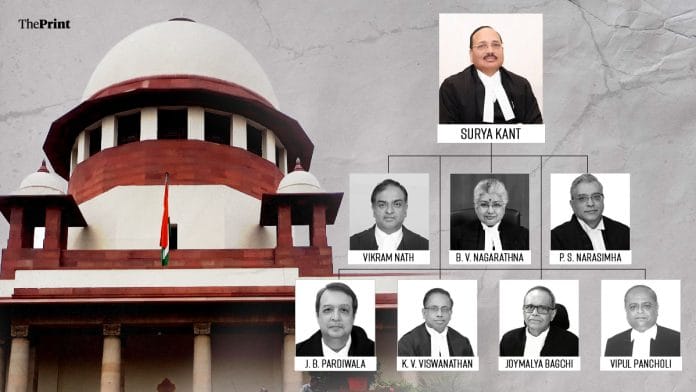

New Delhi: As Chief Justice of India (CJI) Surya Kant enters the tenth month of his fifteen-month-long tenure, and Justice Vikram Nath, the senior-most judge of the Supreme Court, prepares to take the reins, ThePrint looks at the rundown of incoming CJIs and what their tenures will look like in the coming years.
From Justice Nath’s relatively short tenure to Justice B.V. Nagarathna’s historic first as the first female Chief Justice of India, and the longer tenures of Justices J.B. Pardiwala and K.V. Viswanathan, the line of succession will shape the leadership of the Supreme Court over the next several years.
Having taken oath on 24 November, 2025, Kant is scheduled to retire on 9 February, 2027, a day before his 65th birthday. Justice Vikram Nath will take oath on 10 February 2027.
Among major decisions from the Supreme Court during Justice Kant’s tenure was one on the Aravallis, where the Chief Justice, along with Justices K. Vinod Chandran and N.V. Anjaria, ruled against a complete prohibition on mining in the Aravallis. In its November 2025 ruling, the court also made it clear that imposition of a full ban in the area could lead to illegal mining, creation of a land-mining mafia and criminalisation.
Also Read: SC ruling on sustainable mining in Aravallis: What continues, what stops & what comes next
Justice Vikram Nath: Next in line
Born on 24 September, 1962, Justice Vikram Nath belongs to Uttar Pradesh, and is all set to become the next CJI on 10 February next year. His tenure will be a relatively short one, just over seven months, and is expected to come to an end a day before his 65th birthday on 23 September, 2027.
Nath’s tenure will be only 226 days, about half the duration of Kant’s. Nath enrolled with the Bar Council of Uttar Pradesh in March 1987, following which he practiced at the Allahabad HC for about 17 years.
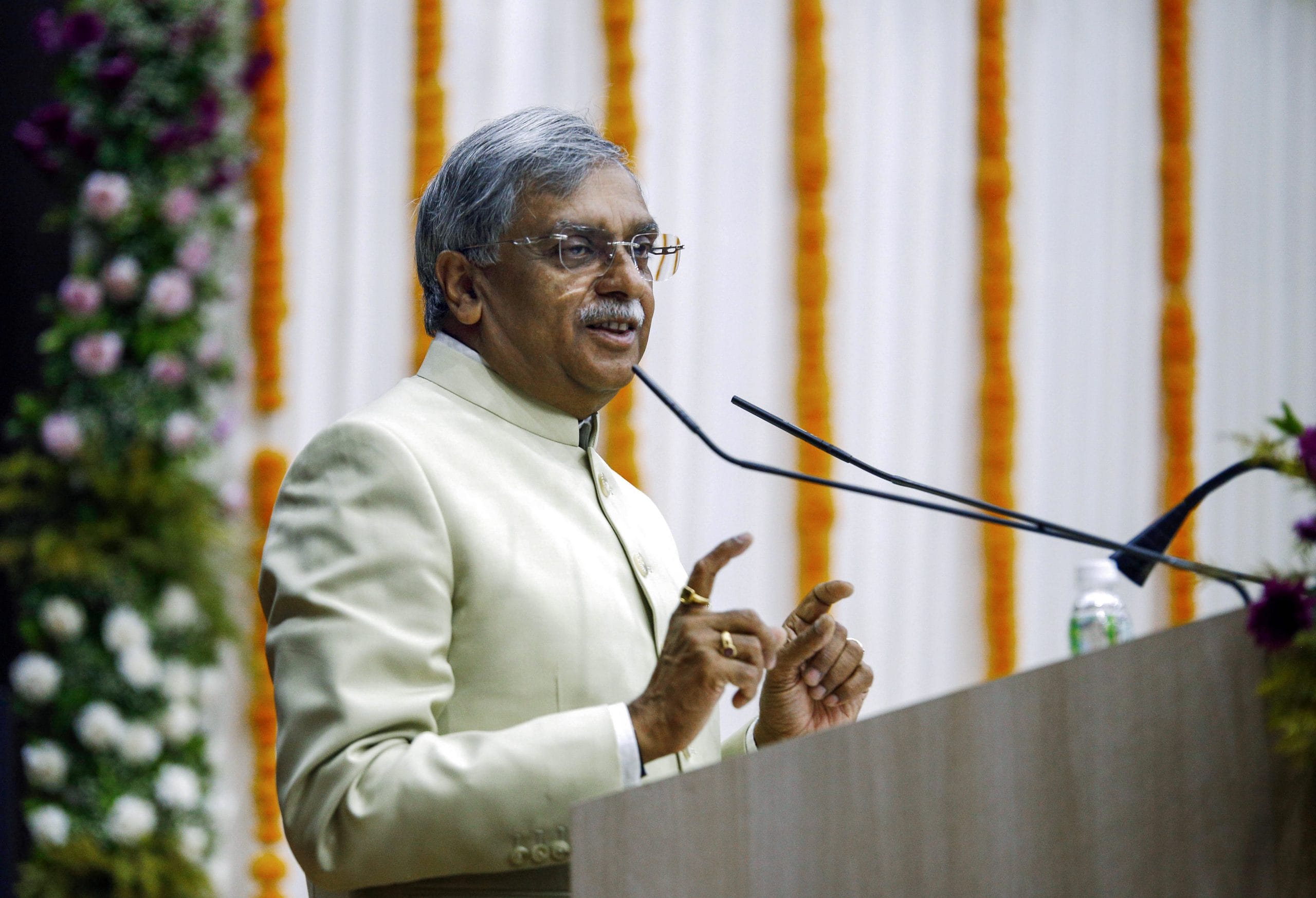
He first became an additional judge of the Allahabad HC in September 2004, followed by his appointment as a permanent judge only two years later in February 2006. After serving in the High Court for 15 years as a judge, he was appointed the Chief Justice of the Gujarat HC in September 2019.
During his tenure as CJI at the Gujarat HC, Nath introduced live-streaming of court proceedings, making him the first Chief Justice of a High Court in India to do so. In August 2021, he was elevated as a judge of the top court, where he also served as the Chairman of the Supreme Court Legal Services Committee, and the e-Committee, which oversees the use of information and communication technology, among others.
Among his most landmark decisions was in May, when the top court, in a first, permitted euthanasia for rabid, incurably ill, or demonstrably dangerous stray dogs to curb the threat to human life. Justice Nath, along with Justices Sandeep Mehta and N.V. Anjaria, were on the bench which issued a slew of directions to deal with the rising population of stray dogs in the country.
In April this year, a three-judge SC bench led by Justice Vikram Nath had stayed the execution of the death sentence imposed on a man and his brother in a triple murder case by the Patna High Court in January.
The case revolved around brothers Aman Singh and his brother Sonal Singh, who were convicted and sentenced to death for killing three relatives five years ago over a land dispute in Bihar’s Rohtas district.
More importantly, the court issued a slew of directions to deal with cases which involved potential death sentences. These included a direction to the trial court calling for a report relating to the aggravating and mitigating circumstances as a matter of course, before determining the sentence of the convict. If such a report has been called for by a trial court, high courts must mandatorily call for the same while admitting such cases, the court had also said.
Justice B.V. Nagarathna: A historic first
On September 24 next year, Justice B.V. Nagarathna will be making history by becoming the first female Chief Justice of India. Interestingly, Justice Nagarathna was elevated to the Supreme Court on the same day as Justice Vikram Nath, 31 August 2021.
Before that, she practised in constitutional, administrative, commercial and family law and was elevated to the Karnataka High Court in 2008. Her Supreme Court profile also records her work as president of the Karnataka Judicial Academy and the Bangalore Mediation Centre.
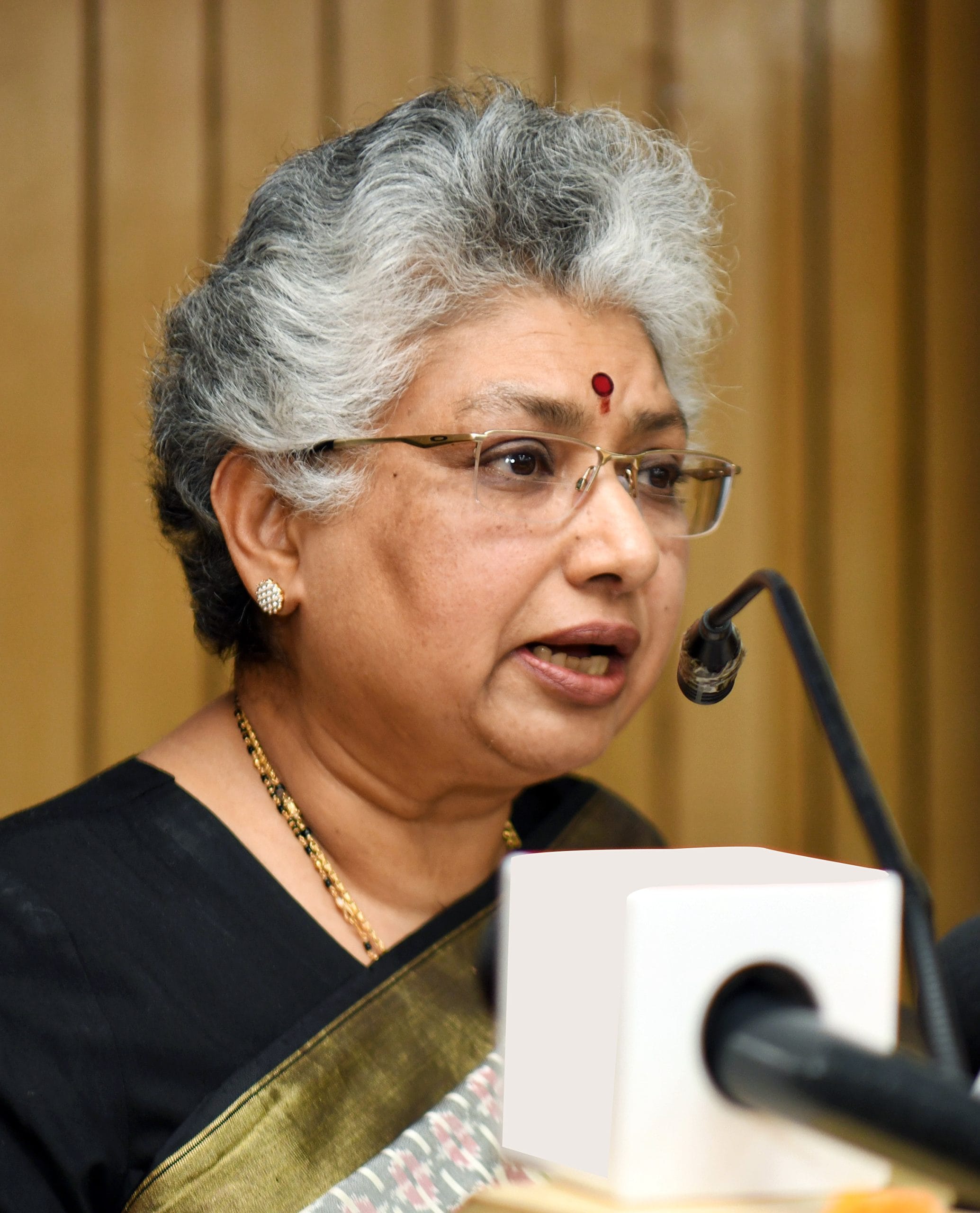
Although her tenure will only span 36 days, as she retires by 29 October, 2027, Justice Nagarathna’s time in office could be very promising, given her long history of being the sole dissenter in multiple landmark decisions rendered by the top court.
For instance, in January 2023, she was the lone dissenter on the five-judge Constitution Bench decision that upheld the legality of the Narendra Modi government’s 2016 demonetisation decision.
Although the 4-1 majority upheld the exercise, Justice Nagarathna concluded that demonetisation of the entire series of Rs 500 and Rs 1,000 notes was well-intentioned but could not have been carried out by the Centre by issuing a notification under Section 26(2) of the Reserve Bank of India Act, which allows the government to declare that any “series of bank notes” is no longer legal tender.
The demonetisation exercise could have been undertaken by the central government only through an ordinance or a parliamentary law, since the process was not initiated by the RBI, she had said.
“On a matter as critical as demonetisation, having a bearing on nearly 86 percent of the total currency in circulation, the same could not have been carried out by way of issuance of an executive notification. A meaningful discussion and debate in Parliament on the proposed measure would have lent legitimacy to the exercise,” the dissenting opinion read.
Apart from this, in August last year, prior to Justices Alok Aradhe and V. M. Pancholi taking oath as judges of the apex court, their appointments were cleared speedily by the Centre. Justice Nagarathna was the sole member of the SC collegium who had dissented against Pancholi’s elevation.
Although the reasons for Nagarathna’s dissent were not publicly revealed, it was reported that concerns relating to seniority and regional representation affected her choice.
One of the reasons, for instance, was that Pancholi’s elevation from Patna HC to the SC superseded several other senior judges, including three women judges such as Gujarat HC CJ Sunita Agarwal, and Justices Revati Prashant Mohite Dere and Lisa Gill of the Bombay and Punjab and Haryana HCs, respectively.
Justice P.S. Narasimha: Senior advocate to CJI
A senior advocate before his appointment to the Supreme Court on 31 August, 2021, Justice Narasimha did not come to the top court through the traditional HC route. His eventual elevation to CJI would therefore make him one of the rare examples of a judge rising directly from legal practice to the very top of the Indian judiciary. Prior to him, former CJIs S.M. Sikri and U.U. Lalit were also directly elevated to the top court from the Bar.
Narasimha is expected to take over on 30 October next year. His expected tenure is slated to last 186 days, a little over six months. He will retire on 2 May, 2028, a day before his 65th birthday.
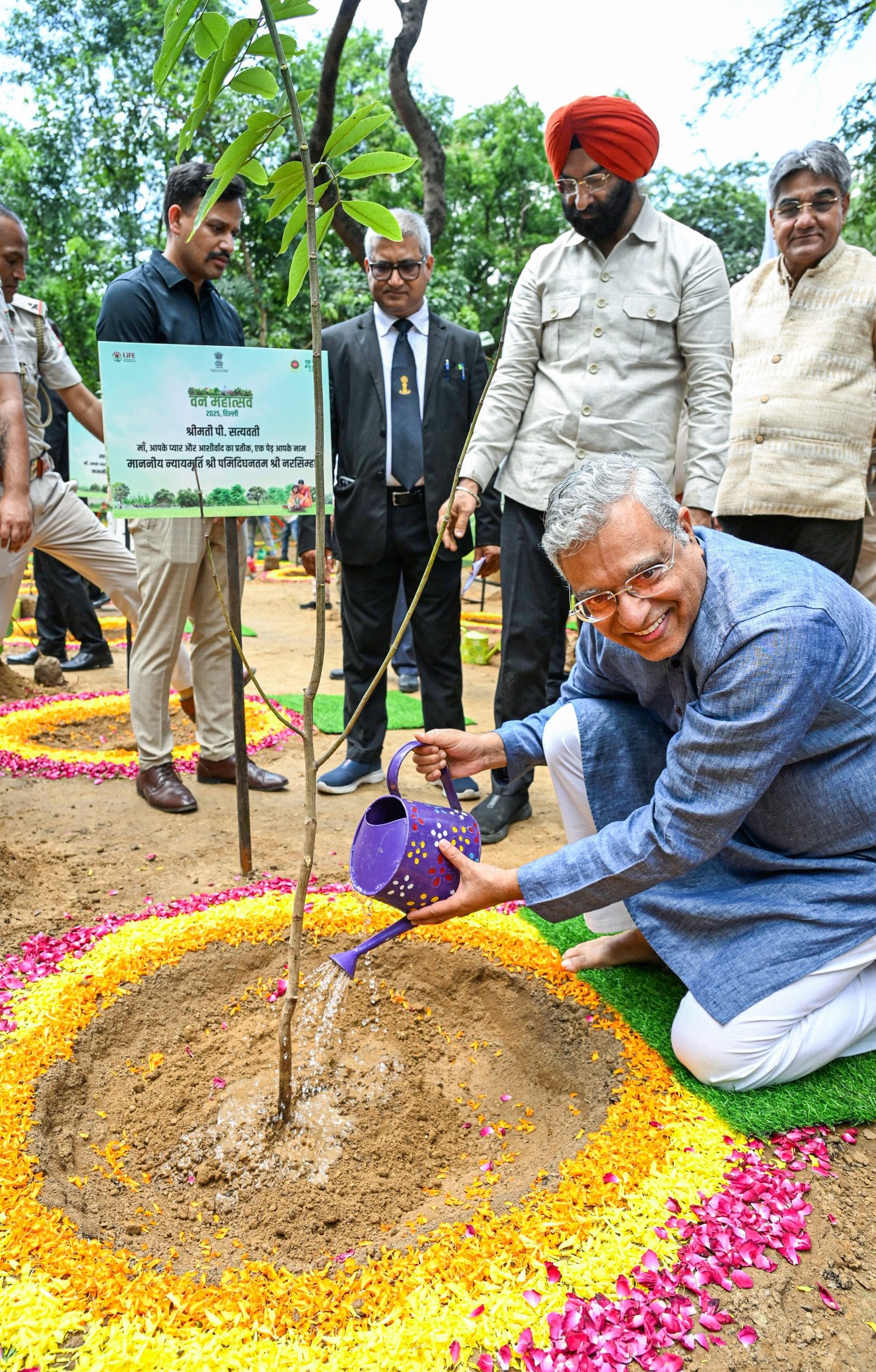
Among the more recent matters associated with Justice Narasimha is the Supreme Court’s July 2026 ruling concerning the use of AI-generated and hallucinated case law in judicial proceedings. Sitting with Justice Alok Aradhe, he dealt with a case in which NCLT and NCLAT decisions had relied on citations that were found to be non-existent or falsely attributed.
Interestingly, Justice Narasimha’s tenure is coming at a time when Artificial Intelligence, or AI, and technology have seeped deep into litigation. Justice Narasimha has also been a part of multiple Constitution benches of the Supreme Court. He was appointed the counsel for the Justice Chinnappa Reddy Commission. He was a member of the Supreme Court Legal Aid Committee.
He was designated a Senior Advocate by the Full Court of the Supreme Court of India in 2008. Years later, he also served as the Additional Solicitor General of India in 2014. During his time as ASG, he argued landmark cases like the Ayodhya case (2019), the National Judicial Appointment Commission case (2015) and the 2019 case on legalising euthanasia.
Justice J.B. Pardiwala: One of the longest tenues as CJI
Justice J.B. Pardiwala is expected to take over as CJI from 3 May, 2028. Interestingly, his tenure is slated to last 831 days, or two years and three months. This means he would exceed the tenure of former CJI D.Y. Chandrachud, who was in office for two years and two days, and had one of the longest tenures in the last five years.
Pardiwala is expected to retire by 11 August, 2030, a day before his 65th birthday. Born on 12 August, 1965 in Mumbai, Pardiwala graduated from the J.P. Arts College, Valsad, in 1985, following which he went on to study law at the K.M. Law College in his hometown, Valsad, Gujarat.
Born to a family of lawyers, Pardiwala began legal practice in 1989 from his hometown, following which he moved to the Ahmedabad HC. Pardiwala’s father, Burjor Cawasji Pardiwala, was also a lawyer who went on to become the Speaker of the 7th Gujarat Legislative Assembly from 1989 to 1990.
Pardiwala also went on to become a member of the Bar Council of Gujarat from 1994 to 2000, after which he was nominated to be a member of the Bar Council of India’s disciplinary committee. Just before becoming a judge at the Gujarat HC in February 2011, he also served as the standing counsel for the Gujarat HC and subordinate courts from 2002.
On 17 February, 2011, he became an additional judge and two years later, in January 2013, he became a permanent judge of the Gujarat HC.
After 11 years as a judge at the Gujarat HC, on 9 May, 2022, he became a judge at the apex court.
In comparison with Nagarathna’s tenure, Pardiwala has a lot more room to influence multiple cycles of collegium recommendations, case-management policies, and what matters the Constitution benches will take up.
Among his notable judgments was the 11 August 2025 ruling by a two-judge bench of the SC which said that stray dogs have to be relocated to shelters and pounds within eight weeks. This order had created widespread panic among dog lovers and animal rights activists.
In November last year, he also authored the ruling which said that courts cannot set timelines for decisions made by the President and the Governor when it comes to granting assent to Bills under the Constitution.
In January, he was also part of the SC bench which declared the right to menstrual health as part of the Right to Life under the Constitution. The landmark decision aimed to ensure gender justice and educational equity, and the bench issued directions to all states and union territories to ensure that these facilities are provided in schools, regardless of whether they are government-run, aided or private.
Justice K.V. Viswanathan: Fourth CJI from the Bar
In 1988, Justice K.V. Viswanathan came to Delhi for the first time in order to start his practice here. However, he never thought that 43 years later he would be at the helm of the Supreme Court of India.
On 12 August 2030, Justice K. V. Viswanathan will take oath as the Chief Justice of India. Significantly, he will be the fourth CJI, after Narasimha, to be appointed from the Bar.
Apart from this, Justice Viswanathan was the tenth advocate in the history of the Indian Supreme Court to be directly elevated as a judge from the Bar. His tenure is expected to last a total of 287 days, or ten months, and come to an end on 25 May 2031, a day before his 65th birthday.
Justice Viswanathan first came to the Supreme Court in May 2023, prior to which he had been serving as a senior advocate since 2009. During his time as a lawyer, he appeared in key Constitution Bench hearings, such as arguing in favour of transgender persons’ right to marry in the batch of petitions seeking marriage equality in 2023.
He had also argued on behalf of the Internet Freedom Foundation in the Constitution Bench case where WhatsApp’s privacy policy was under challenge. He also served as an amicus curiae, advising the court in a case which related to filling up district court vacancies.
One of the notable rulings delivered by him dealt with the right to die with dignity, when the Supreme Court in March this year allowed withdrawal of life support for Harish Rana, a 31-year-old who had been in a vegetative state for around thirteen years.
Apart from this, he was also on the SC bench which delivered a split verdict on the constitutionality of Section 17A of the Prevention of Corruption Act, 1988. Section 17A requires approval from the appropriate government or competent authority before a police officer can conduct an enquiry, inquiry, or investigation into an alleged offence by a public servant. Justice Viswanathan had upheld the provision, saying that it acts like a legitimate legislative filter to protect honest decision-making from malicious or ill-informed complaints.
Justice Joymalya Bagchi: CJI for 4 months
Justice Bagchi is expected to take over the apex court in May 2031, following Justice Viswanathan’s retirement on 26 May 2031. His tenure is expected to last only four months, as he retires on 2 October 2031, a day before his 65th birthday.
Born in Kolkata in October 1966, Bagchi enrolled as an advocate in 1991 after obtaining his law degree from Calcutta University. He specialised in criminal and constitutional law, appearing before the Calcutta High Court, other High Courts and the Supreme Court.
In 2011, he became a judge of the Calcutta HC. A decade later, Justice Bagchi made his way to the Andhra Pradesh HC as a judge, albeit only for a little less than a year. Following this, he was transferred back to his parent HC in Calcutta, where he served as a judge from November 2021 to March 2025. Finally, he made his way to the Supreme Court in March last year.
In recommending him, the Collegium had taken special consideration of the fact that a judge from the Calcutta High Court had not ascended to the post of Chief Justice since the retirement of CJI Altamas Kabir in 2013.
Currently, Justice Bagchi is on the bench, alongside CJI Kant, which heard the pleas concerning the Special Intensive Revision (SIR) of Electoral Rolls in Bihar. The court upheld the Election Commission of India’s SIR of electoral rolls in Bihar, while noting that such an exercise is valid under Article 324 of the Constitution and Section 21(3) of the Representation of the People Act, 1950 (RPA), which allow the ECI to manage free and fair elections and direct a special revision of the electoral roll for any constituency.
Justice Pancholi: Government lawyer-turned-CJI
Born in Ahmedabad on 28 May 1968, Justice Vipul Pancholi will have a tenure of 1.5 years after he takes over as CJI on 3 October 2031. He is expected to retire on 27 May 2033, after a tenure of nineteen months, or 602 days. However, his journey to the top court was not an easy one.
A graduate in electronics who later completed a master’s degree in commercial law, he enrolled with the Bar in 1991 and spent seven years as assistant government pleader and an additional public prosecutor at the Gujarat HC.
In 2014, he became a judge of the Gujarat HC, and nine years later, he was transferred to the Patna HC in 2023, where he became CJ two years later in July 2025. On 29 August last year, he came to the SC, but his appointment was fraught with controversy.
Pancholi’s elevation was cleared by a 4:1 majority, with the only woman judge on the collegium, Justice Nagarathna, submitting a private dissent note, warning that the judge’s elevation could prove “counter-productive” to the administration of justice and damage the credibility of the collegium system. Besides objecting to Pancholi superseding several senior judges, Justice Nagarathna flagged his transfer from the Gujarat HC to the Patna HC in 2023 and sought its scrutiny.
In August last year, ThePrint had reported that Justice Pancholi’s transfer from Gujarat HC to Patna HC came after a complaint of judicial impropriety against him. He was transferred pending an enquiry being held into a complaint against him. However, he was given a clean chit in that enquiry.
(Edited by Viny Mishra)
Also read: How CJI Surya Kant’s new gender sensitivity handbook differs from DY Chandrachud’s