



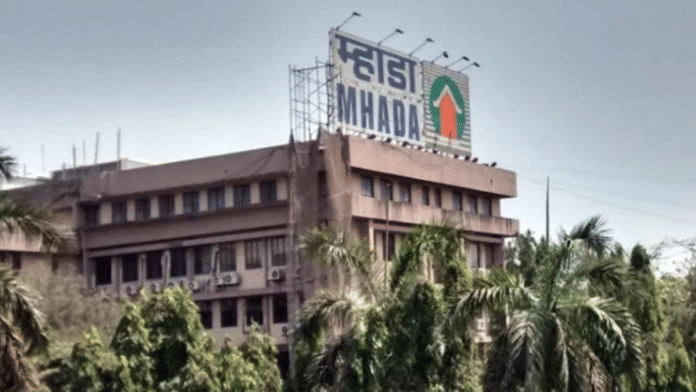
Mumbai: Five years after it was adopted in 2021, a redevelopment model for one large state housing board layout in Mumbai has paved the way for several such large clusters to be developed into integrated townships across the city.
The Maharashtra Housing and Area Development Authority (MHADA) is working on the redevelopment of 11 large clusters in Mumbai on the same model that will result in the transformation of over 900 acres across the city.
Overall, the projects are expected to draw private investment worth more than Rs 3 lakh crore for the redevelopment of a total of 75,445 tenements, according to estimates drawn up by MHADA.
The projects are part of MHADA’s ‘Construction & Development’ model, known as the C&D model, under which the housing authority identifies large clusters of MHADA layouts, appoints private developers with a net worth strong enough to take on such multi-crore projects, and tries to maximise the rehabilitation area for existing residents.
In return, MHADA gets a mixture of monetary payments from developers and a housing stock that it can put up in its annual lottery of affordable houses. “A lot of these projects were stuck for several years because the focus was on redeveloping individual buildings, and the projects would turn out to be unviable,” Sanjeev Jaiswal, MHADA vice president and CEO, told ThePrint.
Of the eleven clusters MHADA plans to redevelop using the C&D approach, the smallest is six acres (Ramkrishna Nagar in Khar) and the largest is 256 acres at Gorai. Both projects are at the proposal stage. Tenders have been awarded for seven of the eleven projects: Abhyudaya Nagar, GTB Nagar, Adarsh Nagar in Worli, Bandra Reclamation, Motilal Nagar, Kamathipura, and SVP Nagar in Andheri. “The projects have attracted large premium developers, who are more likely to ensure timely completion and quality work since their reputations are also at stake,” Jaiswal said.
Developers will benefit by getting a sizable sale component in each project using the Floor Space Index (FSI) after rehabilitating existing residents and accounting for MHADA’s share of the housing stock.
“Even if the redevelopment of individual buildings is viable, in the case of an individual building the redevelopment could be a little faster, but we will be simply creating one vertical building and some basic amenities. In the C&D model, we have podiums, gardens at multiple levels, pet care centres, walking arenas, green spaces and green buildings. The quality of life of the people who will be rehabilitated will see a major upgrade,” Jaiswal said.
Also Read: Mumbai’s BDD chawl revamp gains momentum at last. MHADA says 30% homes set for 2026-end handover
Sluggish record of MHADA redevelopment
MHADA has 56 layouts across the city, many of which had run into disrepair due to poor maintenance and neglect and were in dire need of redevelopment. However, the approach until five years ago was to redevelop individual buildings and layouts. These buildings would pick a developer, who would then bring a proposal to MHADA.
Many of these projects languished for several years as developers would often realise that they were financially unviable.
Some of the projects now under the C&D model by MHADA were ones where redevelopment had been planned for years but did not materialise for various reasons.
For instance, there were talks of redeveloping Kamathipura since 2007. Initially, developers were hesitant to come forward due to the notoriety of the cluster, as the area is home to Mumbai’s illegal prostitution belt. The one developer that did come forward, DB Realty, faced financial constraints and the plan did not see the light of day.
“The cessed buildings in Kamathipura could have gone for individual redevelopment. A handful of them did go initially, some buildings were demolished, some collapsed. But, largely there were no takers,” Jaiswal said. Cessed buildings are those built before 1960 where tenants pay MHADA a cess for the building’s maintenance.
He added that the story of GTB Nagar was not very different. The redevelopment of a handful of buildings here was stuck since 2013. These buildings had signed an agreement with a Navi Mumbai-based developer.
However, a lack of consensus, multiple litigations, and questions over MHADA’s role on private land meant that the project did not take off.
The state government officially appointed MHADA as the special planning authority in 2024.
The approach of treating MHADA layouts as clusters and appointing a private developer under MHADA’s supervision was first adopted for Goregaon’s Motilal Nagar in 2021.
However, the project did not take off until last year as residents of that area moved the Bombay High Court and later the Supreme Court saying the society should be allowed to self develop and appoint a developer of its own choice.
In November 2025, the state cabinet officially cleared an integrated and cluster redevelopment policy for MHADA colonies for the authority to group the redevelopment of individual colonies into large clusters and build large townships. For projects over 20 acres the state government also removed the need for MHADA to obtain individual consent from residents, stating that the project will try to optimise the FSI potential for redevelopment. However, developers appointed through the tender process are required to obtain approval from the housing societies involved in the project.
Jaiswal said the projects are being taken up under different sections of the Development Control Rules to maximise the FSI potential. Wherever there are slums, whether notified or not, those are also being redeveloped using the provisions of 33/10 in the Development Control Rules that deal with slum rehabilitation.
Over 900 acres to go under redevelopment
In March last year, the Adani Group emerged as the highest bidder for Motilal Nagar, spread over 143 acres. The colony has 3,700 houses plus 1,600 slum tenements that are to be rehabilitated. The houses are currently about 230 square feet in size. The residents will be awarded redeveloped units of 1,600 square feet in built-up area, details accessed from MHADA show. The total project is expected to cost Rs 36,000 crore.
In June last year, MHADA, the nodal agency for the cluster redevelopment of Kamathipura, floated bids for the project.
In November, MHADA appointed AATK Constructions, linked to Pune’s Goel Ganga group, for the project. As part of the Rs 15,000-crore project, a 34-acre area will be redeveloped where 8,800 families living in houses of varying sizes will get 500 square feet redeveloped houses.
Then between March and June, MHADA finalised developers for the clusters of GTB Nagar in Sion, Abhyudaya Nagar in Kalachowki, Adarsh Nagar in Worli, Bandra reclamation and Andheri’s SVP Nagar.
Keystone Realtors (Rustomjee) has taken up the redevelopment of GTB Nagar, which includes buildings built for Punjabi and Sindhi families who migrated from Pakistan to India. The GTB Nagar project involves an 11-acre land parcel with 1,200 houses and 350 slum units. Residents, who were earlier living in 270 square feet houses, will get redeveloped houses of 635 square feet.
Abhyudaya Nagar, a 33-acre cluster built to house industrial workers, will be redeveloped by a consortium of MGN Agro Properties, associated with the Welspun Group, NNP Buildcon and Honest Shelters. The project, which will see an investment of Rs 12,000 crore, involves rehabilitating 3,410 houses and 600 slum units. Residents currently living in houses of 208 square feet will get redeveloped houses of 641 square feet.
The clusters of Bandra reclamation (98 acres) and Adarsh Nagar (34 acres) have been awarded to the Adani Group for redevelopment. For both these projects, Lodha Developers and JSW Realty & Infrastructure had also put in their bids. The Rs 13,353-crore Adarsh Nagar project will rehouse 863 families while the Rs 25,200-crore Bandra reclamation revamp will rehabilitate 1,147 families in larger houses.
The tender for the redevelopment of SVP Nagar had also drawn responses from large developers with Reliance 4IR Realty Development Limited, Adani Group, and a consortium led by Hanura Realty Private Limited, a subsidiary of JSW Steel, were in the fray. Ultimately, the consortium led by Hanura Realty won the Rs 33,300 crore project spread over 74 acres.
MHADA is, however, facing a pushback from residents of Bandra reclamation, Adarsh Nagar and SVP Nagar, as the non-requirement of consent is proving problematic. Residents here have alleged that MHADA is taking away their autonomy over redeveloping their homes, saying some already had plans for individual building redevelopment underway, which MHADA’s cluster approach is now stalling.
Another cluster project of seven acres—the PMGP Majaswadi colony—is being implemented by MHADA on an Engineering, Procurement, Construction (EPC) model.
Jaiswal said, two more cluster redevelopment proposals under C&D—Ramkrishna Nagar in Khar, a small cluster over six acres, and the Old MHB Colony in Borivali spanning 26 acres—await the state government’s approval.
Besides, MHADA is also prepared to put up two of its largest cluster proposals for the state government’s approval. One is Charkop in Kandivali, involving the redevelopment of 201 acres and the rehabilitation of 20,040 families with an estimated investment of Rs 87,307 crore. The other, Gorai, will see an estimated investment of Rs 79,111 crore, to redevelop 256 acres for the rehabilitation of 26,206 units.
The procedure
Jaiswal said MHADA tries to identify clusters where redeveloping individual buildings is difficult or does not maximise the value for rehabilitated residents.
“For example, in Charkop, there are CRZ (Coastal Regulation Zone) restrictions. Gorai has the same problem. The standalone buildings in the CRZ area will never get redeveloped. But, if we make a cluster to optimise the FSI, then we can make a green zone or a buffer zone in the CRZ area,” the IAS officer said.
He added that in most of these projects roughly 50 percent of the FSI is being used for the rehabilitation component.
Once MHADA identifies a cluster, it sends a proposal to the state government for the Cabinet’s consideration. Once the state Cabinet approves it, a government resolution (GR) is issued, after which a tender is formulated. The tender then goes to a high-powered committee of the state government for cluster redevelopment for its approval.
After the committee approves it, the housing minister signs off on it, and the tender is published. Once the developer is selected, the proposal once again goes to the high-powered committee for its approval, followed by the approval of the state housing department.
(Edited by Amrtansh Arora)