





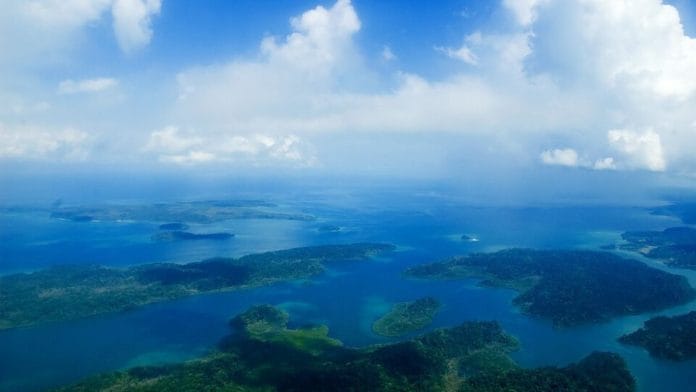


New Delhi: State-owned Oil India Ltd’s (OIL) discovery of natural gas in a shallow offshore block in the Andaman Basin has fuelled hopes of a new energy source at a time when the West Asia conflict has disrupted oil and gas flows globally and forced countries to look at shoring up domestic energy production.
With the June 5 discovery, India’s leading energy company has established the presence of hydrocarbons in two of the three exploratory wells it has drilled in Vijayapuram on the east coast of the Andaman Islands. OIL reported the presence of natural gas in its second exploratory well, Vijayapuram-2, last September.
The discovery is significant even though it’s a long way before its commercial viability is established.
Here’s why. First, the presence of natural gas indicates the existence of a working petroleum system in that part of the Andaman Basin. Second, it gives an impetus to the belief that exploration in the region is worth pursuing. Third, the development will encourage global oil majors looking at India as a promising opportunity.
The discovery is also significant for India’s exploration hydrocarbon landscape as the country’s oil and gas import bill has been on the rise.
“It (the find) validates the geological potential of the Andaman Basin in particular and the potential that other deep and ultra-deep water basins of India hold,” a Ministry of Petroleum and Natural Gas (MoPNG) official told ThePrint.
India imports 88 percent of its crude oil and 50 percent of its natural gas requirements.
Also Read: You can’t be a $30 trillion+ economy without being energy-independent—ex NITI Aayog CEO Amitabh Kant
What do the gas finds in the Andaman Basin mean?
To be sure, a gas discovery, though significant, is just the first step. It’s still a long way off before commercial operations can start at such wells.
OIL said in a press statement on June 5 it was undertaking further gas sampling to assess the “composition and calorific value of gas and to carry out isotope studies to understand the genesis of the gas”.
“As per preliminary assessment, this is a leading indicator of presence of source or migration pathway or accumulation of hydrocarbons in current prospect, which will help in strategizing future exploratory programs,” the statement read.
According to market analysts, commercial operations at such wells remain some years away.
Arvind Jain, vice president (Oil and Gas Research) at Rystad Energy, an independent research and energy intelligence company, said such projects have a long gestation period.
“A discovery is a first step. The agency doing the exploration will have to appraise it, come up with a feasible development plan and establish commerciality. They have to think about the logistics, think about the market value to eventually sell the gas,” Jain told ThePrint.
“There is a lot that needs to happen, a lot that needs to fall in place for this to eventually reach first gas,” he added.
It’s also a time-consuming process.
Jain cited the case of Indonesia, where massive gas discoveries were made in the Indonesian portion of the Andaman Sea between 2022 and 2024.
“These discoveries have multi-Tcf (trillion cubic feet) in-place gas volumes. There, the final investment decisions are expected to come in the next few months, and then first gas from these will probably come in by 2029 or something,” he said.
Tcf is a volume measurement for natural gas used primarily in the US oil and gas industry.
Jain added that based on this timeline and resource base, OIL will need to achieve significant results from the appraisal wells.
Appraisal wells are drilled to gather additional information about a hydrocarbon discovery or reservoir. They are typically drilled after an initial exploration well has encountered signs of oil or gas in a particular area.
“There needs to be a multi–Tcf resource base, and even in that case, we are looking at first gas somewhere around 8-10 years down the line,” he said.
Moreover, he added that the Andaman Basin, where the exploration is taking place, hardly has any infrastructure.
“Commercialisation will depend not only on the size of the resource but also on the economics of creating the required gas value chain. There is work to be done, but I reiterate that it’s a very positive development in terms of establishing a working petroleum system,” Jain said.
The gas finds in the Andaman Basin are being compared by many in the industry to Guyana, where US company ExxonMobil initiated oil and gas exploration activities way back in 2008 but faced many setbacks before drilling its first exploration well in 2015, Liza-1.
Jain said the Andamans story is still unravelling. “It may be a little premature to compare the recent gas find with Guyana, though the potential is definitely there.”
OIL plans to drill a fourth well soon. The company statement issued on 5 June said it had begun an appraisal plan to assess gas occurrences in the second exploratory well, Vijayapuram-2.
As part of the process, it had acquired 600 sq km of three-dimensional seismic data covering the area in and around Vijayapuram-2 and the current well, Vijayapuram-3.
“The processing of the acquired data has commenced; subsequent interpretation will lead to generation of possible appraisal drilling locations,” the statement said.
Jain said commercial development in such an area requires certain critical mass in terms of the resource base.
“Analysis will have to be done based on flow rates from production testing. Then reserve estimation will have to be done, and then they look at the commercial angle of it, whether it is commercially viable or not,” he said.
But if the discovery only contains small volumes, experts say it may not be developed and left stranded unless they are able to find clusters of smaller discoveries.
“These can be developed in the form of cluster development, which is not uncommon,” he added.
Private players showing interest, but more players needed
The gas discoveries have generated interest among private players, including global oil and gas majors.
The Lieutenant Governor of Andaman and Nicobar Islands, Admiral (retired) D.K. Joshi, said at a conference in Delhi last week that leading public sector companies ONGC and OIL are in advanced talks with global oil and gas majors such as BP, Shell, ExxonMobil and Petrobras.
“What these joint ventures and memorandum of understandings will bring to the table is not only funding but deep sea oil exploration technologies and most importantly drilling rigs specifically designed for ultra-deep sea exploration, which relate to more than 1,500 metres of depth, and which are in the Andaman Basin,” Joshi said at the conference on ‘Andaman and Nicobar Islands: Development, Security and Ecology’, organised by The India Foundation.
Rystad Energy’s Jain said that the industry has seen several MoUs, technical partnerships and service agreements over the last few years, which are positive developments and indicate growing interest from global players.
He cited BP’s role as technical service provider to ONGC for Mumbai High and the broader western offshore, as well as TotalEnergies’ technical partnership with Oil India, as examples of increasing international engagement in India’s upstream sector.
However, the next step would be to see that the interest translates into bids and participating interests in the offered exploration blocks, and that is when things would move to the next level.
BP remains the only major international oil company with a significant equity position in India’s upstream sector.
Domestically, the sector is led by state-owned companies ONGC and Oil India, alongside private players Vedanta and Reliance. So, there is scope for more players, particularly in terms of bringing in additional international expertise.
However, foreign players have shied away in the past largely because of regulatory issues and delays in getting clearances.
Joshi, the Andaman and Nicobar Islands LG, said in his address that for a territory that has one-fourth of the country’s coastline, no offshore oil exploration had taken place until about 2020 because the entire stretch of water in and around the Andaman and Nicobar Islands was called a “no-go zone”.
“Why? Because DRDO tests missiles at Wheeler Island (off the coast of Odisha) and from Sriharikota (Andhra Pradesh) and they may fall onto them,” Joshi said on 12 June.
“So, we took it up aggressively in the Island Development Authority (IDA) meeting in 2020 and told them that there are technologies available and you can waypoint these vehicles and missiles in such a way that nothing comes in and around the Andamans. Entire stretches of the Andamans were freed up, and fast forward to the end of last year, and 2026. OIL in Vijaypuram-2 found samples of gas,” he said.
He added that on 27 January, ONGC started drilling a stratigraphic well in the Andaman offshore region with finds of crude condensate. A stratigraphic well is an exploratory hole drilled solely to gather subsurface geological data rather than to find or produce oil, gas or water.
From a policy perspective, Jain said a lot has been done in recent years.
This includes opening up of around 1 million sq km of former “no-go” areas, as well as the passage of the amendments to the Oilfield (Regulation and Development) Act (ORDA) in 2025.
The act, which became operational from 15 April 2025, modernises India’s upstream regulatory framework by simplifying procedures, enabling integrated energy development and strengthening investor confidence.
“I think that should give confidence to international companies,” said Jain.
(Edited by Sugita Katyal)
Also Read: As US-Iran deal announcement paves way for Hormuz reopening, what lies ahead for India & oil markets
Fingers crossed—hopefully this will be a positive and productive for India, creating greater opportunities and prosperity for the people of the Andaman and contributing to the nation’s growth as a whole.