







New Delhi: Telecom operators have declined a proposal, backed by the Supreme Court’s amicus curiae, to block suspicious SIM cards within two-three hours in cases linked to “digital arrest” and other cyber-frauds, citing the need for due diligence to avoid inconveniencing genuine users.
Instead, they agreed only to carry out disconnections “twice a day.”
The exchange is recorded in the telecom service providers’ (TSPs) Action Taken Report (ATR) and the minutes of a meeting with the Department of Telecommunications (DoT), annexed to the fourth status report filed 3 August before the Supreme Court by the Indian Cyber Crime Coordination Centre (I4C), in a suo motu writ petition.
A bench of Chief Justice of India (CJI) Surya Kant, Justice Joymalya Bagchi and Justice V. Mohana passed a fresh set of interim directions on Tuesday.
The action item, drawn from the third Inter-Departmental Committee meeting on 12 March, asked the DoT, in consultation with the TSPs, to examine the feasibility of reducing the blocking timeline for suspicious SIM cards to two-three hours “while maintaining due diligence safeguards.”
In response, the operators informed the committee that they carry out necessary due diligence before disconnection “to avoid any inconvenience or hardship to genuine users,” and agreed that disconnection would be carried out twice a day to reduce the time taken in blocking—well short of the near-real-time cut-off that the amicus had sought.
The record contains a second claim that is likely to draw scrutiny. On the detection of people holding multiple connections, the DoT stated that its own analysis “does not suggest any linkage or co-relation” between SIM cards issued to a person beyond the prescribed limit and their misuse in cyber-frauds.
That assertion sits alongside its admission that the identification of multiple SIMs is currently undertaken only “on a best-effort basis” using demographic and facial information.
Moreover, the committee separately observes, in its minutes, that real-time inter-operator sharing of subscriber-connection data “is presently not available due to the existing licensing framework”—a gap that goes to whether such a linkage could reliably be detected in the first place.
Gaps in SIM issuance
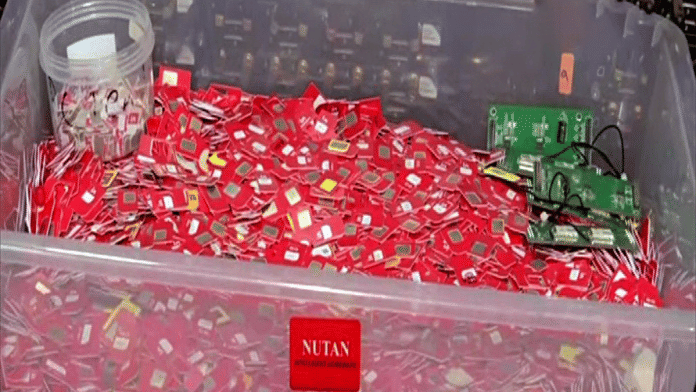
The TSP reports acknowledged continuing misuse of KYC documents by Point of Sale (PoS) agents for the issuance of fraudulent SIM cards, which, the committee noted, facilitates the operation of SIM farms and cyber-fraud networks.
A DoT circular of 31 August 2023, effective from December that year, requires a unique PoS identification number for each agent, franchisee and distributor across operators.
The committee sought stricter compliance on subscriber verification by PoS agents, and mechanisms to prevent the misuse of multiple PoS identities by the same individual.
On timelines, the action items record that national-level visibility of SIM issuance across operators, and biometric-based cross-operator SIM monitoring, are to be implemented within nine months, before December 2026, with technical feasibility still under discussion.
The committee took up the subletting of IP addresses by internet service providers to other entities, including foreign. It emphasised the need for transparency in IP-address allocation and visibility for law enforcement agencies, noting that a mechanism to address this is under discussion within the DoT.
On measures deployed, the TSPs reported that AI-based systems analysing about 250 behavioural parameters were in place to identify spam and suspicious activity involving calls and SMSes.
Malicious links transmitted through SMS were being blocked, they said, adding that a “double consent” mechanism had been rolled out across telecom circles to prevent fraudulent call forwarding.
Under this mechanism, a subscriber who dials a call-forwarding code receives a real-time alert explaining that the action would enable call forwarding, and must confirm before it is activated. If the subscriber denies or does not respond, the request is automatically rejected.
ATRs and blacklisting data on PoS entities were being submitted on the DoT’s Digital Intelligence Platform, accessible to law enforcement, the operators said.
Unnotified rule sets
The DoT said the Telecommunications (Radio Equipment Possession Authorisation) Rules, 2025 have been notified. The Telecommunications (User Identification) Rules, 2025 are in the final stages of finalisation, with the department seeking time until 31 August for notification.
The requirement that over-the-top communication platforms implement a SIM-binding mechanism—tying a messaging account to a verified SIM—to regulate audio and video calls has been reiterated, with the compliance deadline extended to December 2026.
As for a liability framework for telecom operators, the panel chairperson suggested the DoT to examine global best practices on civil-fault liability—distinct from criminal prosecution—so that a mechanism could be developed to compensate victims affected by TSP failure or negligence.
A representative of the Telecom Regulatory Authority of India (TRAI) is to be invited to the next Inter-Departmental Committee meeting. The Supreme Court listed the matter for hearing on 16 September.
(Edited by Tony Rai)
Also Read: e-Zero FIR mechanism now operational in 19 states, govt tells SC bench hearing digital arrests case