





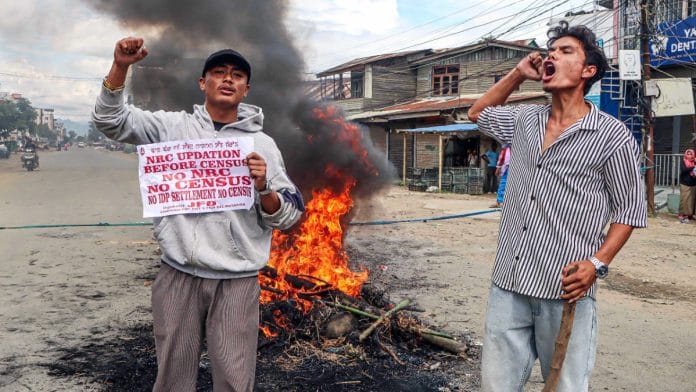

New Delhi: Manipur is witnessing fresh unrest, mostly in valley districts home to the non-tribal Meitei population, over the central government’s decision to conduct a census, without an NRC, followed by a delimitation exercise. Citizens and students’ groups are demanding that the Centre first compile the National Register of Citizens (NRC) to delineate legal residents from illegal immigrants in Manipur before going ahead with the Census.
A citizens’ group under the banner of “Campaign for Just and Fair Delimitation” had last week called for a 48-hour boycott of all central and state government offices in the state. On Saturday, around 2,000 women participated in a torch rally at Keishampat junction in Imphal West to press for the demand. A 10-member team with leaders from different communities are currently in Delhi to meet central ministers in this regard.
Data collection for the decennial Census, which will precede the delimitation, began in Manipur in January. And it’s not just the Meiteis opposing it. Two other ethnic groups, Meitei Pangals (Muslims) and Nagas, have demanded an NRC before the Census exercise.
Why are Meiteis, Pangals and Nagas demanding that NRC precede the Census? ThePrint explains.
‘Absorption of illegal immigrant’
At the heart of the demand is the apprehension among Meiteis that a Census without NRC could result in “demographic changes” in Manipur in light of the influx of illegal immigrants from neighbouring Myanmar.
Myanmar is still grappling with instability following a military coup in February 2021. The Kuki-Chin tribe there has close ties with Kukis across the border in India, and Meiteis claim that since the coup several hundreds have crossed over to Manipur through porous borders.
Many in Manipur blame the illegal influx for the ethnic conflict that first rocked the state in May 2023. The conflict broke out between the two prominent ethnic communities in the state: non-tribal Meiteis, Hindus; and tribal Kukis, mainly Christians. The violence has so far claimed at least 200 lives and displaced more than 60,000 people across the state. It has now, however, moved from Meiteis at odds with Kukis to Kukis at odds with Nagas.
Though no survey has been carried out by the state government or any other agency, resentment has been brewing among Meiteis for long over the illegal immigration that, according to them, has led to a spurt in Kuki population in hill districts. This, Meiteis say, could end up lowering representation of non-tribals in the Assembly after delimitation.
At present, Meiteis dominate Manipur’s politics. Representation in the 60-member Assembly stands at 2:1, where the general category, including Meiteis, can contest from 40 seats while 20 are earmarked for tribals. Of these, 10 seats are earmarked for Kukis and 10 for Nagas.
Bimol Akoijam, Congress’ Inner Manipur MP, in an interview to ThePrint, said Friday that illegal immigration is a key concern for all in the state. “It has affected the demographic profile of the state. There has been a shift in the way the population distribution has happened over the years,” he said.
One way to look at it, Akoijam added, is to compare population growth in Myanmar’s Chin State with neighbouring Manipur and Mizoram. “You see the population growth is faster in Manipur. In 2024, there is actually a decrease in the population in Chin State and correspondingly we see an increase in the population in Manipur. So you can guess it.”
Mizoram had a similar issue, the Congress MP said. “But what happened there was that the people accepted them (illegal immigrants) as guests because of their kinship relationship. However, the Mizos are very clear that they are refugees from the neighbouring country but they will not be assimilated in Mizo society. Unfortunately in Manipur, some sections of the society were supporting this kind of absorption of the illegal immigrant into the local population.”
Akoijam narrated another instance, where the Mizoram government was doing biometric mapping of the refugees. “Many of them were found to be living in villages and when they were asked to move to designated camps, they refused. So this fear of illegal immigrants being absorbed in the local population is a real issue in Manipur. Until and unless you delineate the illegal immigrant from the genuine citizens, they will suffer. And that is why demand from NRC has come not only from Kukis but Pangals and Nagas as well.”
Naga MLA L. Dikho, deputy chief minister in the BJP-led government in Manipur, agrees that NRC must be conducted before the Census. “We (Nagas) are supporting the demand. Otherwise, the population assessment will not be accurate.”
The Kuki-Zo community, meanwhile, has come out against the demand and wants the Census to proceed without any obstruction. A statement issued by the Kuki-Zo Council, an apex body representing Kuki-Zo civil society groups in Manipur, said that demographic issues should not be used as “instruments of communal propaganda or victimisation”.
“The demand for an NRC before the Census appears to be based largely on unsubstantiated allegations and speculation concerning the Kuki-Zo community. Such claims should be assessed against credible demographic data. Since the Census is the appropriate source for such data, demanding an NRC before the completion and publication of Census 2027 results is premature and unjustified,” the Council said in a statement on 23 August.
(Edited by Amrtansh Arora)