



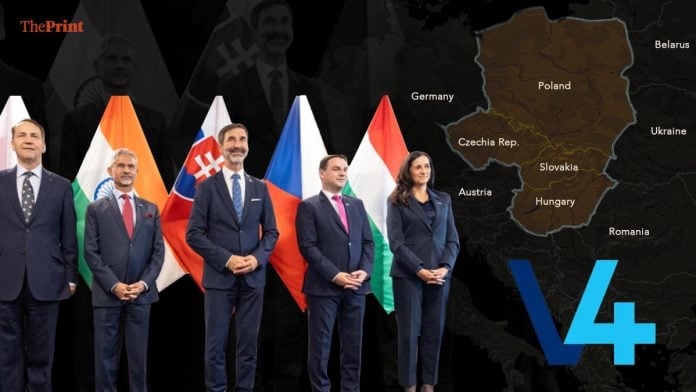
New Delhi: The four nations of the Visegrad Group—Poland, Hungary, the Czech Republic and Slovakia—this week declared their support for India’s bid to secure a permanent seat in the United Nations Security Council.
The endorsement came at the inaugural V4-India Foreign Ministers’ Meeting, held on the sidelines of the ongoing 81st session of the UN General Assembly in New York.
“We all agree as V4 countries that India, as a part of the Global South, an upcoming superpower in the Indo-Pacific region, must be at the table as a permanent member of the UN Security Council,” Slovak Foreign Minister Juraj Blanár told reporters after the session.
External Affairs Minister S Jaishankar joined Blanár and his counterparts for the meeting, the first ministerial-level engagement to bring India together with the bloc as a collective unit.
The Visegrad Four is becoming a significant piece of India’s calculations in Europe. New Delhi’s diplomatic attention has long centered on Western Europe, but that focus is now widening to take in the continent’s central belt offering India opportunities for alignment across manufacturing, innovation and defence.
In the backdrop of the latest development, ThePrint explains the origin, history and economic powers of the bloc.
Also read: What are the reforms proposed by India & its G4 partners for United Nations Security Council
How the bloc was born
It is one of the oldest informal alliances, both within the European Union and the NATO (North Atlantic Treaty Organization).
The Visegrad Group takes its name, and its founding symbolism, from the hilltop Hungarian castle town of Visegrad where three medieval kings—John I of Bohemia (a territory that is now largely part of the Czech Republic), Charles I of Hungary and Casemir III of Poland—convened in 1335 for what was then called the Congress of Visegrád.
Their purpose was mercantile as much as political: to forge new trade routes that would let goods bypass Vienna, then a mandatory stopover port, where the rulers tried to force merchants to unload and sell there before continuing on to other European markets.
That medieval alliance dissolved in the centuries that followed, as the larger central European region was absorbed into the Habsburg monarchy from the 1500s onward. This political order held until the Habsburg Empire collapsed at the end of the First World War in 1918.
Delighted to join the Visegrád Group DPM & FM @radeksikorski #Poland DPM & FM @_OrbanAnita #Hungary FM Juraj Blanár #Slovakia and FM @petr_macinka #Czechia on the sidelines of #UNGA81. Our first meeting in the V4+India format agreed to:
✅ Closer political cooperation including… pic.twitter.com/mBqMTkC6QN
— Dr. S. Jaishankar (@DrSJaishankar) September 21, 2026
In the aftermath of the Second World War, Poland, Hungary and Czechoslovakia increasingly came under Soviet influence. They were formally named as Polish People’s Republic, the Hungarian People’s Republic and the Czechoslovak Socialist Republic.
It was only after the fall of the Berlin Wall in 1989, and the Soviet collapse two years later, that the three countries turned decisively westward again.
It was against that backdrop that then Czechoslovak president Václav Havel, Polish president Lech Wałęsa and Hungarian prime minister József Antall met on 15 February, 1991, in Visegrad, reviving the name of the medieval alliance for the grouping.
Their goal was to shed the legacies of communism and complete the reforms necessary for membership in NATO and the European Union. When Czechoslovakia split into the Czech Republic and Slovakia in 1993, the bloc’s membership grew from three countries to four. All four joined the EU together on 1cMay 2004.
Not always unanimous
But the group has had its differences. During the 2015 European migration crisis, three Visegrad Group nations—Czech Republic, Hungary, and Slovakia—joined Romania in voting against a mandatory refugee quota, pushed by Berlin and Brussels. They called it ‘German bullying’.Poland deserted its Visegrad allies to support the asylum quota system.
Germany, the group’s western neighbour, remains its most significant economic partner in both directions. By 2018, Germany’s trade and investment flows with the V4 already exceeded its flows with China.
The outbreak of the Russia-Ukraine war in 2022 exposed a deeper division, described as ‘canyon-like divergence’ in reports, within the V4 grouping.
Hungary’s government under then PM Viktor Orbán and Slovakia’s under Robert Fico resisted complete support for Kyiv, at times echoing Kremlin’s narratives that blame the NATO provocation for the war. In contrast, The Czech Republic under former PM Petr Fiala, and Poland under Donald Tusk however have positioned themselves among Ukraine’s staunchest backers.
The rift was laid bare at a 2024 summit in Prague, where Fiala remarked pointedly that it “wouldn’t make sense that we differ in the views of the cause of the Russian aggression against Ukraine and the ways of solving it.”
Poland’s foreign minister, Radosław Sikorski, went further, suggesting his country’s priorities lay less with the Visegrad format than with the so-called Weimar Triangle—linking Poland, Germany and France—and with Washington.
Geographically, three of the four V4 members—Hungary, Poland and Slovakia—border Ukraine directly. Poland also borders Belarus and Russia’s Kaliningrad exclave to the northeast Baltic Sea.
Ukraine itself, while not an EU member, ranks among the largest beneficiaries of the International Visegrad Fund and receives support from the bloc for its European integration ambitions. It joined the EU’s Deep and Comprehensive Free Trade Area, and by extension gained privileged trade access to V4 markets, in 2016.
Economic heft
Combined, the Visegrad Group’s gross domestic product ranks fourth in the European Union, fifth in Europe and 15th in the world. In international trade, the bloc ranks fourth in the EU, fifth in Europe and eighth globally.
Poland is the bloc’s giant, with a GDP of $1.353 trillion — the 22nd-largest in the world — built on mining, machinery, metallurgy, chemicals and food processing, alongside a fast-growing technology sector that has drawn investment from Google, Toshiba, Dell, GE, LG and Sharp among others.
The Czech Republic holds the bloc’s highest Human Development Index, (0.915) Human Capital Index of 75 percent, and per-capita GDP of $432.6 billion, making it the 42nd-largest economy globally.
Hungary’s economy, at $350 billion, ranks third within the bloc and 53rd worldwide. Since 1989, it has drawn roughly $18 billion in Foreign Direct Investment, more than a third of all such investment across Central and Eastern Europe including the former Soviet states, with about $6 billion of that coming from American firms.
Slovakia, the smallest of the four at $209.2 billion and 68th globally, holds the world’s highest per-capita rate of automobile production and hosts operations for IBM, Lenovo, SAP and Amazon.
It holds the group’s second-highest per-capita GDP, after the Czech Republic, and in 2009 became the only V4 member to adopt the Euro, even as all four remain treaty-bound to eventually join the Eurozone– a currency union of 21 member states of the European Union that use the Euro— once they meet the required convergence criteria.
All four also share a pro-nuclear stance within the EU, pushing to expand or, in Poland’s case, to build from scratch, nuclear power industries.
They even have close defence ties. In May 2011, Poland’s then-defence minister, Bogdan Klich, announced the country would lead a new EU military force composed of Visegrad members, a decision reached at a V4 defence ministers’ meeting in Levoča, Slovakia.
The unit became operational in the first half of 2016 and eventually included Ukrainian participation.
Russia’s 2014 annexation of Crimea in Ukraine led to the four countries to sign a pact establishing a joint military body within the EU framework, laying out cooperation across defence planning, joint training and exercises, joint procurement and defence-industry coordination, military education, joint airspace protection, coordinated diplomatic positioning and communications strategy.
A V4 Joint Logistics Support Group Headquarters was established in 2020, reaching full operational capacity by early 2023.
The group also operates the Visegrad Patent Institute, created by an agreement signed in Bratislava in February 2015, which functions as an International Searching Authority and International Preliminary Examining Authority under the Patent Cooperation Treaty of 1 July 2016.
India and the V4
A 2026 report from the Central European Institute of Asian Studies (CEIAS) frames this bloc as an important piece of India’s European strategy—one that New Delhi, historically fixated on Western Europe, is only now beginning to take seriously.
Poland and the Czech Republic have emerged as India’s leading partners within the bloc. Prime Minister Narendra Modi’s 2024 visit to Poland—the first by an Indian PM in 45 years—elevated that relationship to a formal Strategic Partnership, with an emphasis on defence, logistics and migration cooperation.
The Czech Republic, meanwhile, has built ties with India around innovation and digital governance, underpinned by substantial trade and institutional links.
Hungary has significant Indian investment and pursues a multi-aligned foreign policy that, in principle, leaves room for deeper ties with New Delhi. Slovakia saw symbolic high-level gestures, such as the 2025 visit by President Droupadi Murmu.
Jaishankar’s 2019 trip to Poland and Hungary as the External Affairs Minister marked the first Indian ministerial outreach to the region in decades. In 2020, he hosted envoys from the four V4 countries in a signal of New Delhi’s recognition of the bloc’s geopolitical relevance. By 2022, he had become the first Indian foreign minister ever to visit Slovakia. He travelled to the Czech Republic the same year.
The CEIAS report, however, points to a structural gap: while a V4-plus-India ministerial dialogue could, in principle, mirror existing V4-plus-Japan and V4-plus-South Korea formats, that kind of institutionalised political coordination remains undeveloped, even as bilateral ties advance. And it flags a subtler obstacle: public opinion.
Polling across the V4 by CEIAS shows limited awareness of, and considerable ambivalence towards India, particularly among younger residents, with Poland as an exception where they exhibit comparatively favourable views.
“A formal V4+India Dialogue, regular 1.5 Track meetings, and sectoral cooperation platforms—focused on green technology, digital governance, defence, and education—are necessary to structure the relationship and deliver tangible outcomes,” the report says.
(Edited by Ajeet Tiwari)
Also read: India has met every bar for permanent UN membership except the one that matters — consent