







Chennai: Scoring 53.3 out of 100, Tamil Nadu has emerged as the third most investment-friendly state in the country, according to the National Institution for Transforming India (NITI) Aayog’s first-ever Investment Friendliness Index (IFI) 2026.
The index, prepared with technical support from research foundation CRISIL, evaluates all States and Union Territories across 84 quantitative indicators grouped under eight key parameters of infrastructure, business climate, resources, government policies, regulatory framework, institutional ecosystem, financial health, and environmental sustainability.
Gujarat topped the rankings with 56.6 points, followed by Maharashtra at 53.7, Tamil Nadu stood third with infrastructure, environmental sustainability and business climate being the top strengths. However, the key challenges of ageing airports, poor sewage management, water recycling shortfalls, logistics bottlenecks, and fiscal strains remain.
The new Tamilaga Vettri Kazhagam (TVK) government is undertaking aggressive investor outreach, utilising the efficient industrial corridors connecting Chennai, Coimbatore, and Hosur, an extensive rail network supporting major industries, and ports that boast some of the best turnaround times nationally. The state also remains investor-friendly with power reliability, owing to electricity downtime and transmission losses below peer averages.
Despite this, the report also highlights several structural concerns that continue to remain a challenge in Tamil Nadu’s overall investment attractiveness. Financial health remains a major concern, with outstanding liabilities at approximately 31 per cent of Gross State Domestic Product (GSDP) which is close to the large-state average, but interest payments account for 3.4 per cent of GSDP.
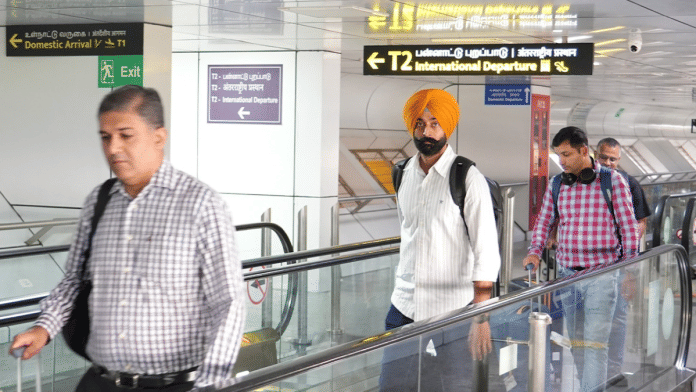
Even as the second airport project at Parandur has been dropped, the state needs to bring out a strategy for its aviation infrastructure needs. The ageing facilities at Chennai airport require significant upgrades to support growing industrial demand and improve international connectivity, especially to European markets where many MNCs operate.
The Confederation of Real Estate Developers’ Associations of India (CREDAI) has strongly advocated a second international airport for Chennai, emphasising that the existing airport’s capacity constraints are already causing the city to lose investments and economic opportunities. In a statement last month, P. Kruthivas, president-elect of CREDAI Chennai and managing director of Pushkar Properties, said that the question is no longer whether Chennai needs a second international airport. “The real question is whether the city can afford to delay it any further. We are already late.”
Kruthivas highlighted that airlines are shifting operations to Bengaluru, with examples including Air France exiting Chennai and Cathay Pacific reducing services from daily flights. This is directly attributed to the current airport’s inability to support further growth. Even after ongoing upgrades raise capacity to around 35 million passengers per annum, the airport is projected to approach saturation between 2028 and 2032.
As per the NITI Aayog report, the logistics gaps are another hurdle for investments as the state’s Container Freight Station and Inland Container Depot capacity lags 33 percent behind the large-state average relative to its manufacturing output. Severe congestion around Chennai Port often results in trucks idling for up to 36 hours, far exceeding global benchmarks of around four hours, thereby inflating costs for businesses.
Challenges for investors
“Whenever there are logistical challenges, it is because the supporting infrastructure was not assessed as part of the larger system. Logistics bottlenecks can be overcome if we start seeing cities as interconnected systems instead of a collection of independent projects,” architect Eromitha Ramesh told ThePrint.
“We can begin predicting where bottlenecks are likely to emerge rather than reacting to them after they occur. That shift in thinking could reduce repeated interventions, improve coordination across sectors, and create a logistical system that is more resilient.”
Water security and sewage management are not just civic concerns but also emerge as critical long-term challenges for investors, with limited availability of treated wastewater for industrial reuse, particularly in drought-prone and landlocked regions.
Ramesh points out at the lack of integration and maintenance of the infrastructure systems Tamil Nadu already has for water security and sewage management concerns.
“Infrastructure investments are coordinated across sectors rather than being conceived as isolated projects. We already have the resources and much of the infrastructure in place for water management but we continue to address concerns of flooding, sewage, lakes, stormwater, groundwater as independent problems, while they all have an effect on one another. Unless, we start understanding them as one system, interventions will continue to lead to rework because solving one issue in isolation often creates another somewhere else.”
Experts suggest that addressing these pain points through integrated planning, mandatory sustainability clauses in industrial allotments, and accelerated infrastructure upgrades could take Tamil Nadu to the top of future rankings.
Urban planner Anandhitha U.S. told ThePrint that Tamil Nadu is largely coasting on infrastructure built two decades ago. The third rank, she emphasised, is not a direct report card on the current planning but rather a lagging indicator of past achievements.
“The technology exists and is world class but the demand side is broken. Industrial uptake of recycled water is voluntary and fresh water is subsidised, so eventually recycled water loses on price to the thing it’s meant to replace. We need to write recycled water offtake into the State Industries Promotion Corporation of Tamil Nadu (SIPCOT) land allotment conditions and planning permissions,” she explained.
Anandhitha drew parallels with Singapore’s successful NEWater programme, which thrives because the state guarantees demand rather than relying solely on technological superiority. Similar coordination deficits plague logistics planning. Manufacturing hubs such as Sriperumbudur, Oragadam, and Hosur were meticulously designed for factories with plots, power, and roads, yet container evacuation capacity was overlooked. As a result, cargo from inland areas funnels through congested urban port gates.
“We need rules. Concrete is easy to announce but getting Metro Water, SIPCOT and Port Trust to plan together is the real infrastructure project. We also need industrial estates to be conditioned the way NSW does it and every SIPCOT estate above a cargo threshold should carry a rail-linked Inland Container Depot obligation, funded proportionally by the beneficiaries. Tamil Nadu plans factories brilliantly and freight as an afterthought,” Anandhitha added.
Experts, however, say that with its strong institutional capacity, policy stability, skilled workforce, and investor facilitation mechanisms, the state can transform these weaknesses into competitive advantages. Since Chief Minister C. Joseph Vijay assumed office, Tamil Nadu has witnessed significant industrial investment announcements, signalling continued private sector confidence in the state’s manufacturing and technology ecosystem.
In June, engineering major Larsen & Toubro signed a MoU for Rs 18,600 crore across three projects, which is expected to generate over 8,200 jobs. This was followed by Hitachi Energy’s Rs 1,000 crore commitment to expand its Global Technology and Innovation Centre in Chennai and manufacturing facility in Chengalpattu, creating around 1,000 jobs.
Another sustainable energy initiative was Vikram Solar’s Rs 15,037 crore Battery Energy Storage Systems (BESS) project in Tirunelveli, ongoing semiconductor and precision components expansion by Japan’s MinebeaMitsumi of Rs 1,980 crore in Tiruvallur and a Rs 1,700 crore non-leather footwear facility by Evervan Kothari Footwear in Karur, among others that collectively point to momentum in electronics, renewables, data infrastructure, and advanced manufacturing.
(Edited by Nardeep Singh Dahiya)
Also Read: Governance overhaul or political agenda? TVK govt goes on rollback-review spree for DMK-era projects