





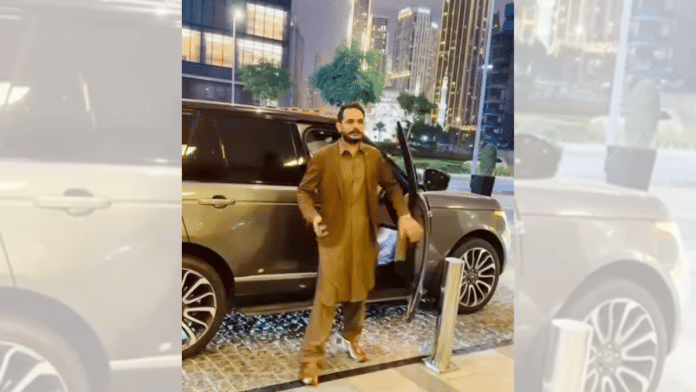

New Delhi: Behind Pakistani gangster Shehzad Bhatti’s carefully curated image on social media and his active ground network are his key, trusted aides who remain in the shadows.
Police investigations from Delhi, Haryana, Uttar Pradesh, Rajasthan, Punjab, Uttarakhand have identified the close aides, including Abid Jatt and Rana Hunain. Their role, as expected, is to build modules and execute nefarious acts in Indian cities.
Investigations have revealed that while Jatt and Rana focus on identifying and recruiting vulnerable young men, the syndicate’s backbone relies on financial and operational operatives such as Ajmal Gujjar and Hamad Memon.
“All are operating at the behest of Pakistan ISI (Inter-Services Intelligence). They manage hawala cash, distribute smuggled weapons, arrange safe houses for accused,” a senior Delhi Police officer said.
This cross-border infrastructure, identified as the Shahzad Bhatti Network (SBN) by the Ministry of Home Affairs (MHA), is now facing the heat from central agencies and state police forces. Over 80 FIRs under the Unlawful Activities (Prevention) Act, the Bharatiya Nyaya Sanhita, the Arms Act, the Narcotic Drugs and Psychotropic Substances Act, and the Explosive Substances Act were registered and more than 200 people were arrested, the MHA had said 17 August.
According to a MHA statement, substantial recoveries were made including IEDs, grenades bearing Pakistan Ordnance Factory markings, pistols, live cartridges and CCTV cameras allegedly used for espionage. The focus is also on Bhatti’s social media presence, with more than 100-plus take down notices, so far.
The recruitment web
The operational network of SBN is run by Jatt and Rana. According to another Delhi Police officer, Jatt and Rana function as Bhatti’s “left and right hands”. “They directly handle recruitment, logistics and weapons.”
The officer said that initially, Bhatti would directly remain in contact with all foot soldiers through encrypted apps. “When agencies began arresting them, the close aides stepped in. Jatt and Rana managed day-to-day communications, and facilitated and executed ground operations.”
The recruitment strategy is to target “impressionable, unemployed, financially desperate young men from the age group 18-25”.
In one such case, an 18-year-old garage worker was arrested in Dehradun who was recruited by ‘Rana bhai’.
“Interrogation revealed that ‘Rana bhai’ who was contacting the man through social media, had promised him a job in Dubai, via Nepal. He had also arranged Italian pistols to be picked up from Delhi, to carry out targeted assignments,” the officer said.
“Bhatti is the poster boy. It is Jatt and Rana who identify those who will be loyal enough to commit actual crimes.”
Also Read: EXCLUSIVE: Pakistan-made Nokia phone is NIA’s smoking gun tying Shahzad Bhatti to Ambala blast
The business of smuggling
A third officer said that the recruits are initially handed low-level assignments like putting up posters, or painting graffiti of outfits like Tehreek-e-Taliban Hindustan, or conducting recce. “The first plan is to check loyalty.”
Payments ranging anywhere around Rs 2,000-Rs 5,000 or up to Rs 7,000 are transferred instantly via UPI/QR codes, said the source.
“Once the recruit proves loyalty, Jatt and Rana direct them to move weapons, or hurl petrol bombs, or grenades, and conduct recce of security posts, police stations.”
While the recruitment of foot soldiers through social media is key, it is entirely dependent on the financial and logistical backbone. Ajmal Gujjar and Hammad Memon handle cross-border trafficking and execution.
One of the above-mentioned officers said that investigation shows that Hammad Memon handles the online hiring logistics. “He acquires disposable SIM cards and sets up social media points of contacts to engage recruits based on their immediate financial desperation.”
“They will approach as per need,” the officer said, adding that Memon assigns tasks ranging from procuring illicit SIM cards to hurling petrol bombs and grenades.
On the operational side, Gujjar runs the distribution of smuggled arms, ammunition, and narcotics.
The Special Cell’s investigation into a module operating in Delhi-NCR, which ThePrint reported, shows how “Gujjar established direct contact with social media users looking to buy weapons”.
The network operated through encrypted applications, disposable numbers, hawala channels, scanner-based financial transactions, and dead-drop delivery mechanisms.
In one specific case, an operative named Arif purchased a Zigana pistol from Gujjar for Rs. 1 lakh. The money was transferred via UPI linked to individuals working in Dubai, with the funds routed back to network conduits in India.
Following the weapon procurement, Gujjar tasked recruits with smuggling heroin, commonly known as ‘chitta’ in Punjab, into Delhi-NCR. The consignments were left at hidden locations to avoid face-to-face contact, investigation had earlier revealed.
Additionally, Gujjar is tasked with coordinating ground recces. “Recruits were directed to photograph and transmit videos of high-profile targets, including popular eateries in Haryana, prominent personalities, and sensitive installations in Delhi-NCR, via encrypted apps like WhatsApp and Signal,” said a police source.
Local criminal networks are also integrated into this logistical web. For instance, Deepak Agrola, a West UP gangster facing 23 cases, maintained direct contact with Bhatti and Gujjar from Delhi’s Mandoli Jail using a smuggled mobile phone.
Based on the analysis of these chats, the police said Agrola addressed Gujjar casually as ‘Gujjar bhai’ due to shared community ties, and that he could procure weapons and drugs with a single message.
Radicalise & execute
Criminal-turned- SM personality Zafar Supari’s name has also come up in the police’s investigation.
A joint team comprising the Chittorgarh District Special Team (DST) and the Bassi Police Station arrested a suspect for following Pakistani gangsters like Bhatti, Gurjar and Supari on social media.
The “lifestyle” that Bhatti presents to his followers is the reason why most of them are drawn to him, according to a senior police officer from Rajasthan. “Posting photos from Dubai, handling sophisticated weapons, luxury cars, expensive phones. The idea is that if Bhatti can do crimes, and have a lifestyle, so can they.”
“There is no religion in this network,” explained a senior Uttarakhand STF (Special Task Force) officer, adding that most young recruits are influenced by Bhatti’s social media presence and how he displays “the lavish lifestyle”.
Bhatti’’s Instagram accounts can be identified with usernames like Shehzad Bhatti001, Shahzad Bhatti002 .
“This is the promise and dream that is shared. For misguided young boys, they are told that working with Bhatti could get them a lavish life in Dubai. They can earn a lot of money. All they have to do is anti-India activities,” the STF officer said.
A senior Haryana STF officer revealed that they have identified over 150 individuals in the state, where most of them were connected directly via Instagram and Facebook.
These suspects, the officer said, were told that they will receive payments ranging from Rs 7,000 to Rs 10,000 into their bank accounts for completing tasks such as delivering weapons across state borders.
“The SBN tracks the social media profiles of those engaging with their content. Who likes a photo, a video, who comments. Everything is tracked.”
To execute the task, the network uses a pseudo-identity like Tehreek-e-Taliban Hindustan. Tehreek-e-Taliban Hindustan is believed to be a “pseudo identity” for a little-known group with no clear independent existence and members allegedly linked to Pakistan-based handlers.
The Special Cell had earlier found an operative named Sohail was paid Rs. 5,000 to post Tehreek-e-Taliban Hindustan posters in Delhi and Faridabad. He also had to transmit the video proof back to Bhatti via encrypted apps.
“Handlers also direct operatives to paint graffiti and conduct recce of security establishments and police posts to project the illusion of a massive, organised terror outfit,” said a senior UP STF officer.
The UP STF has managed to identity some of these handlers—Abid Jatt, Hammad Memon alias Hammad Barkati, Javed Pakistani, Raza Bhai Pakistani, Ajmal Gujjar Pakistani, Rashid Bhatti, Rana Hunain, Major Iqbal, Major Hameed, and Major Anwar.
Bhatti, through himself and active members of his network, is radicalizing young men from Uttar Pradesh and other states by luring them with money and work, the UP STF officer said.
“He is inciting them to threaten and kill ex-Muslims, Hindu religious leaders, politicians, and police personnel, and to attack BJP/RSS offices, police stations, and other sensitive installations with bombs, grenades, and petrol bombs, with the aim of instilling fear and terror among the public.”
Active SBN members first indoctrinate these misguided young men into small terrorist activities, such as recce, arson, threats, pasting ‘Jihadi’ posters, and throwing petrol bombs, the officer said. “After these small terrorist activities, they are then encouraged to carry out major terrorist attacks.”
(Edited by Tony Rai)