



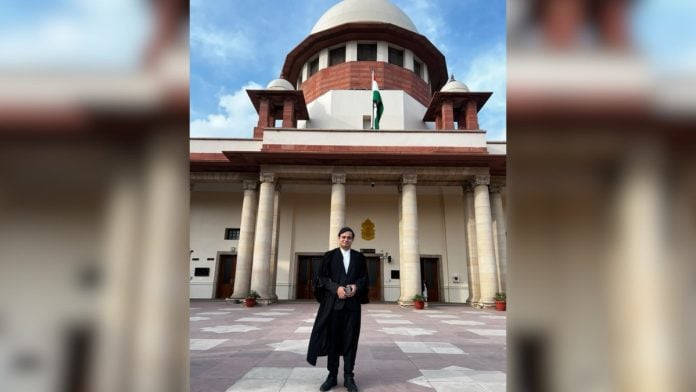
Gurugram: Supreme Court advocate Naveen Bamel had one thing in mind when he walked into the office of the Hansi Superintendent of Police (SP) in Haryana on 29 December last year: he wanted to flag the rising drug abuse in the town and the crimes associated with it. But he did not get past the entrance.
After Bamel, accompanied by his lawyer friend Shubham Ghanghas from the Hisar court, submitted his visiting card, they were called inside by then SP Amit Yashvardhan. But the security personnel at the door had a condition: they had to leave their mobile phones outside.
“I objected and told him that I may have to show something from my mobile to the officer. But he didn’t relent. When I asked him to confirm with the officer, he went in and came out and told me that I was not allowed to go in and meet the officer,” Bamel told ThePrint on Tuesday.
Nearly nine months later, the matter reached the National Human Rights Commission (NHRC), which on Monday directed the Haryana Director General of Police to examine it and submit an action taken report within four weeks.
According to Bamel, when he discussed the incident with media friends in Hansi, they told him they too had been asked to surrender their phones while visiting the SP’s office. However, he said, the rule was not applied when the SP “wished his video byte to be amplified on media and social media”, and media persons were allowed to carry their phones inside.
“I found that there was no hard and fast policy or rules regarding carrying one’s phones inside the SP office. They were using this as a diktat, allowing it only when it suited them,” he added.
The complaint trail
The day after he was denied entry, Bamel filed a written complaint at the Hansi SP office, asking how an officer could refuse to meet a visitor during public working hours and under what law the staff was authorised to demand that visitors deposit their phones before entering. The complaint was registered and a CCTNS number was provided, with an assurance printed on the receipt that action would follow within 15 days.
CCTNS, or the Crime and Criminal Tracking Network System, is a nationwide online platform used by the Haryana Police to digitise police operations, including registration of FIRs, investigations and chargesheets.
“I was issued a number for my complaint but no result came out,” Bamel said.
With the SP’s office silent for over a month, Bamel escalated the matter on 2 February with a complaint addressed to R.C. Mishra, IPS (retd), Chairperson of the Haryana State Police Complaint Authority. He invoked the Supreme Court’s 2006 judgment in Prakash Singh vs Union of India, (2006) 8 SCC 1, under which the court directed states to establish independent Police Complaints Authorities to examine serious misconduct by officers of the rank of SP and above.
Bamel’s complaint questioned the legality of the rule at the SP’s office. He argued that demanding that a visitor surrender a personal phone as a precondition for meeting a public officer had no basis in the Haryana Police Act or any notified circular or standing order, and was therefore “self-created, extra-legal and unconstitutional”.
He further argued that denying him entry orally, without a written order or stated reason, violated natural justice. He said the incident was particularly consequential because he was a practising Supreme Court advocate and it set a “dangerous precedent” that could deter ordinary citizens from approaching the police.
On 12 March, the Authority, in a letter signed by its deputy superintendent, told Bamel that it had examined his complaint and found that it did not fall under Section 65 of the Haryana Police Act, 2007, as amended in 2014, under which the Authority is empowered to act.
NHRC steps in
Having drawn a blank at both the local police level and the state oversight body, Bamel approached the National Human Rights Commission in Delhi. The Commission took up his complaint on 3 September.
In its 21 September order, the NHRC recorded Bamel’s version of events, including that after he declined to part with his phone, the staff consulted the SP and returned to inform him that he would not be allowed to meet the officer. His visiting card was then handed back to him.
The Commission also noted the subsequent chain of events—the registered complaint that received no inquiry report or reasoned response, followed by its rejection by the state Police Complaint Authority. Bamel had sought an independent and impartial inquiry, accountability for what he described as an abuse of official position, and effective redressal.
The Commission directed that a copy of the complaint be sent to the Director General of Police, Haryana, online, “to ensure the needful action”, and that an action taken report be submitted within four weeks of receipt of its letter. The order specifically said the report must be “duly translated in English”.
Meanwhile, Yashvardhan, when asked about the incident, said he could not recall the specifics. “I am not sure how and why the officials in the office at Hansi stopped the lawyer’s entry on that day. If I am asked by my superiors or by the Commission to file a reply, I will do so by checking the records,” he told ThePrint on Tuesday.
A 2018-batch IPS officer, Yashvardhan has since moved on and is currently posted as SP Security in the Crime Investigation Department at the Police Headquarters in Panchkula.
(Edited by Chingkheinganbi Mayengbam)
Also Read: 36 yrs after Haryana woman took Indian Oil to court, SC rules she was denied job because of gender