



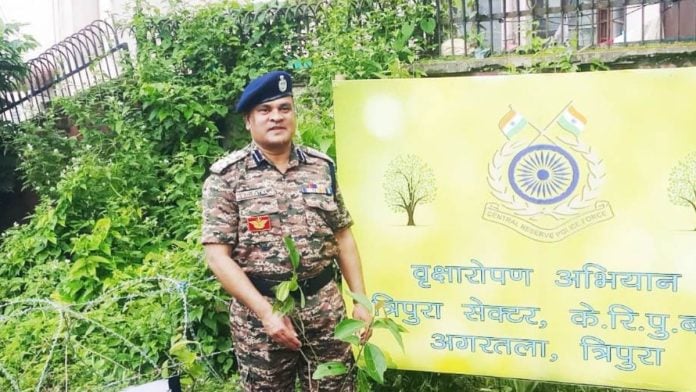

New Delhi: President Droupadi Murmu has revoked the suspension of a Deputy Inspector General-rank officer who was suspended earlier this year because of a social media post he made after the Central Armed Police Forces (General Administration) Act in April formalised deputation of Indian Police Service (IPS) officers to senior positions in these forces.
After the President revoked the suspension, the Central Reserve Police Force (CRPF) Tuesday also revoked the suspension of officer Bidhan Chandra Patra, forwarding the information to the local formation in Tripura.
Sources in the force said the CRPF headquarters revoked the suspension nearly two weeks after the President of India did so in late August, a decision conveyed to the force on 27 August.
At the time of suspension, officials had suggested that Patra was found to have violated service rules by allegedly sharing content on social media platforms that called for “changing” the country’s lawfully elected government during the passage of the Central Armed Police Forces (General Administration) Bill 2026. Along with Patra’s suspension, the force had also transferred nearly two dozen officers and personnel in the wake of widespread protests against the CAPF Act.
Patra, a DIG-rank officer of the 1994 batch of the force’s in-house cadre, was posted at the Tripura sector headquarters in Agartala at the time of his suspension in June this year. Patra was suspended from the services with immediate effect through an internal administrative order passed by the force’s directorate general on 17 June under Sub-Rule (1) of Rule 10 of the CCS (CCA) Rules, 1965 pending a preliminary enquiry.
“WHEREAS, an order placing Shri Bidhan Chandra Patra, DIG (IRLA 40618) of Tripura Sector Hars, CRPF, Agartala, under suspension was made vide P/Order dated 17.06.2026…,” an order of the CRPF passed on Tuesday reads.
“AND WHEREAS, the President in exercise of the powers conferred under Clause (c) of sub-rule (5) of Rule 10 of CCS(CA) Rules, 1965 approved to revoke the said suspension order with immediate effect. NOW, THEREFORE, the said order of suspension in respect of Shri Bidhan Chandra Patra, DIG is hereby revoked with immediate effect. The period of suspension w.e.f. 18.06.2026 (effective date of suspension) till the date of revocation will be regularised as per rules, after finalisation of pending inquiry,” another DIG-level officer posted at the force’s headquarters read.
The President gave her assent to the bills in April, thereby making them law and governing the deputation of IPS officers. The bill was introduced in the wake of a Supreme Court order of May last year, urging the government to progressively reduce the number of IPS officers on deputation up to the level of the Senior Administrative Grades (SAGs).
The new law ensured that top positions in the Central Armed Police Forces (CAPFs) are held by Indian Police Service officers by mandating that the director and special directors general be appointed on deputation from the IPS. The law also formalised the reservation of at least 67 per cent of posts at the additional director general level for IPS officers on deputation. For the inspector general position, the cap was at 50 per cent.
The act was widely criticised by serving and veteran CAPF officers. On the eve of the government introducing the bill in Parliament, veterans from the Central Reserve Police Force (CRPF), Central Industrial Security Force (CISF), Indo-Tibetan Border Police (ITBP) and the Sashastra Seema Bal (SSB) stated they are protesting not only for ranks and promotions but also for constitutional equity and a say in policies concerning the CAPFs.
“To put it bluntly, we do not have a lobby—our voices do not directly reach the government; they reach through imposed leadership,” retired BSF Additional Director General (ADG) Sanjiv Krishan Sood had said, adding that the bill did not originate from a “mistrust of CAPF officers” but was a “consequence of pressure groups”.
(Edited by Nardeep Singh Dahiya)