



New Delhi: At the 80th Independence Day celebrations at Red Fort in Delhi, Prime Minister Narendra Modi looked into the past—specifically India before 2014—to prop up the last 12 years, listing developments and the country’s achievements during his tenure.
“Over the past 12 years, crores of citizens across the country—whether Dalits, the oppressed, the marginalised, or tribals; rural or urban dwellers; the poor or the middle class; youth or the elderly; women or men; and people from the North, South, East, or West—have strived with unwavering resolve and dedication to take the nation to new heights. I deeply respect these efforts, and it is a result of this very endeavour that 25 crore fellow citizens have risen out of poverty in such a short span of time,” he said.
PM Modi pointed out that India was once counted among the world’s ‘Fragile Five’ economies but has become a major and fast-paced economy in the last 12 years. The ‘Fragile Five’ included India, along with Brazil, Indonesia, South Africa and Turkey.
Throughout his hour-long speech, the Prime Minister listed several changes that India has witnessed in the last 12 years, since the NDA government came to power in 2014.
ThePrint lists down 11 of the achievements PM Modi mentioned in his Independence Day speech.
First, he said that in the last 12 years, defence production has seen a four-fold increase. Defence Minister Rajnath Singh had also mentioned this on Friday, while addressing soldiers through Akashvani on the eve of the 80th Independence Day. He said domestic defence production had risen from Rs 46,000 crore in 2014 to a record Rs 1.78 lakh crore in 2025-26.
Second, PM Modi similarly listed down the growth in various sectors since 2014 at the beginning of his speech.
“Production in rural and industrial sectors increased five-fold, electronic manufacturing grew nearly seven-fold, production of modern railway coaches increased 21-fold, mobile phone production increased 35-fold, internet consumers increased four-fold, the number of patents granted increased four-fold, digital transactions increased 100-fold,” he said.
“We provided tap water connections at an average rate fifteen times faster each year. We issued gas connections to people at an average pace six times faster annually, constructed toilets for the poor at four times the speed, and provided homes to the poor at three times the pace,” he added.
“In terms of governance, we eliminated thousands of compliance requirements and repealed hundreds of outdated laws. One cannot march into the 21st century with laws from the last century,” the PM further said.
Third, Modi said that before 2014, only 70 cities in India had access to piped gas, while now, more than 700 cities have piped gas connections. “This is the speed; this is the scale. Before 2014, barely 20–22 lakh households received piped gas; today, work is underway to provide piped gas to 1.75 crore households.”
Fourth, he said that 12 years ago, the solar energy capacity in the country was merely 2 gigawatts. “Today, we have achieved 160 gigawatts. We also focused our energy into ensuring that this advantage reaches the country’s middle class. We started the ‘PM Surya Ghar Muft Bijli Yojana’ and today, I am satisfied that we have crossed the milestone of 50 lakh households powered by solar energy in such a short span of time.”
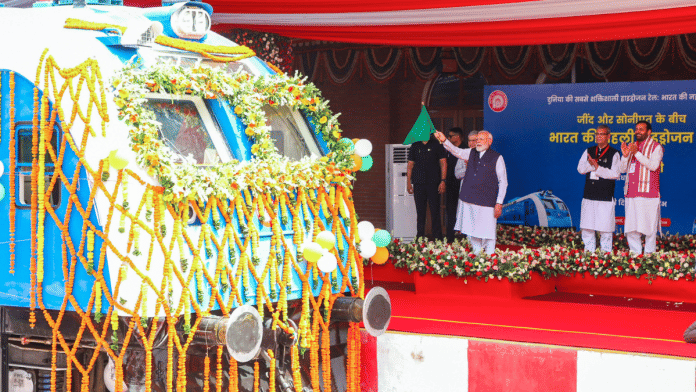
Fifth, he spoke about railway electrification which, he said, began in 1925. “However, for 90 years after that, only 30 percent was electrified. Only 30 percent in 90 years. Now look at our speed. Just look at our race to achieve the goal. Within a decade we have completed the job of railway electrification…This has saved fuel imports, and has benefited the environment. We have not stopped here…We have touched a new frontier for fuel, and run a new hydrogen train. This is the longest and most powerful hydrogen train.”
Sixth, Modi said that since 2014, India has been working on free trade agreements (FTAs) with 40 countries.
“These trade agreements are a big opportunity. I want to tell our MSMEs (Micro, Small, and Medium Enterprises), please do not let up this opportunity, Indian products should reach the world markets…We have to meet global standards, improve on what is available in the world. From Ludhiana in Punjab to Tirupur in Tamil Nadu, our textile sector can reach the world. From Keralam to Gujarat, and Tamil Nadu to Bengal, for our coastline and our fishermen brothers and sisters, our shrimp export opportunities have increased because of these FTAs. Our seafood export opportunities have increased,” he said.
Seventh, he listed down the steps taken in the past 12 years for the youth. “In the last 10-12 years, under the Startup India campaign, there are over 2.5 lakh registered start-ups in the country. They are working and providing employment to several people. A 1 lakh crore innovation fund has been announced by the Indian government…We will not let there be a shortage of resources.”
He added: “Skill India is a national programme. We opened the space sector. We made a national drone policy, ‘Khelo India’ policy. There was no education policy for 35 years, so we brought a new education policy. Middle class families have benefitted from this.”
Eighth, he said that between 2004 and 2024, there were less than 350 universities in India. “Within 10-12 years, 650 new universities have come up, reaching the 1,000 figure. Before 2014, there used to be only 400 seats for medical. Today, there are around 850 medical seats. Even foreign universities are coming here…Over 10,000 Atal Tinkering Labs have been made for kids to guide them towards technology and innovation. Our youth, averaging 28 years of age, launched their own satellite. This is a big achievement…We held the AI Impact summit. Its impact is spreading fast.”
Ninth, he said that before 2014, less than 25 crore people had social security cover. “Within a decade, we have provided social security cover to around 100 crore people,” he said, talking about the Ayushman Bharat Yojana.
Tenth, he spoke about India’s bioeconomy, saying that before 2014, Rs 60,000 crore bioeconomy work used to happen in India, but it has now surged past Rs 20 lakh crore.
Eleventh, he spoke of electric vehicles (EVs), saying that in 2009-10, only 1.5 lakh EVs were sold, while 25 lakh electric vehicles have been sold in 2025-26.
(Edited by Gitanjali Das)