



Gurugram: Two women sit in an agricultural field, dupattas pulled over their heads, talking how neighbours do, over a fence. “Neend mein arr Jind mein kime bhi ho sake,” one says. “Paani aali rail chala di.”
(Anything can happen in your sleep, or in Jind…They’re running a train on water.)
The 32-second video clip, posted from Haryana BJP’s official X handle, had been viewed 17.2 lakh times across platforms by midnight Tuesday, according to Ashok Chhabra, media coordinator to CM Nayab Singh Saini, who shared the figure with The Print.
It is also, strictly speaking, not true. The train does not run on water. But that has not stopped it from becoming the centrepiece of one of the most coordinated political messaging campaigns Haryana BJP has mounted in recent months.
जो कहवै थे – 'जींद म्हं अर नींद म्हं किमे भी हो सकै सै…' 😎
इब देख ल्यो… जींद म्हं मोदी जी की रैल चलैगी,
बिन बिजली, बिन तेल चलैगी… 🔥🪷🚩 pic.twitter.com/vLDv6aVMSQ
— Haryana BJP (@BJP4Haryana) July 13, 2026
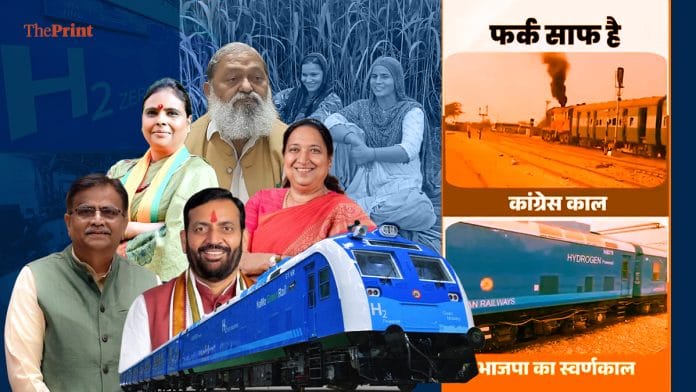
In another X post with a message “Farq Saaf Hai (the difference is clear),” the BJP Wednesday posted two videos—one of the ‘Congress-era’ coal engine train, and the other of a ‘BJP era’ Hydrogen train.
फर्क साफ है pic.twitter.com/c7PTJHSvas
— Haryana BJP (@BJP4Haryana) July 15, 2026
Also Read: Budget 2023: Rs 2.40 lakh crore for Railways to boost expansion — highest outlay since 2013
The event behind the video
On 17 July, Prime Minister Narendra Modi is scheduled to flag off India’s first hydrogen-powered train from Jind railway station, connecting Jind and Sonepat over an 89-km stretch. Built at a cost of around Rs 141 crore, with two driving power cars and eight passenger coaches, it is billed as among the longest hydrogen trains running anywhere in the world on broad gauge. The fuel-cell propulsion system is rated at 1,200 kilowatts per power car—a combined output of roughly 2,400 kW. The train can carry more than 2,600 passengers in a single run.
Train number 74010 will depart from Jind at 7:40 AM and reach Sonepat by 9:40 AM. The return service, 74009, will depart from Sonepat at 10:40 AM and reach Jind by 1 PM. The service will run six days a week, halting at 14 stations including Gohana, Rabhra and Lath, with Sunday set aside for maintenance.
The Chief Commissioner of Railway Safety has cleared the train following trial runs, an official at Jind railway station told The Print over the phone.
The launch is part of the Railway Ministry’s “Hydrogen for Heritage” plan, under which 35 hydrogen trains are to run on heritage and hill routes nationally as India works toward a 2070 net-zero target. Each train costs close to Rs 80 crore to build, with another roughly Rs 70 crore spent on hydrogen infrastructure per route.
Four press conferences, one message
What has followed the video posted from BJP’s X handle is a campaign with few recent parallels in state politics. Over three days, BJP national secretary Om Prakash Dhankar, senior BJP leader and former MP Sudha Yadav, Energy Minister Anil Vij and state president Archana Gupta have each addressed separate press conferences built around the same launch. Chief Minister Saini has gone further still, publishing a signed article in a leading Chandigarh daily that frames the train as evidence India has moved from consuming technology to creating it.
Dhankar, speaking in Jhajjar, hailed 17 July as a date of national significance and strung the Jind launch into a chain of events he said carried Modi’s personal imprint: a veterans’ welfare announcement in Rewari, the ‘Beti Bachao Beti Padhao’ launch in Panipat, and Hisar airport’s expanding air links.
Yadav, in Jind, tied the launch to India’s 2047 “Viksit Bharat” target, reeling off welfare statistics—more than 55 crore Jan Dhan accounts, over 10 crore Ujjwala gas connections—before recalling her own entry into politics in the 1999 Lok Sabha elections, when Modi headed the party’s Haryana unit.
Vij framed the train within a broader argument about energy security. With fossil fuel reserves running down, he said, the shift to solar, wind and hydrogen power had become unavoidable. He then credited Modi with pushing all three.
Archana Gupta linked the event to a clean energy drive of her own, saying the convoy travelling to Jind would use only CNG and electric vehicles, no petrol, no diesel.
Double-engine, double messaging: Saini’s newspaper pitch
Chief Minister Nayab Singh Saini added his own voice to the campaign through an opinion piece in The Tribune published from Chandigarh, timed to land just ahead of the Jind launch. In it, Saini cast the hydrogen train as proof that India has moved from merely consuming technology to building it, calling the project a fully indigenous effort in design, manufacturing and conversion that reflects the capability of the country’s engineers.
He described the train as one of the longest and the most powerful hydrogen-powered trains, noted that its trials and safety clearances were already complete, and argued the Jind-Sonepat corridor would give Haryana a new identity in modern rail technology.
The piece leaned heavily on the “double-engine government” framing that has become a fixture of BJP’s political messaging in the state, crediting coordinated work between the Centre and Haryana for everything from highway expansion to industrial investment. He then linked the hydrogen train to Modi’s broader Viksit Bharat and Green India goals.
Saini concluded the piece by describing the project less as a railway upgrade and more as a symbol of Atmanirbhar Bharat and the state’s ambition to be counted among India’s most progressive.
Where the ‘water train’ claim breaks down
Archana Gupta’s video leaves the impression that the train runs directly on water. It doesn’t.
A senior Haryana government official explained that a hydrogen plant with a capacity of 430 kg a day has been set up inside the Jind railway station complex.
Groundwater is purified there and passed through an electrolyser, which uses electricity to split water into hydrogen and oxygen—a process called electrolysis.
The hydrogen is compressed, stored, and then fed into fuel cells on the train, where it reacts with oxygen from the air to generate the electricity that turns the motors.
What comes out the other end is water vapour and heat, nothing else—which is why the technology counts as green, even if it isn’t quite the folk-tale version being sold in the agricultural field.
Congress hits back: ‘Distraction from Ram temple row, SIR’
The Congress was quick to push back against the BJP’s messaging blitz. Former MP Brijendra Singh said the ruling party had a habit of reaching for distraction whenever it found itself under pressure.
He was careful to separate the technology from the politics around it, saying he welcomed Modi’s visit and the shift away from fossil fuels in principle. But he argued the scale of the BJP’s build-up told its own story, calling it an attempt to shift attention away from the ongoing probe into embezzlement of donations at the Ram temple in Ayodhya and discrepancies in the Special Intensive Revision (SIR) of electoral rolls, among other issues.
Singh also took aim at the BJP’s framing of the launch as a technological leap over the Congress era, pointing out that Germany ran the world’s first hydrogen train back in 2018—four years after Modi first became Prime Minister.
He also asked why the party had taken so long to bring the technology to India if it considered it such a priority.
He was sharper still on what he called the BJP’s pattern of making claims that leave little room for reasoned debate, citing a video of a small-time Right wing leader he’d seen a day earlier alleging that contributions to the Ram temple fund from suspect sources, rather than genuine donations, were the ones that had gone missing. Singh cited the claim as an example of the kind of assertion he said the party’s supporters routinely make without evidence.
Ground zero: Jind gets a makeover
Preparations on the ground have matched the pace of the political messaging.
Haryana Chief Secretary Anurag Rastogi held a video conference with deputy commissioners of all connected districts Monday, after which Sonepat District Collector Neha Singh reviewed arrangements at Gohana, Lath, Mohana and Sonepat stations, directing officials to lock in drinking water, sound systems, security and sanitation arrangements well ahead of time.
Rohtak PGIMS has sent cardiologists, neurologists and other specialists to Jind for the visit, backed by 15 advanced and seven basic life-support ambulances.
Security arrangements for the visit have reportedly been built around a deployment of close to 5,000 police personnel and 15 IPS officers. The Prime Minister’s road route—from the police line helipad via Gohana Road, Rani Talab, the SD School crossing and Patiala Chowk to the railway station—has seen electrical cabling replaced, potholes filled, and walls freshly painted in the run-up to the visit.
(Edited by Amrtansh Arora)
Also Read: Who is Dr Archana Gupta, second woman to lead Haryana BJP in 43 years