



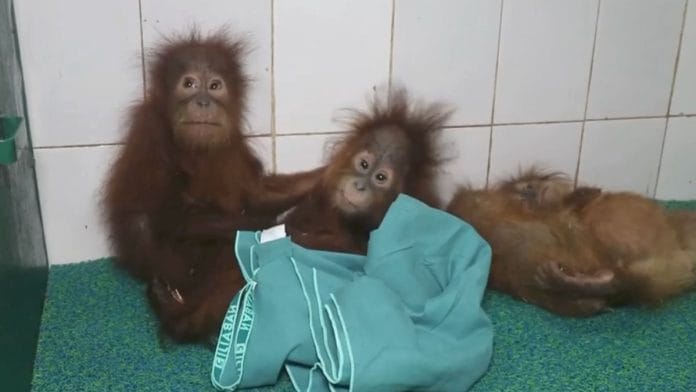
New Delhi: After five young orangutans were rescued from a forest in Odisha’s Balasore district on Tuesday morning, wildlife activists and forest officials say that a trafficking gang is likely to have been involved.
The babies are now reportedly under the care of forest officials in the Nandankanan Zoological Park in Bhubaneshwar, the state’s capital city.
Orangutans are native to the rainforests of Borneo and Sumatra, nearly 3000 km away from India.
“Orangutans can’t just land up in Odisha. This incident is obviously linked to wildlife trafficking. The problem is even more shocking and sad because these great apes are critically endangered and endemic to only some parts of SE Asia, and yet there is reckless trafficking of this magnitude in India,” Uttara Mendiratta, a wildlife researcher and conservationist, told ThePrint.
Mendiratta highlighted a much larger trafficking problem that is simply not being spoken about enough unless such isolated cases crop up.
“This kind of trafficking began with birds, then moved to turtles and pythons, and even exotic reptiles like iguanas. Now even exotic mammals are being traded. We don’t have the exact data but we often hear of seizures and it seems like the trade has gone up,” Ramesh Pande, ADG wildlife in Uttar Pradesh, told ThePrint.
Not the first time
Ajay Dubey, a wildlife activist from Madhya Pradesh, pointed out that this is not the first time that orangutans have been caught in India.
“From the looks of it, the animals were healthy. Clearly they were being taken care of. But there must be a larger syndicate. I think the information about their mission might have leaked and they must have left the babies in the forest to protect themselves,” Dubey told ThePrint.
Sumanth Bindumadhav, Director of Wildlife Protection at Humane World for Animals India, also said that this is not an isolated incident.
“Our legislative analysis published in June flagged this exact failure. India has no framework for restricting private ownership of species for whom captivity is inherently unsuitable — great apes most of all. A juvenile orangutan surfaced in a Mumbai flat raid in November 2024. Five more have now been found abandoned in Odisha. There’s a high possibility that these young orangutans were taken only after their mothers were killed, or were bred in horrid captive conditions. Until these gaps are closed, we will keep learning about the magnitude of this trade only when it fails,” he wrote in a statement.
According to Dubey, much of this trade finds an entry point in the “porous land border” that Mizoram shares with Myanmar. The coastal and road networks of West Bengal and Odisha are then exploited as key transit corridors for trafficking exotic Australian and Southeast Asian species into India.
According to the Directorate of Revenue Intelligence (DRI), India is both the source and the destination for wildlife trafficking. Its long coastline and international airports make for transit points in wider trafficking networks. The Chennai, Kolkata, Mumbai and Bengaluru airports and the Chennai and Jawaharlal Nehru Port are key points to move wildlife in and out of the country.
The Wildlife Trust of India conducted a review of seizures between April and December 2025 and found that Bangkok and Kuala Lumpur were two of the major cities, from where exotic wildlife entered India. It names Hong Kong, Singapore, Sri Lanka and Dhaka as other major hubs.
Great apes under threat
Among the native Asian apes, a worrying trend has been the rise in seizures of gibbons at Indian airports and border states, reported Mongabay. There are about 20 species of gibbons across 11 Asian countries. Five of these are critically endangered while 14 are endangered as per the International Union for Conservation of Nature (IUCN).
“Without the involvement of forest officials, this work would not be possible. When orangutans were found in Mizoram, if the officials had followed up properly, this would not have happened again. Whether it is trade of local or exotic species, the gangs are working without fear, that is clear,” said Dubey.
Shubhobroto Ghosh, Wildlife Projects Manager, World Animal Protection, says that such rackets stem from demand.
“These exotic species are in demand by rich people. There is a fetish for having these animals as pets, and this has only risen in the past few years in India. Orangutans and chimpanzees are not well suited for being captive pets, so it is not moral.” Ghosh told ThePrint.
Forest officials will now send samples of their blood for a blood test where their country of origin can be identified. Pande said that usually the country itself reaches out in such cases to take the animals back. Repatriation is the only way forward here and the animals are not supposed to be left indefinitely in zoos, he added.
“There is no commercial captive breeding or farming of orangutans. These babies have most likely come from the wild. They must be repatriated so that they have a hope to be back in the wild, or at the very least able to contribute to the gene pool in the wild.” Mendiratta added.
(Edited by Aakriti Handa)
Mizoram is a lawless state. The state exists only to protect and serve people of Mizo ethnicity. Nothing else bothers the state government of Mizoram. The government itself is xenophobic – what can one expect from the average lay person?
The Indian media – without ever having set foot in Mizoram or studied it’s complex and violent history – keeps hailing it as a success story. Why? Because it has 99% literacy. It never bothers to ask how many IIT/IIM/UPSC/AIIMS/IISER/etc. successful candidates are from this state?
Also, the atrocious treatment meted out both by Mizo people as well as the Mizoram government to Brus/Reangs/Chakmas is never covered by the mainstream media. ThePrint cries it’s heart out for Manipur with Shekhar Gupta doing multiple Manipur related CTCs. But not once does it visit the refugee camps for Brus on Tripura or cover the brutal history of what happened to them in Mizoram.
If today Manipur is burning, a major factor for that is the large Kuki population residing in Manipur. How did the Kuki population suddenly boom in India? They were primarily residents of Myanmar – so how come they landed up in a sensitive state of Manipur in such large numbers?
The answer is Mizoram. The Mizos, especially the student and youth organisations, facilitated the illegal immigration of the Kukis over decades. However, the Mizos won’t let them settle down on Mizo land. So they made provisions for settling them in the remote forested and hilly tracts of neighbouring Manipur. The various church organisations active in the region helped in this rehabilitation project.