



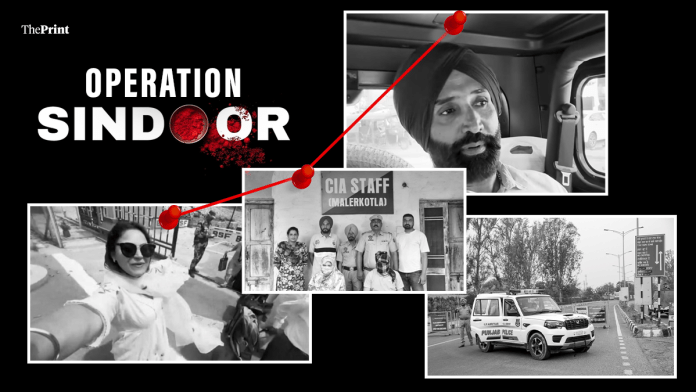
New Delhi: It has been a year since India carried out Operation Sindoor against Pakistan after the Pahalgam terror attack, but the shadows linger on in courtrooms and case files. As the two countries teetered on the brink of war, as lethal missiles stood at the ready and troops were in a state of complete preparedness, a quieter battle was unfolding within India—peopled by alleged informants, digital trails, and suspect loyalties.
But now, on the one year anniversary of Op Sindoor, that covert war seems to be blunted, the investigations losing edge. Arrests in 2025 were swift, the accusations grave, but the prosecution has now faltered, evidence has got diluted under scrutiny, and many of those once branded as conduits of enemy intelligence are out on bail. What remains are stacks of files that seem to be going nowhere, and a system tasked with proving charges that are leaving the courts unconvinced.
Soon after Indian Armed Forces launched Op Sindoor against terror infrastructure and launchpads in Pakistan and Pakistan-occupied Kashmir, police forces and investigating agencies stepped up surveillance on multiple individuals who were suspected of working with Pakistan, attempting to sabotage operations by sending whatever information they could from the border. This included images of troop movements and details of India’s S-400 anti-aircraft missile system.
The police of Punjab, Haryana and Rajasthan arrested multiple people, accusing them of espionage and sharing confidential and sensitive information. In some cases, individuals were detained by the armed forces and handed over to state police.
Nearly a year later, ThePrint takes a look at the status of the nine cases and the fate of both the investigation and those arrested.
In the four cases probed by Punjab Police, they are yet to file a charge sheet in one case, while the other three have progressed to the stage of arguments on charges. All the accused arrested by the Punjab Police are out on bail.
On the other hand, only one of the four accused arrested by the Haryana Police is out on bail. The cases have moved to various stages before the relevant courts.
Only the suspect arrested by the Rajasthan Police is still in custody, and the case has progressed to framing of charges.
In fact in one incident, Military Intelligence detained an individual who was observed looking at the S-400 anti-aircraft missile systems. However, it turned out the person was just a curious civilian, not an informant at all. No case was registered, and he was let off.
‘Espionage’ arrests by Punjab Police
Around 24 hours after India and Pakistan reached a ceasefire, a Punjab Police statement claimed they had blown the lid off a massive spy racket originating from the Pakistan High Commission in New Delhi.
According to the Malerkotla district police, when hostilities between the two countries were at their peak, Pakistani national Ehsan-ur-Rahim, alias Danish, employed at the high commission had been extracting sensitive information from two Indians—Yameen Mohammed and Gazala—from Malerkotla and passing it to his government in Pakistan.
Danish was expelled by the Ministry of External Affairs, and the Punjab police arrested Yameen Mohammed and Gazala.
ThePrint had then reported that Gazala had allegedly met Danish at the Pakistan High Commission when she visited it to apply for a visa, and they became friends and started communicating on WhatsApp and Telegram. The Punjab Police found Yameen had visited Pakistan twice in 2018 and 2022, while Gazala had last visited the Pakistan High Commission twice.
The Punjab Police also found that Gazala had received Rs 30,000 in her bank accounts and passed it on to other members of the alleged module, including Yameen. Nearly a month later, another local resident, Saleem Khan, was arrested by the police for being a part of the alleged module.
Yet, despite the big espionage charges, all three are now out on bail, and the police are yet to file a charge sheet.
But this was not the only ‘cross border espionage racket’ the Punjab Police found. Around the same time, Punjab Director General of Police, Gaurav Yadav, announced his force had busted another cross-border espionage racket, run by two youths from Gurdaspur.
Karanbir Singh and Sukhpreet Singh were arrested on 15 May, accused of sharing photos and videos of troop movement in the border area. The Gurdaspur Police claimed to have found evidence on their phones of sensitive details being sent to Pakistan on the instructions of US-based handler Gurlal Singh. The two were also accused if chatting with associates abroad.
“In one of the videos, the co-accused is visible while driving the motorcycle when the video was being prepared by the accused, who was the pillion rider. In another video, his face is visible. All these videos relate to the movement of the Indian Army. These videos were tagged to chats on the mobile phone of Sukhpreet Singh,” the Punjab Police told the court.
Their case hasn’t progressed much in court, and Karanbir and Sukhpreet were granted bail by the Punjab and Haryana High Court earlier this month. Arguments are yet to start, while the court awaits a supplementary charge sheet.
On 3 June 2025, the Tarn Taran Police arrested Gagandeep Singh from the border district on charges of collecting and sharing sensitive information, including troop deployments, strategic locations and army movements during Operation Sindoor.
DGP Yadav claimed Gagandeep was in touch with Pakistan-based Khalistan supporter Gopal Singh Chawla for the past five years, and that they had found he had been sharing sensitive information with 20 contacts known to be operatives of Pakistan’s ISI.
In September, a district court released Gagandeep on bail, without commenting on the merits of the allegations against him. The case is at the point of consideration of charges.
On 4 June, the Punjab Police also arrested YouTube influencer Jasbir Singh for allegedly being in touch with ‘handlers’ in Pakistan and providing them with classified and sensitive information.
The Punjab Police claimed that Jasbir, who hosted a YouTube channel ‘Jaan Mahal’, had been to Pakistan several times and remained in contact with ISI agents, sharing information on the movement of the Indian Army with them. Also, he allegedly maintained close ties with Haryana-based YouTuber Jyoti Malhotra and Danish.
Jasbir moved the Punjab and Haryana High Court, claiming he used to be a resident of Norway and had several foreign contacts, which the prosecution had portrayed as Pakistani contacts.
The high court, in October last year, stayed proceedings against Jasbir, and granted him bail, observing that the videos which formed the basis of the case against him, prima facie, appeared to be of locations and subjects that are accessible to the general public.
Moreover, the high court said the prosecution had failed to prove Jasbir’s association with Pakistani intelligence operatives or that he had access to confidential information.
Haryana Police cases stuck in court
While the Punjab Police continued its crackdown on ‘spies’, the police in Haryana also went into overdrive, focusing on surveillance.
The Kaithal police arrested Davender Singh, a student of Patiala’s Khalsa College, for allegedly sharing details about the Indian Army with Pakistani intelligence operatives over WhatsApp and Snapchat. The police also claimed Davender developed loyalties to Pakistan after visting Kartarpur Sahib and Nankana Sahib, and transferred Rs 1,500 to someone on the directions of a Pakistani agent.
The Punjab and Haryana High Court last month completely rejected the prosecution’s allegations, saying they had failed to provide proof either of sensitive information being shared or of any affinity towards Pakistan. The court granted him bail earlier last month, even as charges are yet to be framed against the student.
The shadow of the Pakistani High Commission employee loomed large over developments in Haryana too, as the police registered at least three cases connected to Danish and another Pakistan high commission employee, Asif Baloch.
On 16 May, the Hisar Police arrested YouTube influencer Jyoti Malhotra on charges of spying, over a series of alleged communications with Pakistani intelligence operatives, including sharing photographs and videos of a sensitive location. She is also accused of being in touch with Danish, his associates and Pakistani intelligence operatives.
ThePrint earlier reported that Malhotra has been behind bars since then, with the Punjab and Haryana High Court rejecting her bail plea in March, and the trial is yet to reach even the stage of arguments on framing of charges.
Around the same time, the police in Nuh district arrested local youth Arman on similar charges. He allegedly confessed to being in contact with Danish and passing on secret information about the activities of the Indian Army to him in exchange for money.
The Haryana Police alleged Arman had pictures and details of the Defence Expo, which he shared with mobile numbers in Pakistan.
He was charged under sections of the Official Secrets Act, and remains in jail. The trial has advanced to the stage of examination of prosecution witnesses.
On 18 May, the Nuh district police arrested another local youth, Mohammed Tarif, and claimed to have found several Pakistani numbers on his phone. The charge sheet accused him of deleting data on his phone.
“On inquiry, the accused disclosed that he had been transmitting confidential intelligence information and details regarding the activities of the Indian Army to one Asif Baloch, stated to be an employee posted at the Pakistan High Commission in Delhi. He further admitted that, in consideration of such transmissions, the said Asif Baloch had been providing him with monetary benefits from time to time,” the police alleged.
He is currently in jail, and the court is examining the prosecution’s evidence.
Navy clerk in Rajasthan custody
Over a month after the ceasefire, the intelligence wing of the Rajasthan Police arrested Vishal Yadav, a clerk posted at the Naval headquarters in New Delhi for allegedly leaking classified information related to Operation Sindoor.
The Police alleged he was continuously in touch with ‘Priya Sharma’ a female ISI handler over social media, and he had shared strategic information from the Naval Headquarters in return for money.
“Examination of chats and documents recovered from the device confirms that Vishal Yadav had shared confidential naval and defence-related information with the female Pakistani handler even during Operation Sindoor. This indicates that he had been an active part of the espionage racket for a long time,” the police had said in a statement.
Vishal Yadav remains in judicial custody, and a charge sheet is awaiting consideration by a Jaipur court.
(Edited by Viny Mishra)