



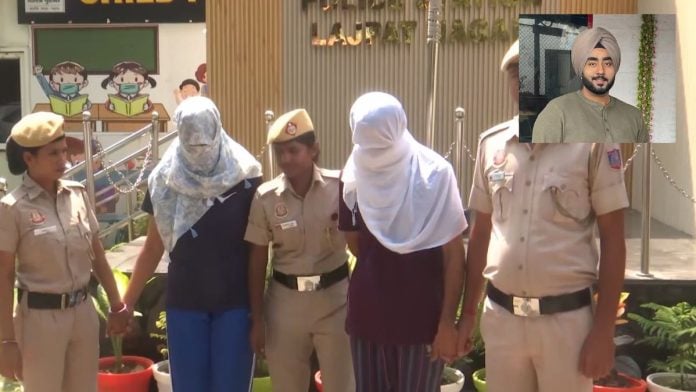
Gurugram: Harsimran Manchanda spent five days searching for her younger brother before she filed a missing person complaint. She spent five more days waiting for word from the police. When word finally came, on 16 September, she was shown photographs of a body that had already been cremated two days earlier, as an “unidentified” corpse, by the Gurugram Police.
Her brother, 31-year-old Yuvraj Singh Manchanda, a manager with the firm Adani Realty in Gurugram’s Sector 29, had been missing since 6 September. He was last seen leaving a family shopping trip in Delhi’s Lajpat Nagar, telling his sisters he had a meeting in Gurugram and would be home by 10 pm. He never returned.
What the family did not know, as they waited through those 10 days, was that Yuvraj was already dead, shot twice in the neck and dumped in a Sector 70 drain, allegedly by the very colleague he had gone to meet.
Cremated first, family told later
Gurugram police recovered a decomposed body from the Sector 70 sewer on the morning of 10 September. Officers at Badshahpur Police Station registered a case of unidentified death and sent the body for a post-mortem examination. Four days later, on 14 September, the body was cremated.
The family was contacted only on 16 September, two days after the cremation, and asked to identify Yuvraj from photographs and his belongings.
This is where the family’s anger begins.
Harsimran Manchanda, a doctor at a private hospital in Faridabad, had lodged a missing complaint at Lajpat Nagar police station on 11 September, a day after the body was recovered in Gurugram. In her complaint, she said the family had lunch with Yuvraj in Lajpat Nagar on 6 September before he left for Gurugram in the family car. “We rang him at 7 pm when he said that he would return by 10 pm. We received his last WhatsApp message at 4.16 am, after which he was traceless,” she said in her statement to police.
In videos viral on social media, an inconsolable Harsimran is seen alleging that if Gurugram Police had promptly uploaded the recovered body’s details to the Zonal Integrated Police Network, the ZIPNET portal that is meant precisely to help families and other police stations trace unidentified bodies, they could have been informed within days, not weeks. Instead, they say, the body was cremated before that basic step was completed on time.
ZIPNET is an online database system used by police departments to share information about missing persons, unidentified dead bodies, stolen vehicles, missing mobile phones, and so on.
The family has now demanded that police preserve and hand over the post-mortem report, DNA samples, photographs, the inquiry papers, and Yuvraj’s personal belongings, material they fear may otherwise be lost now that the body itself is gone.
Police defend the timeline
A Gurugram Police spokesperson, contacted by ThePrint Friday, defended the department’s handling of the case. The spokesperson said the body had been recovered from the drain on 10 September and sent for post-mortem, and that a case of unnatural death was registered at Badshahpur Police Station under Section 194 of the Bharatiya Nyaya Sanhita.
The body, the spokesperson said, had likely been in the drain since 6 September and had remained in water for nearly five days by the time it was found, leaving it badly decomposed. Under standard procedure, police must wait 72 hours before cremating an unidentified body, a window, the spokesperson said, that was observed before all other states and stations were informed.
On the family’s specific allegation that details were never posted to ZIPNET, the spokesperson said the information had been sent from their end to all concerned parties, but that the department could not confirm when, or whether, it was actually uploaded to the portal in time.
Murder case solved by Delhi Police
Even as the family pressed its questions about the cremation, Delhi Police had separately cracked the murder case.
Investigators in Delhi traced Yuvraj’s last calls to Anya Vats, a former office colleague, and found he had told his family he was going to Gurugram to meet her. When Anya’s phone went unreachable, police began tracking her movements and eventually traced a new SIM card she had bought after the murder to a location in Uttarakhand. There, Delhi Police arrested Anya Vats and her live-in partner, Sanyam Sachdeva.
According to a source, the two confessed during interrogation. The police said the trio had a dispute over money, which escalated, and Anya and Sanyam shot Yuvraj twice in the neck. They kept his body in their car for nearly seven hours, trying to decide where to dispose it, before finally dumping it in the Sector 70 drain and fleeing to Uttarakhand.
The Delhi Police has said that the case is still being investigated, with the money dispute the suspected motive so far, though Anya has repeatedly changed her statements during questioning. Both accused were produced in court on Thursday and remanded to five days in police custody.
For the Manchanda family, though, the arrests have not settled the matter. Their questions are no longer about who killed Yuvraj—that answer has been given. Their questions are about why they had to bury the fact that they had already lost him, and they didn’t even get an opportunity to perform his last rites.
(Edited by Nardeep Singh Dahiya)
Also Read: Two funerals, one word: How ‘encounter’ is Haryana’s new currency of grief and justice