





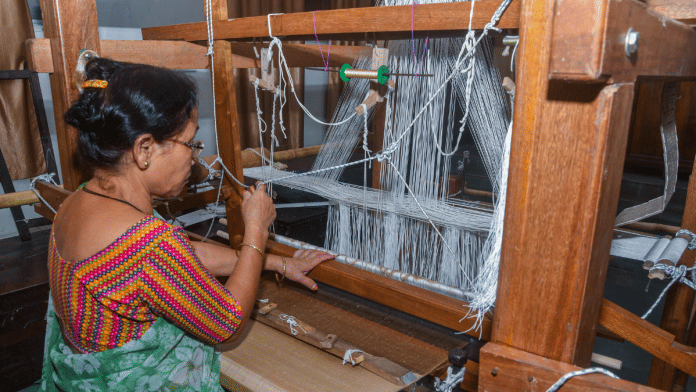


New Delhi: The weaver who spends a month making a Kanjivaram sari that retails for Rs 30,000 takes home no more than Rs 7,000 for that work. The artisan who weaves an Assamese mekhela chador selling for Rs 6,000 to Rs 10,000 earns the same. Across India’s handicraft and handloom sector, the average worker makes Rs 270 a day—below the prescribed daily minimum wage in every state where the survey was conducted.
These are the central findings of ‘Economics of Indian Craft’, a survey released on Monday by the Institute for Human Development (IHD) and the Crafts Council of India (CCI). The study, led by Professor G.C. Manna, former Director-General of the National Sample Survey Organisation, also estimates the sector employs 113 lakh people nationally—nearly double the 64.66 lakh cited in the government’s Economic Survey 2025-26.Fieldwork for the study was carried out across the five states between December 2023 and February 2025.
Union Textiles Minister Giriraj Singh acknowledged the wage gap directly: “Under an economic survey, concerns were expressed about the low wages of the handloom and handicraft artists. But under the leadership of Narendra Modi, we have proposed a new blueprint for export, product, income. I hope that PM Modi uplifts the poor population— the 70 lakh artisans who are there, and more than one crore who are working—their income will definitely increase.”
Scale of the sector
Across Assam, Rajasthan, Tamil Nadu, Uttar Pradesh (UP), and West Bengal, the study counted 34 lakh handicraft and handloom establishments employing 61 lakh workers. Projected nationally, these numbers scale to 65 lakh establishments and 113 lakh workers.
Compared to Annual Survey of Unincorporated Sector Enterprises data for 2023-24, nearly 42 percent of all manufacturing establishments in these states are engaged in handicraft or handloom activity. One in four manufacturing workers in the five states works in this sector. In Rajasthan, the figure reaches 43.8 percent.
The five states together generate an estimated Rs 51,445 crore in annual gross value added—contributing 9.9 percent of manufacturing-sector state value added in Rajasthan, 9.6 percent in Assam, and 6.8 percent in West Bengal. UP leads in both units (12.5 lakh establishments) and employment (22 lakh workers).
West Bengal records the highest per-worker annual Gross Value Added (GVA)—the measure of the value of goods and services produced in an area, industry or sector of an economy—at Rs 1.25 lakh. UP records the lowest at Rs 44,000 — less than Rs 3,700 per month — for a workforce where 71.6 percent are women.
Invisible & unregistered
The sector is almost entirely household-based and operates largely outside formal systems. Over 56 percent of establishments work with a single worker; nearly 100 percent are proprietary in nature. In UP, 97 percent operate from within household premises.
A significant proportion of handloom establishments remain unregistered under any formal government scheme. West Bengal reported the highest proportion of account-keeping establishments at just 3.8 percent; UP the lowest at 0.1 percent.
Professor Manna noted this means the majority of workers have learned their craft through “traditional, inherited and caste-based knowledge” passed through generations, with negligible formal technical training.
Female ownership is high—94.5 percent of handloom establishments in Rajasthan are women-owned, 78.2 percent in UP, 68.8 percent in Assam. In handicraft, female ownership is significant in UP (65.1 percent), West Bengal (49.5 percent), and Assam (44 percent). Yet educational levels among establishment owners are low, with roughly two-thirds in UP educated to primary level or below, and fewer than 7 percent having completed higher secondary education in Rajasthan, UP, and West Bengal.
Decline—and a generational shift
In most states, far more establishments report declining production than growth, relative to both ten years ago and the pre-Covid period. In Tamil Nadu, 66.3 percent of handloom units report decline over the decade; only 2.1 percent have grown. In Assam, 50.4 percent of handloom units are in decline. The sector has survived demonetization, GST disruption, and Covid, but the proportion reporting decline “has been substantially high,” the report states.
Yet there are signs of change. Children of artisans who once saw the profession as a badge of shame are returning—drawn back by mobile phones, online training, and entrepreneurship programmes. The report notes an acceleration among younger people moving out of cities to rural households, seeking to build on the handmade tradition while acquiring modern marketing and design skills.
Professor Ashok Chatterjee, advisor to the CCI and former Director of the National Institute of Design, Ahmedabad, placed this in historical context: “Indian handmade is our identity and landscape against which our freedom was built. While the emphasis stayed with the first Five Year Plan, things began to change by the late 1990s and early 2000s, when we were told by those in the government that handmade has no future, that it is a ‘sunset industry’. For those of us who have been working with craftspeople, we were told like the maharajas and snake charmers, handicrafts too had to go.”
The turning point, Chatterjee said, came from an unexpected direction. “In 2004, we happened to visit China, where a person from Beijing told us the two vital industries in their country were IT and handicraft. They called it their ‘sunrise industry’. The cultural revolution had wiped away centuries-old indigenous knowledge and they were determined to get it back. Around the same time, the EU had promoted the ‘Future is Handmade’ slogan. It was going back to the culture of creativity and innovation.”
What report recommends
The report calls for pan-India surveys to build a comprehensive national database, greater awareness of government schemes among artisans, skilling in modern design and eco-friendly techniques, and expanded social security. It recommends e-commerce platforms, exhibitions, and buyer-seller meets to widen market access, and reduced administrative hurdles to credit and insurance.
Its central structural recommendation: “strengthen the status of master craftspersons as key trainers, mentors and knowledge holders with technology and design institutions supporting their role.” It also calls for linking youth to the sector through entrepreneurship schools and higher education, noting that many establishment owners remain unaware of government support schemes—a gap it says requires stronger partnerships between authorities and civil society.
(Edited by Tony Rai)
Also Read: Naming Mythos, SEBI warns all market entities on new-gen AI, tells them to lock down cyber defences