





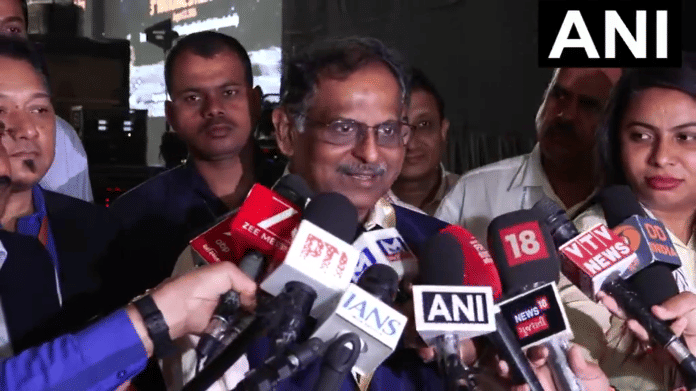

Ahmedabad: India is working towards establishing its own space station by 2035, with the first module of the proposed Bharatiya Antariksha Station already approved, ISRO Chairman Dr V Narayanan said on Sunday. Speaking at the third National Space Day celebrations in Ahmedabad, Narayanan highlighted India’s growing capabilities in space technology and said the country is now using space-based applications across more than 50 areas directly serving citizens.
“Today, we are celebrating the third National Space Day. The theme is very important: innovation, collaboration, and aspiring for global leadership in the space sector,” Narayanan said. He said India has been steadily expanding its capabilities since launching its space programme 64 years ago.
“India started its space programme 64 years ago, and today we are serving the common man in more than 50 areas, including Earth observation, remote sensing, telecommunications, television broadcasting, tele-education, disaster warning and mitigation, ensuring the safety and security of every citizen, navigation, real-time monitoring and tracking,” the ISRO chief said. Narayanan also outlined some of the country’s major upcoming space programmes, including the Gaganyaan human spaceflight mission and the development of India’s own space station.
“Under the visionary leadership of Prime Minister Narendra Modi, many programmes are in the pipeline. We are working on the Gaganyaan programme. We are also working towards establishing our own space station, the Bharatiya Antariksha Station,” he said.
“The first module has already been approved, and we aim to establish the space station by 2035,” Narayanan added.
The ISRO chief’s remarks came during celebrations marking India’s achievements in space exploration and the third National Space Day. Union Minister Gajendra Singh Shekhawat, who also addressed the event, recalled the significance of Chandrayaan-3’s historic landing near the Moon’s south polar region. He said National Space Day was announced following the successful Chandrayaan mission and India’s achievement of reaching the lunar south pole at the location named Shiv Shakti Point.
“Following the success of the Chandrayaan mission and the announcement by the Prime Minister, India will observe the day it set foot on the Moon’s south pole-at the ‘Shiv Shakti Point’-as National Space Day,” Shekhawat said. He said the third National Space Day was being celebrated in Ahmedabad under the aegis of the Space Applications Centre and highlighted the government’s efforts to expand participation in the space sector. “Under the Prime Minister’s leadership, the privatisation of the space science sector has opened doors to immense possibilities for India,” Shekhawat said.
He said the expansion of private participation had created new opportunities for India’s space industry while also complementing the work being undertaken by ISRO. “ISRO’s workload has not decreased; rather, its operational capacity has expanded manifold,” the Union Minister said. Shekhawat further noted that the time taken for several space-related activities, including developing applications, manufacturing satellites, creating payloads and launching satellites, had been substantially reduced. “These processes are now being executed with far greater proficiency,” he said.
India’s space programme has expanded significantly from its early focus on developing basic satellite and launch capabilities to missions involving lunar exploration, human spaceflight, advanced Earth observation and satellite-based applications.
The Chandrayaan-3 mission, which successfully landed on the Moon on August 23, 2023, became a landmark achievement for the country’s space programme and is commemorated annually through National Space Day. With Gaganyaan and the proposed Bharatiya Antariksha Station, India is now looking beyond lunar exploration towards sustained human activity in space and a larger role in the global space ecosystem.
This report is auto-generated from ANI news service. ThePrint holds no responsibility for its content.
Please control the prices of groceries first. Space station can wait. We need to go back to the 60s and 70s – Roti, kappa our makhaan!!