




New Delhi: India’s crude imports from the Gulf region have recovered to around 2.7-3 million barrels per day (b/d) in September, broadly returning to pre-conflict levels, as improving flows through the Strait of Hormuz allowed refiners to increase purchases from Iraq, Saudi Arabia and other Middle-Eastern suppliers, according to data from trade intelligence firm Kpler.
“The recovery has been supported by higher flows from Iraq, Kuwait and Saudi Arabia, alongside improving crude movements through the Strait of Hormuz,” Sumit Ritolia, senior manager for oil markets and refining at Kpler, told ThePrint.
The increase in Middle-Eastern supplies comes after the US-Israel and Iran conflict disrupted crude movements through the Strait of Hormuz, prompting Indian refiners to diversify their sourcing.
September data shows a significant increase in supplies from key Gulf producers, with Iraq contributing around 575,000 b/d, Saudi Arabia around 566,000 b/d, the UAE nearly 480,000 b/d and Kuwait about 331,000 b/d.
All Gulf suppliers, except the UAE, saw an increase in volumes compared with August. Supplies from Iraq grew by more than 250 percent, while those from Saudi Arabia increased by around 63 percent.
Ship-to-ship (STS) transfers and other logistical arrangements have also helped Indian refiners rebuild Middle Eastern purchases as regional supply availability improves.
India’s overall crude imports have averaged around 5.3 million b/d as of 28 September, up about 600,000 b/d from August. The increase comes as refinery maintenance eases, while refiners continue to run at high rates amid healthy domestic fuel demand and strong international product margins.
“The increase is being driven both by the need to sustain healthy domestic fuel demand and by export-oriented refiners running at high rates to take advantage of exceptionally strong international product margins and a tight global products market,” Ritolia said.
Also Read: Govt, OMCs, consumers may have to share oil price burden again if energy shock persists, says CEA
Russian crude imports fall to lowest since April
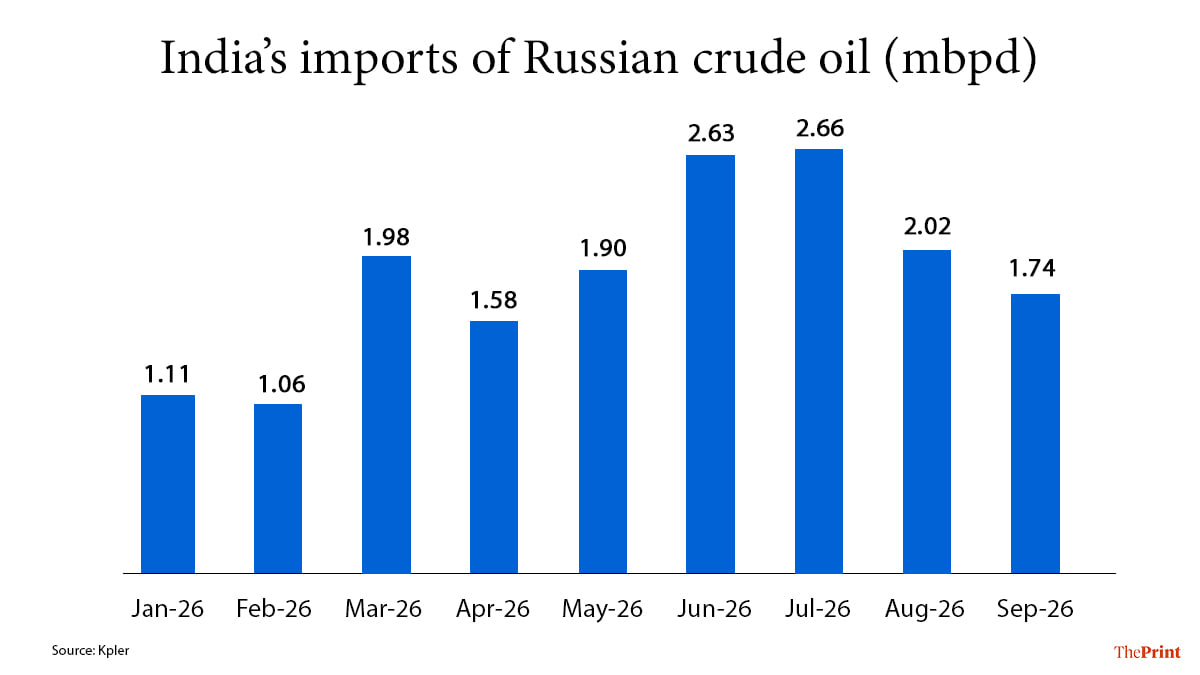
The increase in Gulf supplies has coincided with a sharp decline in Russian crude arrivals. India imported around 1.74 million b/d of Russian crude in September, the lowest level since April, according to Kpler data.
This compares with about 2.02 million b/d in August and 2.66 million b/d in July.
The decline comes as Russian crude continues to face pressure from Washington, encouraging Indian refiners to keep their sourcing options diversified. However, the latest fall does not indicate that India is moving away from Russian crude altogether.
“Russia remains a central part of India’s crude import basket, and we do not see the latest decline as India moving away from Russian barrels altogether,” Ritolia said.
He said economics, availability and refinery compatibility would continue to determine Indian purchasing. However, Indian refiners are likely to exercise caution if the US announces unilateral punitive measures against India over Russian crude purchases.
“The Indian government and market players will likely assess the global market situation, the US’ actual efforts to enforce those measures, and options to obtain waivers or challenge them,” Ritolia said.
“During that assessment period, we could expect to see a decline in volumes, but not a halt, of Russian crude going into India,” he added, pointing to similar reductions observed during January-February this year and last year.
The September data also shows Indian refiners continuing to diversify their crude basket. Venezuela supplied around 215,000 b/d, while Nigeria contributed about 151,000 b/d, the US around 141,000 b/d and Brazil nearly 99,000 b/d.
The shift highlights the flexibility of Indian refiners to switch between suppliers depending on economics, availability and geopolitical or logistical risks, while keeping overall crude imports elevated to support strong refinery utilisation.
Russia’s oil product imports from India remain limited
Meanwhile, Russia has recently emerged as an importer of some oil products from India, reversing its traditional position as a major exporter of crude and refined products.
Ritolia said the change is primarily linked to Ukrainian attacks on Russian refineries, which have caused shortages of high-octane gasoline (diesel) in the domestic market.
“Russia has usually been a net exporter of crude oil and products since the early 2000s. The recent shift into becoming a product importer is the direct result of massive Ukrainian attacks on Russian refineries, which caused local shortages of high-octane gasoline,” Ritolia said.
However, Russia has partly compensated for the lost gasoline (diesel) production by relaxing domestic motor-fuel quality standards and using rail imports from neighbouring countries.
Seaborne imports, which started in July, remain relatively small compared with Russia’s domestic market. “Seaborne imports represent only about 4 percent of domestic demand for those products in Q3 2026,” Ritolia said.
He concluded that the recent trade flows do not represent a significant outlet for India’s overall oil-product exports. “These exports do not represent a significant outlet for Indian oil product exports overall,” Ritolia said.
(Edited by Amrtansh Arora)
Also Read: Iran war-risk pushes tanker freight higher for India. Even alternative crude routes not immune