New Delhi: The burden of higher crude oil prices may again have to be shared between the government, oil marketing companies (OMCs) and consumers if the latest price rise persists into October and November, Chief Economic Advisor (CEA) V Anantha Nageswaran said on Thursday.
“It is too premature to conclude that OMCs are the ones who are bearing this increase in the crude price because the second phase of the energy shock is just beginning to happen in the last two weeks,” Nageswaran said.
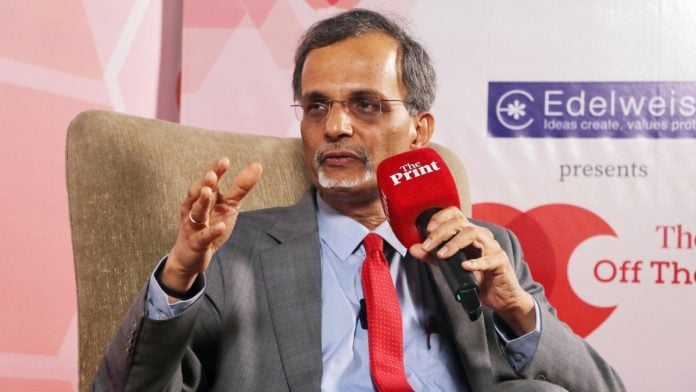
The CEA was speaking at ThePrint’s Off The Cuff, organised at the Quorum Club in Mumbai, with ThePrint editor-in-chief Shekhar Gupta.
His comments came against the backdrop of the US-Iran war that began in February and the resulting disruption and uncertainty in global energy supplies, which pushed crude prices higher again in September after easing to around $80-$85 a barrel in June and July. On 10 September, Brent crude crossed $100 a barrel for the first time since May and is currently at around $105 per barrel.
Nageswaran said that when crude prices rose earlier, the government had not left OMCs to absorb the entire increase. Instead, the response involved a combination of higher domestic fuel prices, lower excise duties and changes in cooking fuel prices.
Petrol and diesel prices were increased by around Rs 7-10 per litre during the earlier phase, while cooking gas prices for commercial establishments were also raised, he said. At the same time, excise duties were lowered and efforts were made to encourage consumers to shift from LPG to PNG.
“There was a little bit of a burden sharing between the government, the households and businesses and the oil marketing companies,” he said.
Whether a similar approach is required now, he said, would depend on how long crude prices remain elevated.
“Whether it will necessarily have to be borne only by the oil companies or there has to be a similar pattern of burden sharing between the three entities—government, oil companies and households and businesses—will also depend on the persistence of the current oil price situation into October and November,” he said.
The CEA, however, cautioned against assuming that the latest increase would necessarily turn into a prolonged oil shock. “We have to wait and see. We cannot conclude that it will necessarily be persistent,” he said.
The distinction is important because India imports roughly 85 percent of its crude oil requirements to meet domestic consumption, and a sustained rise in international prices can affect domestic fuel prices, inflation, corporate costs and the current account.
Higher oil prices did not lower Q1 GDP
Nageswaran said it was not possible to simply calculate what India’s GDP growth would have been in the first quarter had the energy shock not occurred.
India’s real gross domestic product (GDP) grew 7.8 percent in the first quarter (April-June) of the current fiscal (Q1FY27). The CEA said, however, that the impact of higher crude oil prices on the domestic economy depended on how much of the increase was passed on to domestic prices.
“Ultimately, regardless of the crude oil price, what would matter to domestic prices, domestic growth would be the extent of pass-through, and the pass-through was relatively limited,” he said.
Nageswaran also explained why the oil shock did not necessarily reduce GDP growth as much as might be expected under the revised GDP calculation method. India uses a method called “double deflation”, which separately accounts for changes in the prices of goods produced and the inputs used to produce them.
He said the sharp rise in import prices affected the calculation of real imports and, in turn, increased the contribution of net exports—exports minus imports—to real GDP growth.
“So, if the prices had not gone up so much, it could be very well possible that net exports wouldn’t have made as big a contribution to GDP growth as it did,” he said.
This led to what Nageswaran described as a paradox—the GDP growth may “even have been lower in real terms” if oil prices had not risen as much. Since imports are subtracted when calculating GDP, changes in import prices can affect the measurement of real GDP growth.
Energy diversification strengthened India’s resilience
Nageswaran said India had become more resilient to external shocks because of improvements across the economy, including better supply infrastructure, a stronger banking system, greater financial inclusion and energy diversification.
India was earlier more vulnerable to what economists call “overheating”—when rapid growth puts pressure on the banking system, pushes up inflation and imports, and widens the current account deficit. This would eventually force the economy to slow down.
“That overheating tendency has come down,” Nageswaran said, adding that this had allowed India to grow for longer without running into the same constraints.
He said the banking system was now in a better position and India had also “definitely diversified far better” in energy. He pointed to the scale of renewable energy installation as one of the changes that had reduced the economy’s vulnerability to external energy shocks.
The improvement in resilience, he said, was therefore not the result of any one factor. “All of these things are collectively adding up to making us more resilient. It’s not one single factor,” he said.
(Edited by Chingkheinganbi Mayengbam)