



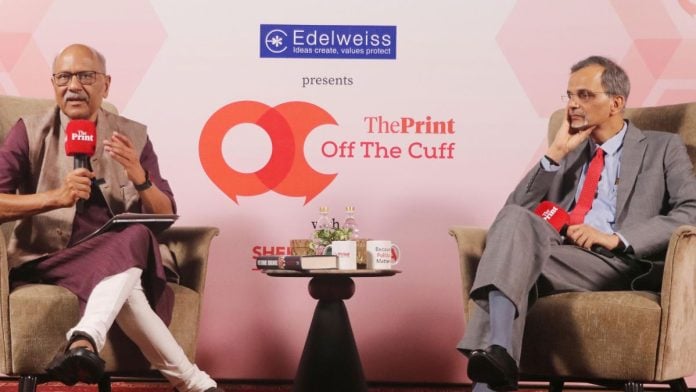
New Delhi: India needs to urgently reduce its dependence on foreign supply chains for critical inputs, such as chemicals, energy and base metals, while expanding manufacturing and labour-intensive services to create jobs, Chief Economic Adviser V. Anantha Nageswaran said Thursday at ThePrint’s Off The Cuff in Mumbai.
Speaking to Editor-in-Chief Shekhar Gupta, Nageswaran said dependence on imported inputs makes the economy vulnerable to supply disruptions, particularly when those inputs come from a limited number of sources.
“When the bulk of your imports are intermediate or capital goods, then naturally you are vulnerable,” he said. Intermediate goods are inputs used to make other products, while capital goods include machinery and equipment used in production.
Nageswaran said the vulnerability is not limited to chemicals, but extends to energy and base metals, where India remains largely dependent on imports. “One cannot remain vulnerable or captive to the supply chain, weaponisation, and chokepoints of other countries, even in basic materials.”
He said India needed to address this with an “extraordinary sense of urgency”.
Also Read: GDP math under fire: What critics and fanboys are both getting wrong
Manufacturing has role
Nageswaran said India’s response should not be limited to replacing every imported product with domestic production. Instead, the country should either manufacture critical inputs, diversify its sources of imports, or combine both approaches. “We have to either manufacture or diversify our sources or do a combination of the two,” he said.
He also suggested that India should identify areas where it could develop capabilities important enough to give it strategic leverage in global supply chains. That approach is closely linked to the country’s employment challenge. One participant at the event estimated that around 150 million people could join the workforce over the next 10-15 years, while another 100 million could move from farms to non-farm jobs, and around 100 million women could potentially enter the workforce.
Nageswaran said the government’s July 2024 Budget had focused on employment through measures covering internships, apprenticeships, first-time job-holders and the government’s willingness to absorb part of employee provident fund contributions. He stressed, however, that the government itself could not be the main source of jobs. “Ultimately, employment creation happens in the private sector, not in the government,” he said.
Manufacturing, Nageswaran said, would remain an important source of jobs, even though its share of the economy has come under scrutiny. He said manufacturing’s share of gross value added (GVA)—the value generated by different sectors—has remained broadly stable when measured at constant prices.
The apparent decline in its share in current-price data is partly because agricultural prices have risen faster, while manufacturing faces import competition and generally lower price increases. “Manufacturing [in India] is alive and kicking,” he said.
Nageswaran said India could pursue different types of manufacturing across states, with more developed states focusing on sectors such as semiconductors, electronics and petrochemicals, while others could focus on labour-intensive manufacturing.
Agro-processing is another area with room to expand, he said. India often exports raw materials that are processed in other countries, and building more processing capacity domestically could create jobs as well as a wider ecosystem around these industries.
Also Read: From liberalisation to lost momentum—the promise of 1991 has been only partially redeemed
AI could reshape job market
The services sector will also have to play a role in absorbing workers, particularly as artificial intelligence (AI) changes some parts of the economy. Nageswaran said AI could affect employment at the junior level in the infotech (IT) sector, although it was not yet clear that it would reduce overall output.
For employment, he pointed to sectors where human interaction remains important, including hospitality, tourism, elderly care, special-needs childcare, physiotherapy and sports coaching. “AI may force India to discover the strength of its labour endowment, both in services and in manufacturing,” he said.
This makes the employment challenge broader than simply increasing factory output. India will need a mix of labour-intensive manufacturing, agro-processing and services that can absorb large numbers of workers while also building higher-value capabilities.
FTAs and Indian firms
Nageswaran also linked employment and manufacturing opportunities to India’s free trade agreements (FTAs). He said the trade agreement with the UK and India’s engagement with Europe could open opportunities for labour-intensive goods and services, but smaller Indian companies would also need to become part of global supply chains by producing components critical to larger manufacturers.
“If you want to become strategically important, you have to find that which is indispensable and start making that,” he said.
That could allow Indian companies to benefit from efforts by global manufacturers to diversify their supply chains rather than relying too heavily on a single country. Nageswaran said this was particularly important because India continues to face strong competition from China in manufacturing.
At the same time, he pointed to progress made in sectors such as electronics as an example of how Indian manufacturing could expand its role in global supply chains. The challenge, therefore, is to build industries that can create jobs, expand exports and reduce dependence on vulnerable supply chains.
Nageswaran said India should combine domestic production with diversified sourcing and develop capabilities in areas where it can become strategically important. This could help strengthen supply-chain resilience while creating opportunities for manufacturing, exports and employment.
(Edited by Nardeep Singh Dahiya)

Also Read: Beyond free UPI: Why the government is testing political capital over economic logicFTA