



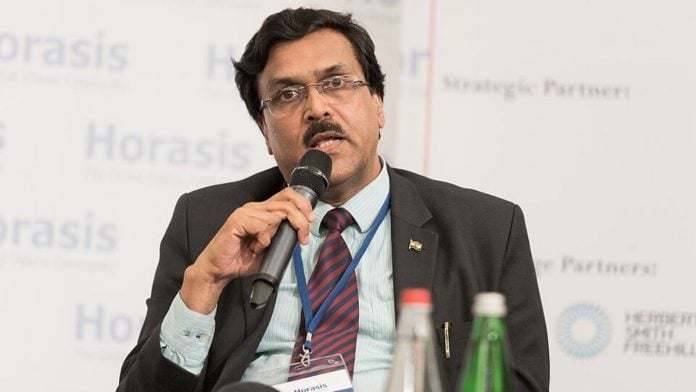
New Delhi: Officers of the Indian Administrative Service (IAS) in key government posts “could not advise the political executive to follow the path that China did”, former telecom secretary J.S. Deepak said Monday during a discussion on his memoir, I Dared to Dial Differently: An Insider’s Account of the IAS.
Speaking at the India International Centre (IIC), Deepak said: “When I joined the service, the per capita income of India was more than China. Today, China is five times more than us. So maybe that’s an opportunity lost. We failed in a number of areas. But I think, overall, the service has not only contributed, it has made a difference to put India on the path that it is.”
Trade expert Abhijit Das read from the book’s chapter on Regional Comprehensive Economic Partnership (RCEP), where Deepak writes: “India’s negotiating position was not a secret, it was a mystery”. According to Das, the book shows that India had by mid-2015 secured terms that would have protected its interests against China, but these gains were later given up. “We don’t know why. So the mystery deepens further,” Das said.
Prime Minister Narendra Modi announced at the RCEP summit in Bangkok on 4 November 2019 that India would not join the trade deal. The chapter refers to a dig at free trade agreements in the Dussehra speech of the Rashtriya Swayamsevak Sangh (RSS) chief and to the Swadeshi Jagran Manch’s efforts to stop the pact. Deepak writes that the Prime Minister took the right decision, but that it was “impossible to hide the fact that our economic diplomacy had failed big time”.
“Did the Department of Commerce engage in any introspection? Were corrective actions taken? Maybe, sir, that’s the theme for your next book,” Das said.
In his opening remarks, Deepak said the life of a civil servant “is always difficult, sometimes tough, but never dull.” The effort, he said, was “to be as candid as possible without getting into any trouble,” adding that some friends, including Das, had worried for him.
He said the book was written for people who ask why civil servants do not speak up while in service, but write books after they retire. “There are many things which cannot be said while you are in service. The civil service rules prohibit us from doing it. Expectation of the media and civil society want us to do it. And therefore, there is tension between the two,” he said.
Cases where officers stood up to prevent mischief, he said, often remain sealed in government files. “More often than not, civil servants are like stones of the foundation, which are not seen, but on whose strength tall buildings and lofty structures are built and stand.”
The book is also meant for civil services aspirants. “When I did the exam, 95,000 people competed for 100 positions,” he said, asking whether today’s candidates, drawn in by coaching centres’ full-page newspaper advertisements, “understand what they are getting into”. The Union Public Service Commission (UPSC) notified 1,016 vacancies for this year’s Civil Services Examination.
Deepak, a 1982-batch IAS officer of the Uttar Pradesh cadre, designed and conducted the 2010 3G spectrum auction as joint secretary in the Department of Telecommunications. At the Department of Commerce, he was India’s chief negotiator for World Trade Organization (WTO), RCEP and European Union trade agreements. He is now with Bharti Enterprises.
The 344-page memoir was published by Hachette India on 20 August. In it, Deepak writes that government directors on the board of Bharat Sanchar Nigam Limited (BSNL) blocked a single-vendor equipment tender worth over Rs 30,000 crore, averting a loss of about Rs 8,000 crore. He argues that the 2G spectrum loss was more than Rs 2 lakh crore, higher than the Rs 1.76 lakh crore estimated by the Comptroller and Auditor General (CAG).
He was moved out as telecom secretary on 1 March 2017, while attending the Mobile World Congress in Spain. The move came shortly after he wrote to the Telecom Regulatory Authority of India (TRAI) asking it to restrict telecom companies’ promotional offers, saying Reliance Jio’s free offers had cost the government almost Rs 800 crore.
“I nearly lost my job four times,” Deepak said, naming Ballia, Varanasi, the telecom department and Uttar Pradesh’s education department. He credited senior officers he called “guardian angels” who saved him, among them D.K. Mittal, who was in the audience.
On corruption, he said that when he joined in 1982, “In UP, we could count the number of corrupt people on the fingers of one hand.” Such officers were “ostracised, blackballed, blacklisted”, he said, but things had “deteriorated very fast” by 1996. That year, officers of the Uttar Pradesh IAS Association held a vote to identify the three most corrupt bureaucrats among them.
“The general feeling is that most IAS officers and civil servants who are dynamic are corrupt,” Deepak said. The book includes case studies of officers who “went to the service on their own terms, did a lot of work, played with a straight back and still rose to the top”.
The last chapter asks whether the IAS is a civil service or a circus. “I, of course, believe it’s a service,” Deepak said, but added that many people, including friends of the service, feel it could become “more of a circus” if course corrections are not made. He said a former head of ICICI Bank had told him the IAS suffers from “mistaking articulation for action”.
Das read out the book’s descriptions of four ministers, without naming them. One would “hear nothing, do nothing”; another “weaponised bullying as a tactic”. Deepak said he had been “equally frank” about officers. He quoted cartoonist R.K. Laxman: “I stopped making cartoons of politicians when cartoons became politicians.” He described some of the politicians he worked with, including former Prime Minister Manmohan Singh, as “best in class, top of the league”.
Former cabinet secretary Rajiv Gauba, Deepak’s batchmate and now a member of NITI Aayog (National Institution for Transforming India), said most civil service memoirs are about officers who “did great things in the face of many odds”, but Deepak “has not blown his own trumpet”. Atal Innovation Mission’s director Deepak Bagla called the book “a master class in how to do business in India”.
Opening the discussion, ThePrint Editor-in-chief Shekhar Gupta said it was important that more civil servants were writing memoirs, because no one in India can write a fair biography. “Somebody will burn the bookshop,” he said. He recalled that when Richard Attenborough approached Jawaharlal Nehru about a film on Mahatma Gandhi, Nehru told him to show Gandhi as he was. “Today you cannot make any film on any leader,” Gupta said.
Gupta recalled meeting Gauba in Assam in 1983, when young officers from across India were sent to conduct that year’s election. The Nellie massacre took place during those polls, on 18 February 1983.
He said that since Independence, the commerce minister’s job had largely been to shut out trade. “Everybody is averse to trade. Everybody thinks trade is against India’s interest,” he said. He put India’s trade deficit with China at $120 billion. Official figures put it at a record $112.6 billion in 2025-26.
Gupta also recalled former Haryana Chief Minister Om Prakash Chautala telling him that secretaries should be honest, however much politicians “mess up”. Chautala and his son Ajay were sentenced to 10 years in 2013 in the Junior Basic Trained (JBT) teachers’ recruitment scam.
Responding to an audience question, Deepak recalled Nehru’s remark that the Indian Civil Service (ICS) was “neither Indian, nor civil, nor a service”. “When all is said and done, much more has been done than said by members of the service,” he said.
(Edited by Nardeep Singh Dahiya)