



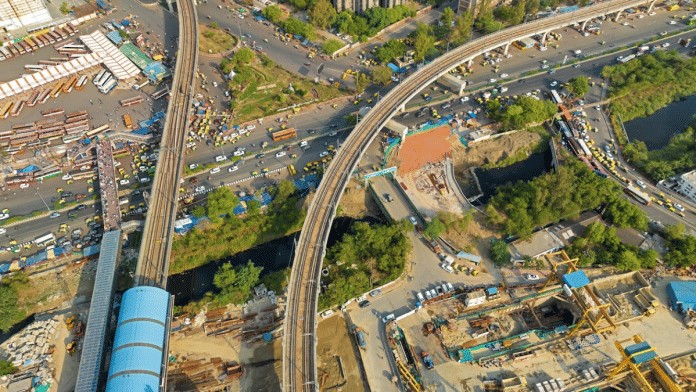
New Delhi: India may already be far more urban than what official estimates suggest, according to a working paper released by the Economic Advisory Council to the Prime Minister (EAC-PM), which argues that the country’s urbanisation level could have been as high as 63 percent in 2015 based on satellite data—more than double the official Census 2011 estimate of 31 percent.
According to the 2011 Census, India officially counted 377 million people, or 31.1 percent of its population living in urban areas. But, the EAC-PM paper, ‘India’s Hidden Urbanisation & Its Policy Implications’, says daytime satellite data from the Global Human Settlement Layer (GHSL) showed India was already 63 percent urban in 2015.
It also cites a World Bank methodology which estimated that India was 55.3 percent urban as early as 2010.
The working paper released in March 2026 is authored by EAC-PM member Shamika Ravi along with consultants Manuj Joshi and Apurv Kumar Mishra, and calls for a complete rethink of how India defines ‘urban’.
“What is beyond doubt is that the current classification which uses a combination of administrative definition and census criteria is inadequate in capturing the speed and scale of urbanisation in India,” the paper states. It adds that the mismatch between reality and official classification of urban and rural areas has serious policy consequences.
“Misclassification of ‘urban’ and ‘rural’ has serious consequences: it undermines targeted policy formulation, misallocates public resources, and masks the real scale of India’s urban transition,” it states.
The working paper also argues that India’s current definition of urban settlements is outdated. Under the existing Census criteria, a settlement qualifies as urban if it has a population above 5,000, a density of at least 400 people per sq km, and 75 percent of employed men engaged in non-agricultural work.
Settlements which meet these three criteria are called “census towns” even though their respective state governments may still classify them as “rural”. The paper notes that this definition has remained unchanged since 1971 and will continue for Census 2027 as well.
The working paper says India’s urban growth is now spreading well beyond major metros into Tier-2 cities and peri-urban districts—transitional zones between urban and rural areas.
The paper points to Oxford Economics projections showing that 17 of the world’s 20 fastest-growing cities between 2019 and 2035 will be in India. Besides Bengaluru, Hyderabad and Chennai, the list includes Surat, Agra, Nagpur, Tiruppur, Rajkot, Vijayawada and Tiruchirappalli.
Also Read: Karnataka’s Koraga tribe to urban renters—UN report highlights India’s housing inequality
What does the paper recommend?
On tracking urban areas, the paper recommends replacing the current Census-based system with satellite imagery that measures built-up volume data to identify areas that are functionally urban.
“Using daytime satellite data to measure built-up volume is a better source for mapping the state of urbanisation and the average size of urban conglomerates. The daytime satellite imagery provides the opportunity to consider physical structures in a city improving inferences,” the paper states.
It also calls for ‘trigger mechanisms’ that automatically convert rapidly urbanising settlements from rural to urban governance structures once they cross certain thresholds.
“The government needs to establish ‘trigger mechanisms’ which automate the transition from rural to urban settlement on meeting prescribed thresholds derived through a formulaic framework so that the disincentives to shift to ULBs [urban local bodies] are bypassed,” the paper says.
On governance, the paper says India’s cities suffer from fragmented administration and weak urban local bodies. Citing a 2021 NITI Aayog report, the paper notes that nearly half of India’s urban settlements continue to be governed as rural entities.
The paper uses Gurugram as an example of poor urban planning, pointing out that the city did not get a municipal corporation until 2008 despite rapid growth.
It also recommends upgrading many town panchayats and municipalities into municipal corporations, arguing that current governance structures are inadequate for fast-growing urban regions.
The paper proposes major administrative reforms as well, including fixed three-year tenures for bureaucrats handling urbanisation and linking promotions to measurable outcomes such as reduced commute times, improved waste management, better air quality and public health indicators.
The broader message of the paper is that India must stop treating urbanisation only as a welfare issue and instead view cities as engines of economic growth. “India stands at a crossroads: it can either continue with fragmented, unplanned urban growth, or it can proactively plan, govern, and finance cities as drivers of prosperity,” the paper says.
(Edited by Archishman Ganguly)