



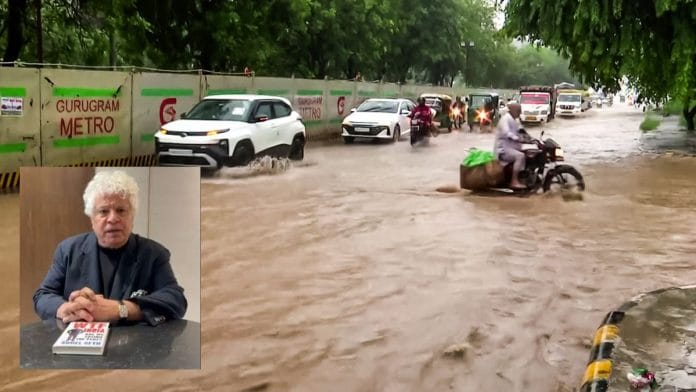
Gurugram: After ‘cockroaches’ in the heart of the Capital, it could well be the turn of the ‘rodents’ from the southernmost part of Haryana. As monsoon flooding drowned the vaunted Millennium City in its annual chapter of woe, Gurugram-based marketing expert and author Suhel Seth’s call for a citizens’ “movement” against India’s crumbling urban infrastructure got off to an apparently healthy start.
It was on Saturday when Gurugram’s waterlogging had maxed out on the misery scale that Seth posted a short video on social media platform X. “I am angry, furious and raging over the miserable life we live in the cities across India,” he said, a copy of his new book WTF India in front of him. “We live like rodents. Even worse.”
Cities were flooded, potholes had grown to the size of “Mount Everest”, and the average citizen was living a life he or she did not deserve, he said.
Seth reserved his deepest scorn for Gurugram’s administration, which he said had “mastered the fine art” of turning the city into “Venice every monsoon”—as if officials believed the rains, arriving reliably for four millennia, would somehow skip the city this year.
He was careful to frame the exercise as constructive, not combative. Writing WTF India, he said, was never about complaining or venting anger, but about turning “honest and collective anger” into accountability for those in power. “It’s time we join hands,” he said, appealing to citizens to photograph what was wrong around them rather than simply protest or shout from rooftops.
Let’s join hands and create a movement that will make real change happen. If you are unhappy with the way you live, WhatsApp photographs, videos with the date and location on 9910331864 and I will amplify it. Let’s start, we deserve cities that we can live in. pic.twitter.com/bZ8fpCkWlZ
— SUHEL SETH (@Suhelseth) August 8, 2026
The call was specific: WhatsApp photographs and videos of waterlogged neighbourhoods, with date and location, to a number he shared, which he promised to amplify across media until, as he put it, people knew a movement had begun and that they were no longer voiceless. “Let’s stop talking about the problems and work towards solutions,” he said. “We deserve the cities we can live in, not the cities we are forced to swim in.”
The Saturday video followed an earlier post last week in which Seth, with characteristic sarcasm, advised anyone travelling to or from Gurugram to carry a boat, thanking Haryana Chief Minister Nayab Singh Saini and the Gurugram deputy commissioner for their “thoughtfulness” in leaving the city flooded yet again.
Issued in public interest: for all those coming to Gurugram today and / or leaving, kindly use a boat. Thanks to the brilliance of the administration which never anticipates the monsoon, we are happily flooded. Thank you @NayabSainiBJP and @DC_Gurugram for your thoughtfulness.
— SUHEL SETH (@Suhelseth) August 4, 2026
By Sunday evening, more than 700 users had responded to Seth’s call, many with photographs and videos of waterlogged streets, stalled traffic and marooned housing societies from Gurugram and beyond.
Biocon founder Kiran Mazumdar-Shaw quote-posted Seth’s message, calling for the effort to become a national movement and invoking the decade-old Swachh Bharat campaign, while noting that sustained civic action, not just a clean-up drive, was what cities like Bengaluru needed.
This must be a national movement. Hon PM @narendramodi had started the Swachh Bharat movement a decade ago and it is a matter of civic shame that we as a people failed to act. In Bengaluru we are focused on a clean city drive. But it has to be sustained action through cleaner… https://t.co/hONuNobcnR
— Kiran Mazumdar-Shaw (@kiranshaw) August 8, 2026
Advocate Sidharth Luthra recalled Seth’s earlier amplification of the oxygen crisis during the Covid pandemic. Users posted from Gurugram’s Sector 65, Sector 15, Suncity and the Old Delhi-Gurugram Highway, and from as far as Chennai’s Triplicane neighbourhood, where a newspaper clipping showed residents had organised on their own to save their street from flooding.
Excellent idea !!
I recall how you helped get oxygen to some hospitals in Covid by amplifying the crisis. And it worked..
— Sidharth Luthra (@Luthra_Sidharth) August 9, 2026
You are doing a good thing sir. Prominent Citizens action and activism is the need of the hour. Not to blame govt, but to be responsible and make a meaningful change. pic.twitter.com/3bSYIkcspZ
— KSV Kuppuswamy (@ksvkuppu) August 9, 2026
The pile-up of photo evidence on Seth’s timeline stood in some contrast to the account offered by the Gurugram Metropolitan Development Authority (GMDA) Saturday.
In a press note issued on August 8, the authority said the city had received more than 200 mm of rain over three days but had “largely stayed afloat”, with most traditional waterlogging hotspots, including Subhash Chowk, Signature Tower, AIT Chowk, Medanta Road and Rajiv Chowk, remaining free of major accumulation, and water clearing within two to three hours wherever it did collect.
GMDA credited the improvement to pre-monsoon drainage works, including a new drain built in about six weeks to give Narsinghpur, long one of the city’s worst flooding spots, a direct outlet instead of routing water through Hero Honda Chowk for pumping, and a separate drain taken under the Delhi-Jaipur Highway using trenchless technology after an earlier plan for a culvert did not go through.
Another new drain between Vatika Chowk and Sector 37D was said to have eased pressure on the Southern Peripheral Road. The authority also pointed to desilting of its three main stormwater arteries and the addition of hundreds of road-gully inlets ahead of the monsoon.
MCG Commissioner Pradeep Dahiya was reported to have inspected several vulnerable stretches during the latest spell, directing officials to clear accumulated water without delay. GMDA said it was also working with IIT Delhi on rainwater-harvesting structures, with one already built at AIT Chowk to recharge groundwater and more planned across the district.
The authority did concede some trouble-spots remained, Sheetla Mata Road and the area near Aira Mall in Badshahpur among them, and said a detailed post-monsoon assessment and permanent fixes were planned for these locations. GMDA chief P.C. Meena had told ThePrint last week that the authority’s measures included removing encroachments from Gurugram’s three natural drains and building an additional drain for the city.
Whether Seth’s campaign will translate into sustained pressure on the administration, or ebb like monsoon outrage cycles of the past is a question for Gurugram’s post-deluge streets to answer.
(Edited by Nardeep Singh Dahiya)
Why don’t people protest for this ? Like I would get behind it honestly but most of these protesters we see are people who hate development. Decent citizens just don’t go to protests anymore. Which is why all these protests are captured by the communists instead of good citizens who care about the country.
Anyone who protests because of infrastructure issues will get my support. You shouldn’t tolerate bad governance because these things can be fixed easily. Some things are harder to fix just because we are not a rich country but you don’t have to be a rich country to have a decent road.