



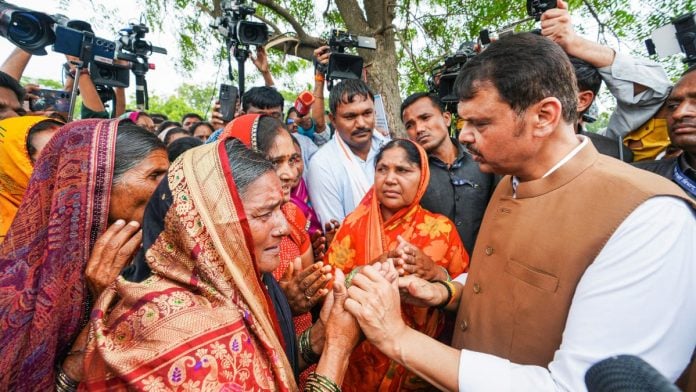
Mumbai: Maharashtra Chief Minister Devendra Fadnavis visited drought-affected tehsils in Latur, Solapur and Dharashiv in Marathwada Wednesday to take stock of the situation, assuring government support to farmers who are facing water and fodder scarcity, and crop failure amid widespread rainfall deficit.
Describing the situation as “extremely serious”, Fadnavis said that these districts alone received 50 percent less rainfall than normal, and that the government would begin panchanama, or crop damage assessments. The CM said that a primary government resolution will be released Saturday.
“The situation is extremely serious. Latur and Dharashiv are two districts that received only 50 per cent rainfall this year. The rainfall deficit had severely affected crops, particularly soybean,” Fadnavis told reporters, and warned that the shortage of water would also create problems for drinking water and livestock fodder.
The state report says Maharashtra received 80.82 percent of its average rainfall between June 1 and September 21, with significant deficits reported in several districts. Solapur is amongst the worst-affected districts, with a 56 percent deficit featuring dry spells of between 21 and 43 days. while other districts in Marathwada—Latur, Dharashiv, Beed, Parbhani—have a rainfall deficit of between 35 and 40 percent.
Government report estimates possible crop losses of more than 60 percent, with soybean, 80-90 percent decline in moong and urad, while bajra, maize and tur could see a 60–70 percent decline. “There is distress and anguish among farmers. But I have told them that the government will stand firmly behind them. We will provide all possible assistance. There will be no shortage of funds for drought relief,” said Fadnavis.
Fadnavis visited fields with withered soybean crops and dried-up wells and met distressed farmers in these districts. Farmers said their crops withered after sprouting due to lack of rain. Fadnavis said that the situation has to be scientifically assessed as per the law, but the devastation was evident and support should be given to the farmers without any discrimination.
“We have gathered all the reports and are taking action accordingly. The government has taken the drought situation very seriously and has started working. We are going to help the farmers, and our loan waiver scheme is also on and will not be shut. We are arranging water availability and fodder as well,” he said.
Fadnavis acknowledged the seriousness of the situation and attributed it to ‘Super El Nino’ impact. Speaking to farmers, he said: “I met a farmer whose crop had initially grown well but has now completely been destroyed . There is no water in his well. The situation is extremely serious, but the government will stand firmly with the farmers,” he said. “We are focusing on implementing farm loan waivers effectively. I have already instructed officials to issue the first government order on relief by Saturday,” he said.
“Wiping the tears of farmers is the government’s first duty. We will certainly seek funds from the Centre under national disaster norms. However, farmers will not be made to wait until the Central funds arrive. The state government will immediately start providing assistance from its own treasury,” he added.
Fadnavis said that the government’s priority will also be given to drinking water, as the rainfall deficit had severely affected groundwater levels and water bodies. “If only 50 percent rainfall is received, there will obviously be an impact on water in reservoirs and wells,” he said
“We have tried to conserve sufficient water for drinking purposes. We have water required until December, and we have also tried to preserve water up to June. Even then, there will be a drinking water crisis and we are making arrangements for it,” he said.
(Edited by Nardeep Singh Dahiya)
Also Read: Maharashtra turns to private capital to fund climate transition, launches $1 bn investment pipeline