





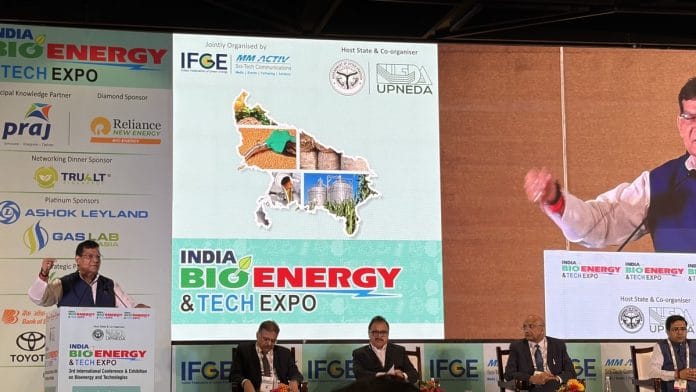


New Delhi: With Uttar Pradesh looking to expand its bioenergy sector using agricultural and urban waste, state energy minister AK Sharma Tuesday called for greater private investment in compressed biogas (CBG), waste-to-energy and other renewable energy projects.
Speaking at the inaugural session of the 3rd India Bioenergy & Tech Expo 2026 at India Expo Centre & Mart in Greater Noida, Sharma said that Uttar Pradesh has 58 Compressed Bio-Gas (CBG) plants, making them the largest contributor to the sector in the country. The state has also emerged as the second-largest in installations under the PM Surya Ghar scheme, he said.
“Bioenergy can also be harvested if we are able to adopt the right technologies,” Sharma said, arguing that converting waste into energy could simultaneously increase farmers income, create employment and improve the environment.
The minister said Uttar Pradesh generates around 60 million tonnes of agricultural waste annually, creating a significant feedstock base for bioenergy projects. Converting this waste into energy could benefit farmers, particularly small and marginal farmers, while also reducing the environmental impact of crop residue burning, he said.
“Farmer’s income goes up, state’s economy and employment also go up, and for the industry also, there will be an opportunity to create wealth,” Sharma said.
The minister, who also holds the urban development portfolio, said Uttar Pradesh generates around 15,000 tonnes of municipal waste every day. He said processing this waste and converting it into energy could help address the challenge of waste disposal while creating another source of energy. “We are very keen to process waste and see that our cities are cleaner,” he said, adding that bioenergy could also help tackle legacy waste and improve urban living conditions.
Sharma also highlighted Uttar Pradesh’s progress under the PM Surya Ghar scheme. He said the state has around 7,000 vendors under the programme and is currently second in the country in total installations, while claiming that it has already achieved the highest rate of daily installations and could soon become the top state overall.
He credited Prime Minister Narendra Modi for pursuing an energy transition that balances India’s development needs with climate concerns. Sharma said India resisted international pressure to immediately shut thermal power plants, arguing that the country’s rising energy demand and lower per-capita electricity consumption meant it could not simply follow the path taken by developed economies.
Instead, Modi pushed for expanding renewable energy while continuing to meet the country’s growing power requirements, Sharma said.
He also credited the state government’s policy approach under Chief Minister Yogi Adityanath for making Uttar Pradesh more attractive to investors in the clean-energy sector. He said the state’s objective was to create a system where businesses could implement projects without having to repeatedly approach ministers or senior officials.
“None of you who has implemented projects in UP was required to meet the minister and see the face of the minister,” Sharma said, stressing that policy implementation should be predictable and transparent.
The minister said the state would continue its bioenergy policy and consider suggestions from industry on making it more conducive to investment. He asked participants at the expo to submit a consolidated report listing specific policy and regulatory changes that could make it easier for companies to operate in Uttar Pradesh.
Sharma also proposed greater collaboration between the government and bioenergy companies to train young people for jobs in the sector. He said the government could allow companies to use existing training institutions to conduct courses and create specialised training programmes for the emerging bioenergy industry.
He cited the experience of the solar sector, where thousands of vendors have been deployed under the PM Surya Ghar programme as a model that could be replicated for bioenergy.
The minister said the expansion of the sector would require not only technology and investment but also greater awareness among households and farmers.
(Edited by Nardeep Singh Dahiya)
Also Read: Biomass waste can help restore carbon balance. Here’s how