





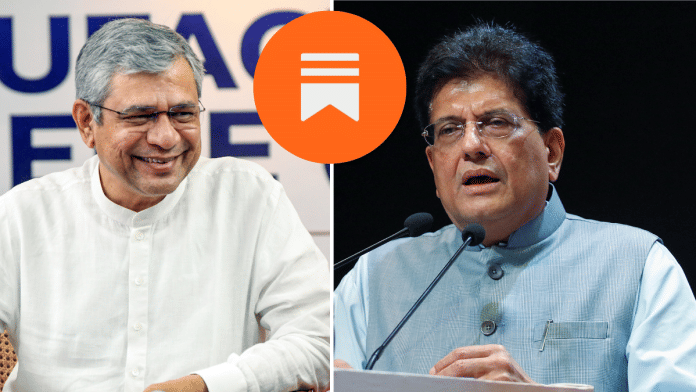

New Delhi: Two senior ministers in the Modi government have started writing on Substack, the subscription newsletter platform where independent journalists, essayists and a growing number of young writers post everything from cultural criticism to diary-style notes.
It is not where members of the Union cabinet usually turn up. But in an unusual move, Ashwini Vaishnaw and Piyush Goyal have each published on the platform within days of one another, and appear to be the first sitting ministers in the government to do so.
The ministers’ move to Substack comes as the party retools how it talks to younger voters following the massive Gen Z protests in Delhi over a medical entrance exam leak.
On 22 August, the BJP named a dedicated Gen Z outreach team that brought in party president Nitin Nabin, general secretaries Smriti Irani and Vinod Tawde, Gujarat minister Harsh Sanghavi and Chhattisgarh minister O.P. Choudhary. They are tasked with understanding what younger Indians want and building ways for them to reach the leadership.
The ministers arrive on a platform whose culture was built by exactly the age group the BJP is now trying to reach. But critics say their posts on chip fabs and trade delegations sit some distance from that register.
Vaishnaw—who holds the electronics and IT, railways, and information and broadcasting portfolios—published his first post on 25 August, a long explainer on the government’s semiconductor programme titled “How we are building India’s semiconductor ecosystem”.
He described chips as a foundational industry feeding into everything from cars and phones to drones, aircraft and MRI machines.
India, he wrote, had approved 12 semiconductor units carrying a cumulative investment of about $20 billion, of which three were already in commercial production, and set a target of moving to far more advanced chip nodes within eight years.
The claims were presented without the questioning they might have faced at a press conference.
Vaishnaw’s post doubled as a rebuttal to the programme’s critics. He recalled the doubts that greeted the mission at its launch, and argued that the government had chosen to build a broad base rather than chase what he called “vanity projects”.
Goyal, the commerce and industry minister, followed within the week with a post on his four-day visit to Japan, “Four Days, Three Cities, and a Partnership Coming of Age”.
He had led a delegation of nearly 200 business figures on the trip, and used the piece to talk up cooperation in semiconductors, artificial intelligence, robotics and clean energy.
He wrote that the two countries had been friends for a long time and that what was changing was the nature of that friendship, moving past an arrangement in which Japan supplied capital and technology while India offered a market and workers.
Both ministers flagged their posts on X and sent readers to the newsletters.
Direct line to readers
Substack allows more length than a press release and fewer interruptions than a television studio, and lets writers address readers who have signed up to hear from them directly.
Founded in 2017 and valued at around $1.1 billion after a funding round last year, Substack crossed five million paid subscriptions worldwide this year, against some 50 million total active subscriptions.
It does not publish India-specific numbers, and its readership here, though growing, remains small compared with its base in the United States.
The platform’s rise has been driven in good part by young readers and writers.
Trade publications have noted a surge of Gen Z interest in Substack over the past year, with users treating it as an antidote to what they call “brain-rot content” and a return to longer, slower reading.
Much of what draws them is personal: hyper-specific essays on fashion, internet culture, relationships, music and mental health, and diary-style writing that feels closer to the old world of Tumblr than to a polished Instagram grid.
Newsletters get passed around the way playlists once were, and some readers describe the habit as part of an “offline-core” aesthetic, a deliberate step back from busy feeds.
The format lets the ministers set out a case without taking questions, a point opposition leaders have raised in a broader complaint about the government’s approach to the press.
They have often noted that Prime Minister Narendra Modi has not held a formal open press conference in his years as prime minister, and have argued that direct-to-public channels let ministers bypass scrutiny.
Government supporters counter that ministers are simply using the tools available to reach citizens without an intermediary.
Tharoor’s Substack foray
For all the attention the two ministers have drawn, a Congress leader had reached Substack well before them, though in a different guise.
Shashi Tharoor, the Thiruvananthapuram MP widely considered one of the more practised writers in Indian politics, published an essay on the platform in January 2024, not on a newsletter of his own but as a guest contributor to The UnPopulist, an American publication run by writer Shikha Dalmia that carries classical-liberal commentary.
The piece, “An Illiberal Hinduism Is a Contradiction in Terms”, ran as part of a series on liberalism and religion and drew a few thousand likes and several dozen comments.
Tharoor used the piece to make a case against the politics associated with the BJP.
Writing as a believing Hindu, he argued that Hinduism is by its nature plural and non-dogmatic, open to many paths at once, and that the Hindutva movement was hollowing out the faith in the name of defending it.
He wrote that the surging Hindutva movement was shrinking “the soaring majesty of the ancient Hindu texts” to “the petty bigotry of its brand of identity politics”.
He set the Hindu nationalism he opposed against the tolerant tradition he traced to Gandhi and Vivekananda.
With the essay timed to the consecration of the Ram temple at Ayodhya that month, he described his Hinduism as one that does not celebrate a temple built on what he described as “the rubble of a mosque razed by a worked-up mob”, as he said Modi was set to do.
He returned to a formulation he has used for years, that the opposite of Hinduism is not Islam or Christianity but Hindutva, and warned that majoritarian nationalism was a form of separatism that risked “a second partition… in the Indian soul, not just in the Indian soil”.
He drew on his 2018 book Why I Am a Hindu throughout. He has kept no regular presence on the platform since.
Reaching out to Gen Z
The latest outreach by the two ministers on Substack follows a difficult summer for the government.
Through June and July, protests at Jantar Mantar over a leak in the NEET-UG medical entrance exam, held on 3 May, grew into one of the sharper youth agitations of Modi’s tenure.
It was led by the satirical Cockroach Janta Party alongside left-leaning student groups and given fresh momentum when Ladakhi activist Sonam Wangchuk joined a hunger strike at the site.
Tens of thousands turned out, some trying to march on Parliament. The government cancelled the compromised paper, ordered a CBI inquiry, held a re-test on 21 June and promised to shift NEET to a computer-based format, but the protests eased only after Education Minister Dharmendra Pradhan resigned on 25 July.
In the weeks after, the party’s attempt to court the same young voters on their own platforms ran into trouble.
Modi posted a midnight selfie video with the greeting “Friends”, a departure from “Mitron” that has long been his signature. The switch was picked apart by content creators who treated the reel as a marketing case study and asked why he had abandoned his own brand.
The BJP’s official handle put out a video set to the theme from the sitcom Friends, captioned “F.R.I.E.N.D.S… PM Modi is there for you”. Critics said the party seemed unaware that the show has fallen out of favour with many younger viewers.
A separate gym reel, in which actors performing as gym-bros spoke in Gen Z slang while dismissing the protests, drew parody clips and teardown videos, one captioned “that one damage control sarkaari paid ad”.
The Chhattisgarh unit’s video described young women dancing at the protests as “Babar ki virasat pe thumke lagane wale Gen Z”. The original dancer hit back, reviewing the BJP’s reel and criticised its captions.
Much of the mockery was centred on the sense that a party which built its media machine on memes and forwards was now straining to imitate a language it did not speak.
These clips were aimed at the roughly 400 million Gen Z voters who will be eligible by the 2029 general election, and ministers were told to become more active on platforms young people use and to let their videos look rougher and less produced.
The Congress has been working the same ground, with Rahul Gandhi taking his “Chhatron Ki Goonj” campaign to college campuses to raise paper leaks, exam irregularities and rising fees.
Substack sits apart from most of this. It is slower than a reel and carries little of the reach the party is chasing, but it lets ministers set out a longer argument in their own words, and it reaches an audience of younger readers who have gravitated to the platform on their own.
A minister’s posts on the platform also sit on the infrastructure of an American company, outside the government’s own channels.
For now, Vaishnaw and Goyal appear to treat the platform as one outlet among several, and it remains to be seen whether either keeps at it or whether the effort fades the way Tharoor’s single essay did two years ago.
(Edited by Sugita Katyal)
Also Read: How Gen Z protests in Delhi have fired up Gen Alpha in UP