





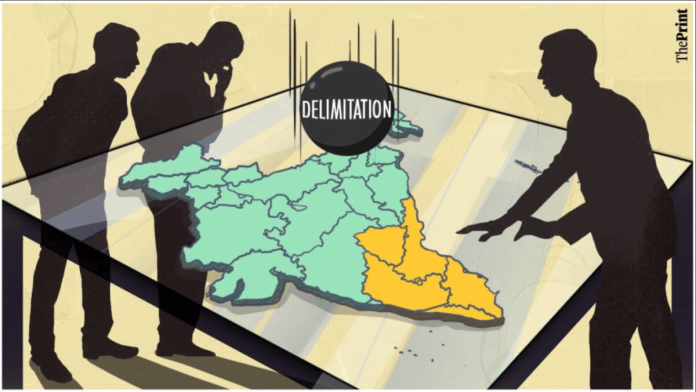


New Delhi: The three new Bills sought to be introduced by the Narendra Modi government in the special sitting of Parliament this week empower the Centre to allow delimitation on the basis of the ‘latest Census’ figures, while increasing the total number of Lok Sabha seats from 543 to 850. Currently, the 2011 Census figures will be considered the ‘latest’.
The three Bills, seen by ThePrint, are called the Delimitation Bill 2026, the Constitution (One Hundred and Thirty-First Amendment) Bill 2026, and the Union Territories Laws (Amendment) Bill 2026.
The government has said that the amendments pave the way for operationalisation of the Nari Shakti Vandan Adhiniyam, which was passed in 2023, and seeks to reserve one-third of the total number of seats for women in Lok Sabha and State Legislative Assemblies.
The Delimitation Bill, 2026 provides for the readjustment of the allocation of seats in the House of the People to the States and Union Territories, the total number of seats in the Legislative Assemblies, the number of seats to be reserved for SCs and STs, and the delimitation of parliamentary and assembly constituencies.
It allows the central government to constitute a Delimitation Commission, which shall readjust seats to the Parliament and legislative assemblies “on the basis of the latest Census figures”.
The latest Census figures is defined to mean “the latest Census figures published as on the date of the constitution of the Commission”.
If this Commission is set up anytime before the next Census is complete, which seems to be the plan, the delimitation exercise would be based on the figure of the 2011 Census.
In a move already facing resistance from the southern states, the Delimitation Bill empowers the Delimitation Commission to readjust seats allotted to states in the Lok Sabha based on the ‘latest’ Census figures—effectively allocating seats to states in proportion to their population. Among other things, the Constitution (One Hundred and Thirty-First Amendment) Bill 2026 also proposes to remove the proviso from Article 82, which froze the allocation of Lok Sabha seats between states made as per the 1971 census till 2026. This bill now allows the Parliament to determine the census on the basis on which the composition to the Lok Sabha would be determined.
Parallely, the Constitution (One Hundred and Thirty-First Amendment) Bill 2026 amends Article 81 of the Constitution, to increase the number of seats in the Lok Sabha from the current 543 to 850 seats.
This Bill also amends Article 334A of the Constitution, which linked the women’s reservation with the next Census and delimitation exercise. The new proposed provision says that the reservation will come into effect after the delimitation exercise, and shall continue for 15 years, unless extended by Parliament.
The Union Territories Laws (Amendment) Bill 2026 suggests similar amendments to the Government of Union Territories Act, 1963, the Government of National Capital Territory of Delhi Act, 1991 and the Jammu and Kashmir Reorganisation Act, 2019. Its stated objective is to implement the provisions relating to delimitation and reservation in Legislative Assemblies of the UTs.
Copies of the Bills were shared with Members of Parliament Tuesday afternoon, as a press conference over the “opaque and non-consultative manner” in which the government is bringing Bills on women’s reservation and delimitation was underway. The press conference was addressed by transparency activist Anjali Bhardwaj, Annie Raja from National Federation of Indian Women, advocate Prashant Bhushan, economist Santosh Mehrotra, social activist Bhanwar Meghwanshi and former Planning Commission member Syeda Hameed.
Bhardwaj asserted that based on preliminary media reports, it appeared that the government was using the women’s reservation legislation as a “smokescreen” for bringing the delimitation Bill. She said that the 2023 women’s reservation law needed a single amendment to delink it from the Census and delimitation and make it operational with immediate effect at the current strength of the legislatures.
Annie Raja also supported the allegation, claiming that the government was “trying to fulfill its political goals” while pretending to be promoting women’s empowerment. Mehrotra emphasised that the proposed Bills could penalise southern states through reduced representation and benefit BJP in the Hindi-speaking belt.
Also Read: Stalin issues ‘final warning’ from Tamil Nadu on delimitation. ‘Every family will take to streets’
Freeze on proportion of seats
Crucially, the constitutional amendment Bill removes the existing freeze of proportion of seats allocated to each state. It was during the Emergency imposed by then Prime Minister Indira Gandhi in 1976 that the Constitution was amended to freeze the allocation of Lok Sabha seats between states made as per the 1971 Census until 2000.
The 84th constitutional amendment in 2001 extended this freeze until 2026.
This freeze often addressed the concerns of the southern states who argue that they are being punished for championing population control measures.
Put together, the three Bills now remove this freeze, allowing a change in the present proportion of seats for each state as well.
“While the freeze of seats on the basis of population figures of the year 1971 Census served an important policy purpose, the country’s demographic profile has since undergone substantial changes, as reflected in the population figures of the latest published Census, including significant inter-State and intra-State population shifts, rapid urbanisation and migration, and disproportionate growth in certain regions, resulting in wide disparities in the population and the constituencies,” reads the statement of objects and reasons of the Constitution (One Hundred and Thirty-First Amendment) Bill 2026.
Last year, opposition leaders from six states alleged that the proposed reallocation of parliamentary seats on the basis of population could “disempower” southern and other “progressive” states.
The leaders were attending the first Joint Action Committee (JAC) meeting on “Fair Delimitation” hosted by Tamil Nadu CM and DMK president M.K. Stalin in Chennai.
On Tuesday, Telangana CM Revanth Reddy wrote to Karnataka CM Siddaramaiah suggesting “unitedly resisting moves to push a pro rata model to increase Lok Sabha seats, which would be highly detrimental and inimical to interests of Southern States”.
The Census to be used
Article 81 of the Constitution talks about the composition of the House of the People and says that the States shall be allocated seats in the Lok Sabha in such a manner that the ratio between the number of seats and the population of the state is the same for all states. It currently says that the expression “population” means the population as ascertained at the last preceding Census of which the relevant figures have been published.
However, the Constitution (One Hundred and Thirty-First Amendment) Bill amends this, to say that “population” means the population as ascertained at such Census, as Parliament may by law determine, of which the relevant figures have been published.
Dr Swapnil Tripathi, who heads the Charkha Constitutional Law Centre at the Vidhi Centre for Legal Policy, says that the amendments alter the language of Article 81 to empower Parliament to determine which Census data is to be used for delimitation.
“This raises the possibility that the exercise may not be based on the next Census (2027), but on earlier data (2011). Prima facie, such a departure sits uneasily with the spirit and structure of the provision, which proceeds on the basis of updated population figures,” he tells ThePrint.
The amendment also raises uncertainties over whether another delimitation exercise would be conducted at all after the 2026 Census.
The Bill also amends Article 82 of the Constitution, which currently requires that the allocation of seats be readjusted after every Census. The proposed Bills replace this with a framework where the readjustment is to be carried out in such a manner as Parliament may determine, “thereby increasing legislative discretion in structuring the exercise and not tying it to a constitutional standard of each Census,” Tripathi says.
The statement of objects and reasons of the Constitution (One Hundred and Thirty-First Amendment) Bill says that the next Census and the consequential delimitation exercise thereafter will take considerable time, “and thus, delay the effective and dedicated participation of women in our democratic polity”. It therefore asserts that implementation of women’s reservation is linked to the constitutional scheme of readjustment in the allocation of seats in the Lok Sabha and State Assemblies and the re-drawing of boundaries of territorial constituencies by the Delimitation Commission.
Delimitation Commission
As for the proposed ‘Delimitation Commission’, it is sought to be headed by a current or former Supreme Court judge. The Chief Election Commissioner or an Election Commissioner nominated by the Chief Election Commissioner as well as the State Election Commissioner of the state concerned would both be ex officio members.
The last such Delimitation Commission was constituted in 2002 and was headed by former Supreme Court judge Justice Kuldip Singh.
The law, in a departure from the 2002 Delimitation Act, also says that the Election Commission shall act as ‘Delimitation Commission’ for the purpose of delimiting constituencies in the Legislative Assembly of the Union Territory of Jammu and Kashmir falling under the occupation of Pakistan, when the area of the Union territory of Jammu and Kashmir under the occupation of Pakistan ceases to be occupied.
Among other things, the Delimitation Bill says that the seats reserved for women in the Lok Sabha and the State Legislative Assemblies, including women from the SC and ST communities, shall be allotted by rotation to different constituencies in a State or a Union Territory. Additionally, the seats reserved for women from SC and ST communities shall be rotated within the constituencies reserved for the SCs or STs, as the case may be.
The statement of objects and reasons of the Bills says that the Delimitation Commission is empowered with the task of carrying out delimitation of Parliamentary and Assembly constituencies and to allocate seats to be reserved for women, including women from the SC and ST communities, in the House of the People and the Legislative Assemblies.
Tripathi points out that the scope for judicial review over these amendments and the exercise of readjustment of seats is “limited”, since Article 329 bars challenges to delimitation exercises before the courts, rendering the decisions of the Delimitation Commission binding.
“Therefore, the scope to shape and influence these provisions lies in Parliament, not through post facto judicial review. It must therefore be debated at length, given the significant implications for our federal design and principles of representation,” he asserts.
(Edited by Amrtansh Arora)
Also Read: Ex-civil servants, activists slam women’s reservation and delimitation bills as ‘opaque’