





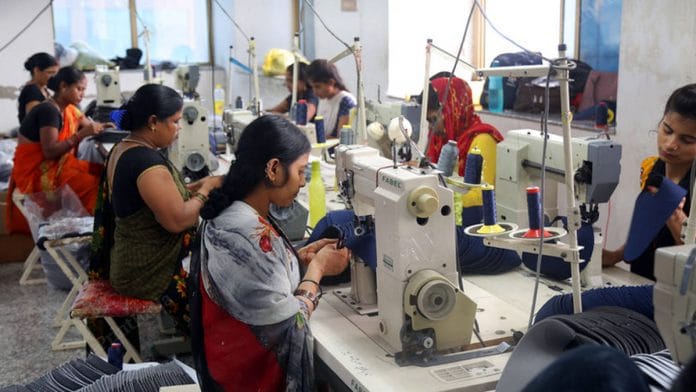

New Delhi: Only three percent of women in India have jobs in the formal sector, while 71 percent are either working in the informal sector, or are in the NEET category—Not in Employment, Education and Training—according to a new NITI Aayog report.
The report, titled “Reimagining Skilling for Viksit Bharat@2047”, flags women’s participation in the workforce as a key challenge for India’s ambition of becoming a developed country by 2047. It says the country’s skilling system needs to move away from a one-size-fits-all approach and account for the different barriers faced by learners and workers.
Women are among the groups requiring targeted interventions, the report says, while identifying access to finance, affordable training, flexible work and safe transport as areas requiring attention.
The 103-page report also highlights how women, particularly from the informal segment, face rigid skilling formats, geographic constraints, gatekeeping, and high opportunity costs. They also encounter additional barriers related to caregiving responsibilities, safety and mobility.
Structural barriers continue to exclude women and marginalised communities from formal economic participation, the report further says, adding that even after training, “the lack of flexible and dignified livelihood options prevents skills from translating into sustained economic participation”.
As a result, many women turn to small, home-based self-employment that promises flexibility, but face constraints related to autonomy, access to capital, and market linkages, the report found.
Women’s participation in the labour force is also constrained by issues relating to trust, social permission, safety, time availability, and uncertainty about employment outcomes. Even where the desire to work or upskill exists, trusted support systems are often missing, the report adds.
These findings come against the backdrop of a workforce in which self-employment and informal work remain dominant.
One of the broader findings in the report was that 79.6 crore people, or 54.9 percent of Indians, remain outside the labour force.
One of the broader findings in the report was that 79.6 crore people, or 54.9 percent of Indians, remain outside the labour force.
Recent data points to a labour force of 65.4 crore, with 58.4 percent self-employed, 21.7 percent regular wage employees and 19.8 percent casual labourers alongside 79.6 crore who remain outside the labour force. Included in this category are 29 crore students across the education system, the report states.
The report also states that, in the non-agricultural workforce, around 7 crore people are in jobs that provide at least one social security benefit, compared with 27 crore people working without any social security benefit.
Women are spread across these different segments, but their distribution points to a significant gap in access to formal employment.
Also Read: NITI Aayog flags funding crunch, shortage of young talent as hurdles to R&D in India
From training to helping women enter jobs
The report’s main argument is that the problem cannot be addressed by expanding training programmes alone.
India has significantly expanded its skilling ecosystem over the past decade, with more than 7.67 crore individuals trained since 2014-15.
The Centre’s Budget for 2025-26 also allocated Rs 34,000 crore towards skilling-related expenditure across multiple central ministries, according to the report.
However, the NITI Aayog said the outcomes of this expansion have remained uneven, requiring a broader restructuring of the system to connect learning more closely with employment and career progression.
For women, this means addressing barriers that can prevent participation even where training programmes are available.
The report specifically identifies the need for dedicated financing support for women, along with affordable and subsidised training and financing options. It also flags the importance of flexible work opportunities with safety and transport facilities.
It says that 47 percent of women, 43 percent of NEET youth, 36 percent of higher-education students, 52 percent of formal workers, 55 percent of informal workers do not pursue skills, citing a lack of awareness of the right programmes.
The findings form part of the report’s broader effort to identify barriers faced by different groups rather than treating India’s workforce as a single category.
The report divides India’s population into multiple learner and worker segments. These segments include around 29.2 crore school students, 4.4 crore students in tertiary education (including higher education and ITIs), and 8.7 crore young people in the NEET category, meaning those without jobs, education, or training.
For women, the issue is not only whether opportunities to acquire skills exist, but if those skills can translate into entry into formal work, the findings indicate.
Measures to make systems more accessible
Among the reforms proposed by NITI Aayog are several measures aimed at making the skilling system more accessible to women.
One proposal, titled “Back to School”, envisages using schools as safe spaces for women to upskill or reskill. Another proposed intervention named Surakshit Saathi involves public-private partnership-led hostels and transport for women.
The proposals reflect the report’s larger emphasis on making skilling a continuous process rather than a one-time intervention.
The proposed system includes the creation of Digital Lifelong Learning Accounts, or skill passports, for learners. These are envisaged as portable records of skills and credentials that can help people move between education, training and work.
The report also calls for greater adoption of the National Credit Framework, skills-first hiring practices and outcome-based financing for learner support.
For women who have spent periods outside the formal workforce, such a system could potentially allow re-entry through shorter courses and recognised credentials rather than requiring them to restart their education or training journey.
(Edited by Sugita Katyal)
Also Read: NITI Aayog wants India to reimagine skilling, pitches ‘skills not degree’, training from Class 6
Small issues like not having lights on the streets can hamper women employment. Do they understand that ? Little girls don’t go to school because the school is far away and their parents don’t allow them.
The issues are small but you have to solve it in a local manner because every village and city will have its own unique problem. For that you need competent bureaucrats and politicians? Do they exist ? No.
FFS change the UPSC exam. Hire people who are more smarter. Hire people who have worked in corporate. Again I am not saying all of them are bad but most of them are incompetent because people don’t work in the field they have expertise in. I am not even talking about corruption which is whole another story.