





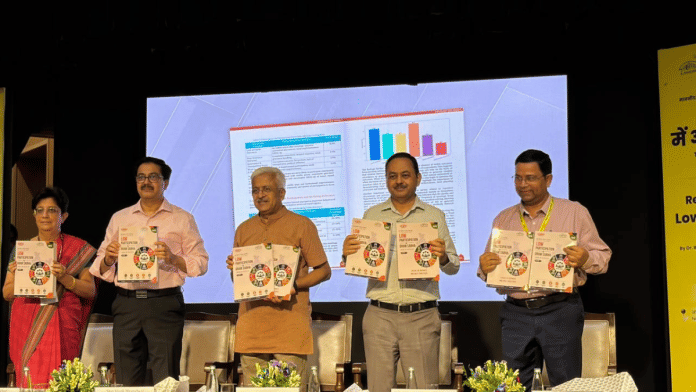


New Delhi: Livelihood and time constraints, low awareness and a lack of reasonable action on issues raised by villagers are key barriers keeping people away from Gram Sabha meetings, according to a national study released by the government Tuesday.
The report, ‘National Study on Low Participation in Gram Sabha’, prepared by the National Institute of Rural Development and Panchayati Raj (NIRDPR) for the Ministry of Panchayati Raj, surveyed nearly 7,790 respondents across 400 Gram Panchayats in 26 states and Union Territories, to understand why attendance remains low in Gram Sabhas.
A Gram Sabha is a village-level democratic body whose members resolve local issues.
The report was released in the presence of Panchayati Raj Secretary Vivek Bharadwaj and NITI Aayog Member R. Balasubramaniam.
The study found that villagers continue to value the Gram Sabha as a platform for discussing local development, welfare schemes and issues. However, participation is constrained by factors like livelihood pressures, communication issues, and lack of visible outcomes.
“Livelihood and occupational constraints emerged as the most significant participation barrier at the national level,” the report stated. It adds that many villagers cannot attend Gram Sabha meetings because they coincide with agricultural work, daily wage employment, and other livelihood-related activities.
According to the government survey, 55.5 percent of respondents cited livelihood and time constraints as a barrier to attending Gram Sabha. This is followed by 16.2 percent citing awareness and communication issues and 9.9 percent citing lack of interest for not attending Gram Sabha meetings.
The study also revealed that participation is highest when people believe Gram Sabha meetings can influence development decisions, resolve grievances and ensure visible implementation of decisions.
“Procedural meetings without follow-up action, grievance resolution or visible outcomes were found to contribute to declining public interest and reduced participation over time,” the government report said.
Active participation in Gram Sabha meetings also depends on people’s ability to express themselves freely and engage confidently. The study reveals that while the majority of people feel comfortable in meetings, a section of respondents cited hesitation to speak in discussions.
Among respondents who reported discomfort in speaking, 35.8 percent cited a lack of confidence, 17.4 percent feared authority figures and 17.2 percent said influential individuals dominated discussions. Gender discrimination and caste discrimination were also cited as barriers by 9.05 percent and 6.6 percent, respectively.
Apart from low attendance, the study highlights a decline in people’s perception of Gram Sabha meetings as capable of addressing local issues. Survey results show that 45.5 percent of respondents expressed concerns over a lack of transparency, 41.9 percent said meetings lacked visible outcomes, while 33.4 percent said discussions were becoming repetitive and a mere formality.
“The findings suggest that participation is not determined solely by awareness and attendance but is also shaped by the extent to which citizens perceive Gram Sabha meetings as meaningful, responsive and capable of addressing local concerns,” the report stated.
According to the findings, announcements through a loudspeaker or drum-beating are considered the most effective way to inform villagers about meetings, preferred by 42.9 percent of respondents. House-to-house campaigns were favoured by 17.1 percent, while 15.8 percent preferred WhatsApp groups and social media for disseminating information.
What is way forward
To improve participation, the government study recommends a series of policy measures to increase awareness, accountability and flexibility of Gram Sabha meetings.
At the national level, the study proposes launching a Gram Sabha awareness campaign through television, radio, schools, self-help groups, WhatsApp and community campaigns.
“Develop and distribute simplified Gram Sabha and citizen rights handbooks in local languages, explaining Gram Sabha powers, welfare rights, grievance systems, GPDP processes, social audit mechanisms, participation responsibilities and local democratic accountability,” the report stated.
Identifying work commitments as a major barrier, the study recommends flexible scheduling by avoiding agricultural seasons, market hours and working hours while encouraging evening and holiday meetings after consulting local communities.
It also calls for making special efforts to enhance the participation of daily wage labourers, migrant workers, women and economically vulnerable households. “Strengthen Mahila Sabha, Ward Sabha, Youth Sabha and community-based participation mechanisms for improving the inclusion of women, SC/ST communities, vulnerable groups, youth and remote habitations,” the report said.
To rebuild public trust, the study recommends mandatory action taken reports (ATRs) on Gram Sabha resolutions, public review of previous resolutions, implementation progress, and time-bound grievance redressal. It also calls for regular participation in meetings by officials from line departments dealing with health, agriculture, education and welfare schemes.
The study says that strengthening citizen participation in Gram Sabha requires moving beyond merely holding statutory meetings. “Effective Gram Sabhas are built not merely through attendance, but through informed, inclusive and meaningful citizen participation,” the report said.
(Edited by Viny Mishra)