



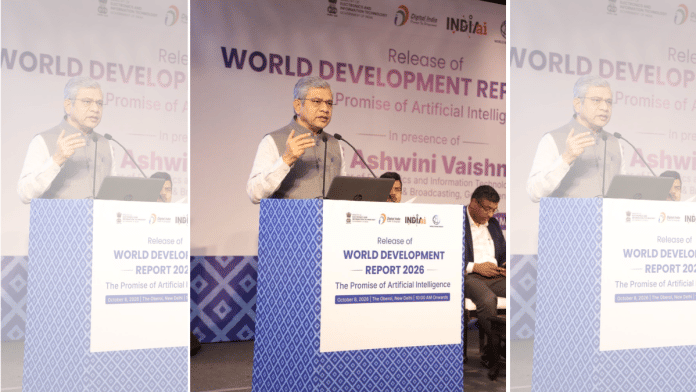
New Delhi: The Ministry of Electronics and IT (MeitY) will publish a consultation paper on regulating artificial intelligence within a month, Union Minister Ashwini Vaishnaw said Thursday.
The ministry, he said at the India launch of the World Bank’s World Development Report 2026: The Promise of Artificial Intelligence, would prepare a “regulation-focused consultation paper” built on four elements: safety, a “human-first” approach, skilling, and ensuring “no person (is) left behind”.
“In a month’s time, they should be able to publish a consultation paper. That consultation paper is probably (the) base for the regulation which has to come,” he said, signaling a shift from the government’s position of relying on existing laws and voluntary compliance.
The paper will also cover harms from deepfakes. “People believe them, and the quality of deepfakes is increasing every day… it sets a totally wrong direction that people get into, get lured into doing wrong things and believing wrong things,” Vaishnaw said, adding that harms linked to psychological disorders would be part of the paper.
Legislation, he said, alone would not be enough. “We have always maintained that AI and technologies cannot be regulated just by having a law. We have to bring a techno-legal solution. We have to have the stakeholders onboarded.”
“Bulk of the responsibility will have to be taken by the industry,” the Electronics & IT minister said, citing cybersecurity, safety and user harm.
Earlier, MeitY secretary S.Krishnan said the World Bank report advocates a sequence similar to India’s: rely on existing laws, move to voluntary compliance, and consider regulation at a later stage. “Maybe some of those times have come,” he said, adding that the minister was “on record saying that it’s time to look at regulations”.
Krishnan said measures by some governments showed regulation was already in place. “If you restrict the flow of the AI model from one country to another, if that were not regulation, I think we don’t know what would be,” he said, without naming any country.
In June, US export controls led Anthropic to suspend access to two of its models, Fable 5 and Mythos 5, for about three weeks.
The India AI Governance Guidelines, released in November 2025, chose not to propose a dedicated AI law. They leaned instead on the IT Act, the Digital Personal Data Protection Act, consumer laws and sectoral rules, with new rules only where gaps appeared.
The guidelines envisaged firms first adopting voluntary commitments, with MeitY considering mandatory requirements only if this proved inadequate over 9-12 months. At the AI Impact Summit in February, Vaishnaw had called for stronger regulation on deepfakes and said the government had begun a dialogue with industry on it.
Also Read: At India Mobile Congress, Modi calls for global framework to prevent cyberfraud, curb deepfakes
Compute & chips
On the government use of AI, Vaishnaw said the MeitY would run an empanelment process, not a tender. Empanelled firms and startups can then bid for tenders from any government department.
The ministry issued an RFP (Request for Proposal) on Wednesday for a five-year supply agreement “so that the industry can then be assured of the demand”. He put demand at 10,000 Graphics Processing Units (GPUs), with the first tender for 5,000.
Krishnan said contracts for 3,000 GPUs were issued last week. He said a term sheet signed during the Prime Minister’s UAE visit would add the equivalent of about 10,000 GPUs. The commercial terms for Condor Galaxy India were formalised during Modi’s state visit to Abu Dhabi in May. The cluster, built by Abu Dhabi’s G42, will have 64 Cerebras CS-3 systems and a capacity of 8 exaflops.
The IndiaAI Mission was approved in March 2024 with an outlay of Rs 10,372 crore over five years to build a scalable artificial intelligence ecosystem. The figures presented in the Lok Sabha in August show 93.18 lakh GPU hours sanctioned across 237 projects, with 15 compute providers empanelled.
Vaishnaw said a roadmap for Indian GPUs for inference “is visible now”, with a solution expected in three to four years. In February 2025, he had put the timeline for an Indian GPU at three to five years.
Skilling
Meanwhile, Krishnan said the ministry’s “immediate mission” is the target set by the Prime Minister on August 15. Narendra Modi had announced that one crore youth would be trained in AI skills over the next year.
Vaishnaw said an industry-drafted curriculum update has been shared with the Ministry of Education, and joint workshops will follow.
The minister went on to cite the use of AI in Baramati that raised sugarcane yield by 40 percent, cut labour costs by 20-40 percent, and used 30 percent less water and fertilisers. Farmers access it “just using a mobile phone… in Marathi,” he said.
Other examples he presented were Amul’s Sarlaben assistant, used by 36 lakh milk producers, and a startup that raised TB detection reliability by about 35 percent.
(Edited by Tony Rai)