



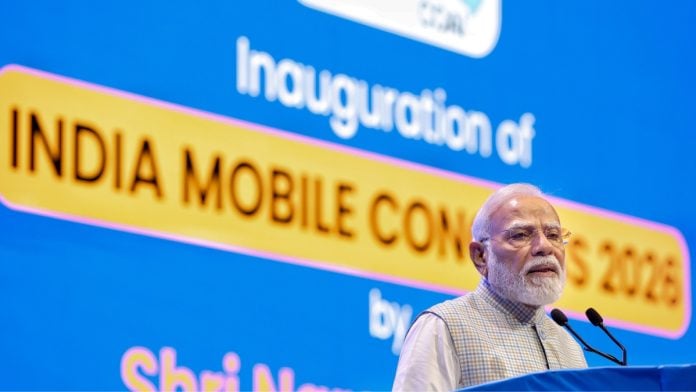
New Delhi: Prime Minister Narendra Modi on Thursday called for a global framework to tackle cyberfraud and deepfakes, saying such crimes have crossed national boundaries and require coordinated action.
He urged the Global System for Mobile Communications Association (GSMA)—which represents mobile operators worldwide—and telecom companies to set up a joint mechanism to prevent cyberfraud from reaching users.
“I urge the GSMA and telecom operators around the world: let us create a global mechanism that can prevent such fraud from reaching people in the first place. India has learned a great deal from its own experience in this direction,” Modi said while inaugurating the 10th edition of the India Mobile Congress (IMC) in New Delhi. He said governments, technology companies, telecom operators and financial institutions would all need to be part of the framework.
“A person sitting in one country can commit a crime in a third country with the help of someone in a second country. We are also witnessing how big a challenge deepfakes have become,” he added.
Over Rs 19,000 crore lost by Indians
Modi’s call comes amid rising cyberfraud in India. Data from the Indian Cyber Crime Coordination Centre (I4C) under the Ministry of Home Affairs shows that Indians lost about Rs 19,813 crore to cyberfraud in 2025, with 21.77 lakh complaints registered. Investment schemes accounted for 77 percent of the losses and digital arrest scams for 8 percent. Over six years, losses have totalled Rs 52,976 crore, with the I4C projecting that annual losses could reach Rs 1.2 lakh crore.
The cross-border nature of such crimes is reflected in I4C data. In 2025, 45 percent of complaints filed on its Citizen Financial Cyber Fraud Reporting and Management System (CFCFRMS) originated from Cambodia, Myanmar and Laos. The Ministry of External Affairs (MEA) told Parliament that 6,998 Indians were rescued from scam compounds in the three countries between 2022 and 2025. Many had been lured with job offers and forced to target people in India.
Modi had raised the issue at the International Telecommunication Union’s (ITU) World Telecommunication Standardisation Assembly (WTSA) in New Delhi in 2024, calling for global “dos and don’ts” for the digital age.
Government action
The Department of Telecommunications (DoT) runs the Sanchar Saathi platform, through which more than 4.7 crore mobile connections have been disconnected based on citizen reports, agency inputs and an artificial intelligence (AI) tool that flags SIM cards obtained using fake documents. Through its Chakshu facility, citizens reported 5,19,662 suspected fraudulent communications in 2025, up from 2,08,224 in 2024, the Rajya Sabha was informed in February.
The DoT also operates a Financial Fraud Risk Indicator (FRI), which assigns risk scores to mobile numbers. Banks can use it to block or verify transactions.
On deepfakes, the Ministry of Electronics and Information Technology (MeitY) amended the Information Technology (IT) Rules, 2021, on 10 February. AI-generated content must now carry a label and permanent metadata, while platforms must remove illegal content within three hours of a government order, down from 36 hours earlier.
Building trust
Modi also stressed the importance of building trust among users, saying technology can achieve scale only when it has gained people’s trust.
“An ordinary citizen does not think in terms of protocols or architecture. For them, trust is extremely important. When they receive a call on their phone, they should know who is calling. When they make a payment, they should have confidence that their money is safe,” he said.
He also highlighted the gains from India’s digital governance push. Modi said 5G, launched from the IMC stage in 2022, had reached every district, with more than 5.5 lakh base stations and mobile internet speeds 10 times those in 2022.
Through Direct Benefit Transfer (DBT), around Rs 50 lakh crore had been credited to beneficiaries’ bank accounts, he said, adding that about Rs 5 lakh crore “was prevented from falling into the wrong hands”.
A decade ago, the digital divide meant modern technology “was increasingly becoming a privilege”, Modi said. The Digital India campaign, telecom reforms and domestic handset manufacturing had since made phones and data more affordable, he said.
Cheaper data had also taken video platforms and regional over-the-top (OTT) services to villages and small towns, while the content creation industry was now worth “thousands of crores of rupees”, he added.
Modi also highlighted the role of telecom expansion in education and referred to the Digital Infrastructure for Knowledge Sharing (DIKSHA) platform. During the pandemic, the platform recorded more than 5 billion learning sessions up to July 2022, he said. The government aims to connect around 250 million students through its online education platforms, he added.
The IMC, organised by the DoT and the Cellular Operators Association of India (COAI), will run until Saturday under the theme ‘Scale Without Boundaries’.
(Edited by Chingkheinganbi Mayengbam)