



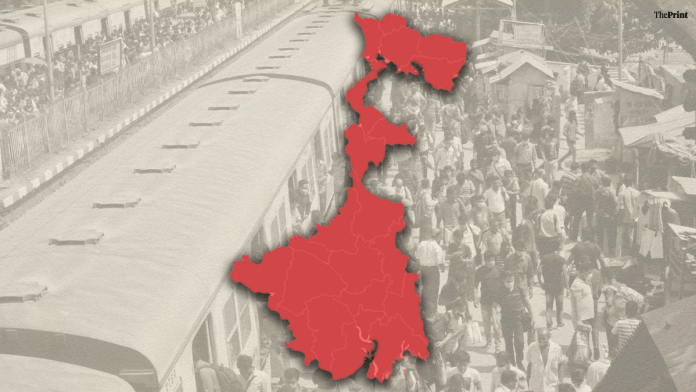
New Delhi: Should West Bengal—India’s fourth most populous state—with a total of 23 districts administering a population of more than 9 crore, have more districts?
It’s a pitch former West Bengal chief minister Mamata Banerjee made multiple times during her 15-year term, which ended last month after the Trinamool Congress’s humiliating defeat at the hands of Bharatiya Janata Party (BJP). During that period, Banerjee’s government carved out five new districts.
Alipurduar in June 2014 and Kalimpong, Jhargram, East Bardhaman and West Bardhaman in April 2017, taking the total number of districts in the state to 23. Banerjee proposed creating seven more in 2022, but it remained on paper.
Now, with a BJP-led government in the state, the pitch to carve out more districts has again gained ground. Two top state government sources have told ThePrint the Suvendu Adhikari dispensation is considering creating new districts by splitting some of the existing ones.
“In the budget, something may be announced,” a senior state government official, who did not wish to be named, told ThePrint.
The official, however, admitted that increasing the number of districts will only be beneficial if the “staffing and infrastructure are commensurately enhanced”. “Past experience is that, that has not always happened.”
The official added, “With Direct Benefit Transfer and a lot of services online, it is now not necessary for citizens to physically attend offices. Proximity of the office is therefore not as critical today as it was, say, a decade back.”
Also Read: From Maharashtra to Bengal, how India’s courts struggle to keep pace with political realities
The why
Of the 23 existing districts, seven—Hooghly, East Medinipur, West Medinipur, Murshidabad, Nadia, North 24 Parganas, and South 24 Parganas—have a population of more than 50 lakhs each, according to the Census 2011.
Eight districts—Bankura, East Bardhaman, Birbhum, Howrah, Kolkata, Malda, West Medinipur, and North Dinajpur—have a population between 30 lakh and 48 lakh.
It’s an administrative challenge to manage these huge populations. And at times, governance becomes too unwieldy due to the geographical spread of districts.
Take North 24 Parganas, for instance. With an area of 4,094 square kilometers, it is geographically huge. It has a population of over one crore. South 24 Parganas, with a total area of 9,960 sq. km. has a total population of more than 81 lakh, while Murshidabad, with a total area of 5,324 sq km, has a population of over 71 lakh.
West Medinipur, with an area of 6,308 sq km, has a population of 59 lakhs. And all these are according to the 2011 Census data. These numbers must have increased significantly over the past 15 years.
Comparing West Bengal with some of the other more populous states also puts things in context.
According to the 2011 data, with a population of around 9 crore spread across just 23 districts, West Bengal has an average of about 39.7 lakh people per district, one of the highest district-level population averages among India’s major states.
India’s most populous state, Uttar Pradesh, has about 19.98 crore people spread across its 75 districts, with an average per district population of about 26.6 lakh.
Bihar, which has a population of 10.4 crore, has 38 districts, bringing the average population per district down to around 27 lakh. Rajasthan, with a population of 6.8 crore, has 41 districts. Madhya Pradesh, with 7.2 crore people, has 55 districts, catering to roughly 13 lakh people per district. Odisha, with 4.2 crore people, has 30 districts, or about 14 lakh people per district.
Basudeb Banerjee, who was West Bengal’s chief secretary between December 2015 and June 2017, said there is a need to increase the number of districts for a very simple reason.
The ideal district size and average district population across major states in India, he said, is about 20-25 lakhs.
“That makes it viable to administer and govern during any kind of eventuality or any kind of natural calamity, or to conduct elections.”
Banerjee, who was also the state’s home secretary, said it was to tackle the geographical spread and large population that West Bengal introduced the concept of a police district, where one large district has two police districts with different jurisdictions. Each of the police districts is headed by a Superintendent of Police (SP)-rank officer.
“So basically, an existing district with one district magistrate has two SPs and two different jurisdictions,” Banerjee said.
South 24 Parganas, for instance, has three SPs with three police districts carved out.
Jawhar Sircar, a former TMC Rajya Sabha MP and a retired West Bengal cadre IAS officer, told ThePrint that historically, district boundaries in West Bengal remained unchanged for decades. “It was only towards the end of the Left Front government that North and South Dinajpur were carved out. Under Mamata Banerjee, several districts were reorganised and bifurcated,” Sircar said.
Bardhaman was split into East and West Bardhaman in April 2017. Jhargram became a separate district in April 2017. Kalimpong was carved out of Darjeeling in February 2017, while Alipurduar was created from Jalpaiguri in June 2014, Sircar added.
The financial cost
While batting for carving out more districts from the existing ones with large population, several West Bengal cadre civil servants ThePrint spoke to said that if the BJP government does increase the number of districts, it should do so after readying the infrastructure and staff requirements.
A former West Bengal chief secretary, who did not wish to be named, said that it makes sense to split large districts into two. “But the government should not do it in an ad-hoc way without providing for the requisite infrastructure. Otherwise, the whole idea will be defeated. Districts should not be carved out just to create posts for IAS and IPS,” the retired official said.
Serving and retired West Bengal cadre officers said that creating new districts will involve substantial financial and administrative costs, and that could be one of the reasons behind the previous TMC government not executing its proposal back in 2022.
In August 2022, then CM Mamata Banerjee announced the creation of seven new districts—Sundarban, Ichhamati, Ranaghat, Bishnupur, Jangipur, Berhampore and Basirhat—which would have increased the state’s total districts to 30. But the announcement was not followed by action.
According to Basudeb Banerjee, “Creating new districts will mean a lot of budgetary allocation needs to be provided.. This was probably the reason that the previous government went in for a police district, where you have two SPs and one district magistrate. And kind of decentralising the police administration.”
According to him, the state needs to carve out districts to bring the average population down to about 25 lakhs.
A serving officer said, “New districts require fresh infrastructure, administrative offices, courts, police establishments, and recruitment of personnel. All this comes with a huge cost.”
Sircar concurs, “There is certainly a case for further subdivision, but district creation must be backed by adequate administrative capacity,” he said.
Challenges galore
Having a full-fledged revenue district means that there will have to be a full-fledged judiciary, too with a district judge.
Former home secretary Banerjee said that before creating a new revenue district, the state government will need clearance from the high court.
“Politicians want fast action, but it takes time on the ground. The high court, for instance, will agree once the state commits to increasing the strength of judicial officers,” he said.
He added, “They (judiciary) are very insistent about the basic infrastructure. It’s not just an administrative matter to have a district set up. A revenue district also means you will have a district judge, an additional district judge…. They will need the requisite infrastructure. It’s not so easily done. There is a monetary angle to it, and there is also infrastructure building and getting clearance.”
Other officials said the creation of new districts will also require recruiting more officers and increasing the allotment of IAS and IPS officers to the state cadre.
“You don’t need to increase the cadre strength because there are still a number of vacancies. Our total cadre strength is around 250-300. But we are short of that. So you don’t need to increase the strength but perhaps increase the allotment of officers to thë cadre. That may need to go up,” a senior state government official, who did not want to be named, said.
The total IAS cadre strength of West Bengal is 378. As of now, there is a shortage of 75 IAS officers in the state cadre.
Banerjee said a state like West Bengal now has 10-12 IAS officers coming to the state cadre. “We have sufficient officers. Every year, between 7-10 officers are getting into the cadre.”
What is required, though, is recruiting more junior-level staff.
“The post of district magistrates can be even filled up with state civil services officers, as is being done in Uttar Pradesh. The real issue is low-level staff. Because recruitment of clerks and other staff, that has kind of tapered off. You need support staff. That aspect is more important than the top state civil service and IAS/IPS,” Banerjee said.
Cadre management
Sircar said that as of now, the limited number of districts also affects career progression for officers, primarily those in the IAS.
“For eight years, I was an Additional District Magistrate while my counterparts in other states had already become DMs. The difference was that they were looking at fairly smaller districts, and I was the ADM of a much larger district with a much bigger population,” he said.
Cadre planning is what is needed, he added. “We do not have enough IAS and IPS officers even for the existing 23 districts. Many posts remain vacant, and state service officers are often appointed as SPs.”
The state has struggled with cadre management in the past, Sircar said. “This was the reason why officers were often not allowed to leave the state on deputation or after promotion because there simply weren’t enough officers available. West Bengal needed them,” he said.
Political considerations also influence district reorganisation.
According to Sircar, the bifurcation of Medinipur in 2002 reduced the geographical influence of local political strongmen by confining their power bases, and that often becomes an issue.
However, he said that district creation requires strong local demand. “You don’t see large public agitations demanding new districts,” he said.
(Edited by Ajeet Tiwari)
Also Read: BJP Bengal win dissolves the old Bhadralok order. It kept Dalits and their issues out