



Chandigarh: Every monsoon, Gurugram’s roads turn into rivers. Offices are shut, cars left stranded and commuters are forced to wade through waterlogged streets to get home. Garbage piles up and the traffic never eases.
Now, the Haryana government wants to look at Stockholm for solutions.
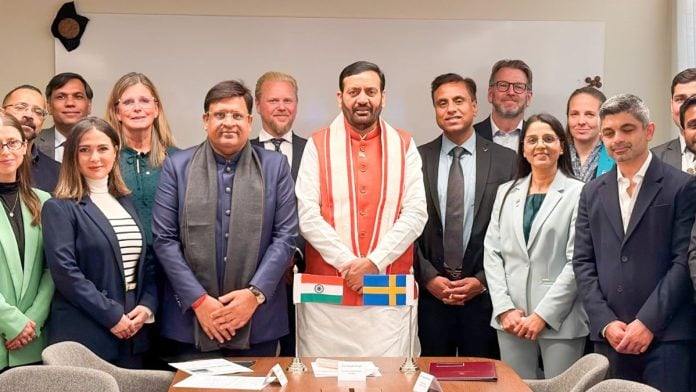
According to an agreement signed during Chief Minister Nayab Singh Saini’s visit to Sweden from 14 to 17 October, Gurugram has become a sister city of the Swedish capital. Urban Local Bodies Minister Vipul Goel, who was part of the delegation, told ThePrint that the state wants to use the partnership to improve the way Gurugram is further developed.
This is the first time an Indian city has got a European sister city, he said, adding that the tie-up would make Gurugram “cosmopolitan in the true sense”, given its large expatriate community and its standing as an investment hub. The government, he said, is working to give the city the look and feel of a European city.
The sister city concept
A sister city, or twin city, pact is a formal link between two cities in different countries. It is meant to build ties in terms of culture, trade, education and governance. The idea took hold after World War II, when cities in Europe and the US began pairing up to promote friendship and understanding across borders.
Such agreements usually involve exchange visits, sharing of technical know-how and joint projects on subjects both cities care about, such as urban planning, waste management or tourism. They are generally not treaties, and carry no legal or financial obligations. What comes out of them depends on how seriously the two cities follow up.
What the pact covers
Under the agreement, Goel said, Gurugram and Stockholm will cooperate on technological innovation, ‘Smart City’ solutions, sustainable urban development, knowledge exchange and investment promotion. The aim, he said, is a long-term partnership between the two cities.
He said waterlogging, drainage, garbage disposal and traffic congestion are the likeliest areas of cooperation. These are the problems Gurugram residents face every year.
Goel said Stockholm is widely seen as a global model for sustainable urban planning, and that several of its practices relate directly to Gurugram’s civic problems.
CM’s pitch
On 15 October, Saini participated in the India-Sweden Round Table Conference on Sustainable Urban Development in Stockholm.
He posted on X that the talks covered smart mobility, water conservation and green energy, and that Swedish companies were invited to explore investment and technology partnerships in Haryana.
“Drawing inspiration from sustainable urban models such as Hammarby Sjöstad and Western Harbour, Haryana aims to leverage Sweden’s expertise to accelerate the development of smart and green cities,” Saini wrote.
आज स्वीडन दौरे के दौरान स्टॉकहोम में भारत-स्वीडन सतत शहरी विकास राउंड टेबल कॉन्फ्रेंस में स्मार्ट मोबिलिटी, जल संरक्षण और हरित ऊर्जा के क्षेत्र में सहयोग की संभावनाओं पर चर्चा की। स्वीडिश कंपनियों को हरियाणा में निवेश और तकनीकी साझेदारी के लिए आमंत्रित किया।
आदरणीय प्रधानमंत्री… pic.twitter.com/qUwKAvuhyu
— Nayab Saini (@NayabSainiBJP) October 15, 2026
He also highlighted Haryana’s plans for 10 new Industrial Model Townships, Gurugram Global City, and five new cities along the KMP Expressway. He said that there was scope for Swedish companies to expand urban facilities in Karnal, Faridabad, Gurugram and Panchkula.
The Stockholm model
ThePrint looked at key documents on the Swedish model shared by a senior Haryana government officer, including a study of Hammarby Sjöstad—a Stockholm district built on a former industrial harbour—and material on Viable Cities, a Swedish programme that aims for climate-neutral cities by 2030.
The officer explained that the state has begun studying how Stockholm plans its neighbourhoods, adding that the documents show how the district handles water, waste and transport.
In Hammarby Sjöstad, stormwater is kept out of the sewage system. Rain from streets is filtered through sand and released into a lake. Water from houses and gardens flows through open drains and basins first. Roofs are covered with sedum plants that soak up rain.
Waste goes into separate chutes and travels through underground vacuum pipes to a central station, so garbage trucks do not enter the district. Organic waste and sludge produce biogas, which fuels buses and cars. The study says only five percent of trips in the district are made by private car.
Goel said Stockholm links energy, water and waste in a closed loop, adding that its heating network recovers waste heat from sources, such as data centres and supermarkets, and feeds it back to the grid.
Funding & limits
The visit also produced Letters of Intent worth Rs 4,000 crore between the Haryana government and Swedish companies, Goel said. These include one worth Rs 3,000 crore, and another one worth Rs 1,000 crore, for the retail and warehousing sectors.
The minister said Gurugram, the state’s main corporate and investment hub, is expected to benefit.
He said how much of the Stockholm model can be used in Gurugram will depend on funding, and on whether the Municipal Corporation of Gurugram and the Gurugram Metropolitan Development Authority take up pilot projects.
Hammarby Sjöstad was built on a cleared industrial site. Gurugram is an old and fast-growing city.
Also Read: Tale of 2 CMs: Saini travels, Mann goes to court after Centre blocks Paris trip over ‘security’