



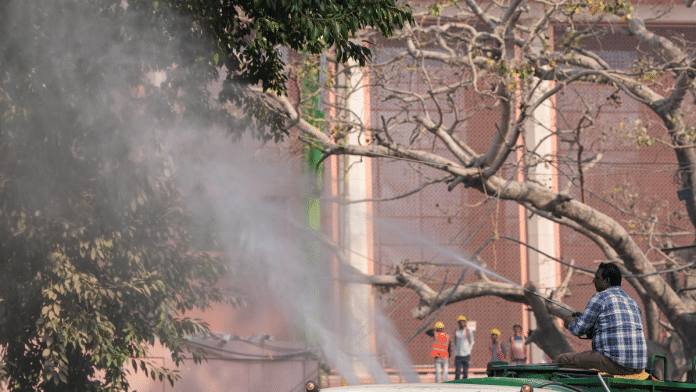
New Delhi: With air pollution scaling hazardous levels in Delhi NCR, central government employees have urged the government to allow work from home, stagger office hours among staff, and promote digital workflow for routine processes.
The Central Secretariat Service (CSS) Forum, in a letter to the secretary of the Department of Personnel and Training (DoPT) Tuesday, said, “At present, with toxic air quality and severe pollution levels in Delhi, thousands of employees commuting daily to the Central Secretariat are experiencing additional health stress.”
The Forum, which represents administrative officials, said in the letter that in the absence of staggered work timings, employees end up getting stuck in traffic jams during rush hours, further exposing them to pollution.
“The uniform office timings are leading to severe traffic congestion—especially around central Delhi and metro stations—forcing employees to spend prolonged periods in polluted air,” the letter said, adding that adverse health impacts will only add to CGHS burden.
Government employees are entitled to CGHS, Central Government Health Scheme, under which medical treatments are free of cost or reimbursed.
Citing this possibility, the Forum asked the government to consider allowing work from home for at least 30-40 percent of the staff.
“Offices that are already equipped with Digital India infrastructure may be allowed to implement partial WFH without compromising efficiency. This will significantly reduce traffic congestion, lower exposure to polluted air, and save infrastructure-related operational costs, while maintaining work output,” the letter said.
Similarly, the Forum suggested staggered office timings. “A minimum two-hour variation in reporting time may be introduced. Currently, lakhs of employees utilise the same metro lines during peak hours, resulting in long queues and extended exposure to polluted air,” it said.
The Commission for Air Quality Management (CAQM), as part of Graded Response Action Plan (GRAP), issued an advisory earlier this week, asking all government and private organisations to implement staggered work hours and work from home for at least half of their staff.
Subsequently, the Delhi government issued a notice that said senior officials in departments have been asked to ensure that half of their workforce is allowed WFH.
Air quality through most of November has been ‘very poor’ or ‘severe’, with doctors recommending people to avoid long-term exposure as far as possible.
On Tuesday, the Forum also requested the government to encourage adoption of digital file processing, virtual meetings and online workflow management – measures that it said will ensure that work would remain unaffected even if employees operate from different locations. “The success of such digital functioning was clearly demonstrated during the Covid-19 period, where most non-sensitive and non-urgent work continued seamlessly from home,” it said.
A CSS officer told ThePrint that they are seeing “unprecedented” number of cases of people feeling unwell and complaining of respiratory issues.
“This is as big an emergency as Covid-19, and we should mobilise the digital infrastructure we have created to ease out the stress on employees,” the officer said.
“We cannot say we are ‘Digital India’ when employees cannot be given WFH in this hazardous environment,” he added.