





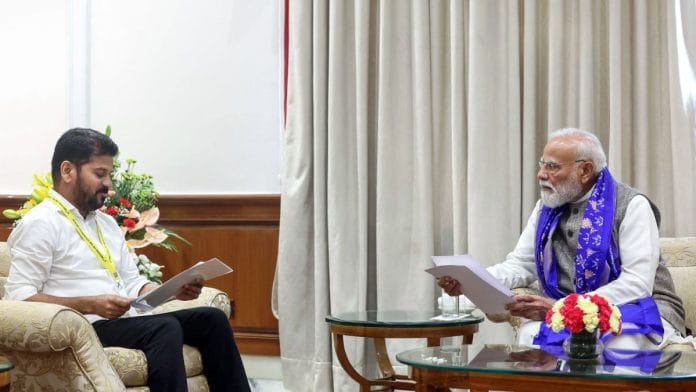


Hyderabad: Telangana Chief Minister A. Revanth Reddy presented key insights of the Social, Economic, Educational, Employment, Political, and Caste (SEEEPC) survey conducted by the Telangana government in 2024 at the 11th NITI Aayog Governing Council meeting in New Delhi Thursday.
Highlighting the survey’s successful completion, he said that Telangana’s economic development plan would be centred on the results, which are based on data from 3.55 crore people across 242 castes.
Reddy emphasised that the goal of ‘Viksit Bharat’ can be achieved only by providing quality education to every citizen. “Good quality education and healthcare constitute the strong foundation for the country’s development, and these services should be available to every student and citizen of the country,” he said at the meeting chaired by Prime Minister Narendra Modi at the Rashtrapati Bhavan.
As he outlined Telangana’s development model, formulated following the caste census, the CM said that he retained the education portfolio in the cabinet with himself because of his deep faith in the power of education. He also acknowledged that while efforts had been made over the past 75 years to provide free education, delivering quality education remained a challenge.
To remedy past challenges, he highlighted how Telangana’s public schools currently offer English-medium instruction, digital classrooms, free breakfast, mid-day meals, evening snacks, school buses, sports facilities, and quality teaching. The concept of ‘Young India Schools’ being established by his government in every constituency would break down the barriers between castes by fostering equality, he said.
In his address, Reddy also presented the ‘Telangana Rising’ vision, where the government aims to transform Telangana into a one-trillion-dollar economy by 2034, and a three-trillion-dollar economic powerhouse by 2047.
With Hyderabad becoming the hub for Global Capability Centres (GCCs), the CM proposed the formation of an ‘M-6 Task Force’ under the Prime Minister’s Office to drive development of six key cities—Delhi, Mumbai, Kolkata, Chennai, Hyderabad, and Bengaluru—which serve as major engines of the nation’s economic growth. He requested a special fund of Rs 6 lakh crore for the development of these cities, specifically asking for an allocation of Rs 1 lakh crore per city for infrastructure development.
Reddy put forward several proposals seeking Centre’s cooperation for Telangana’s development, including the Regional Ring Road, second-phase expansion of the Hyderabad Metro, rejuvenation of the Musi River, development of ‘Bharat Future City’, clearances for Palamuru-Rangareddy Lift Irrigation Scheme, setting up semiconductor industries, and establishment of an IIM in Hyderabad.
Also Read: India moves to diversify pharma exports & cut US market dependence, eyes $130 billion target by 2030