



New Delhi: The world is closer to gender-parity than ever since the World Economic Forum (WEF) started measuring the global gender gap in 2006, but complete parity is still 120 years away.
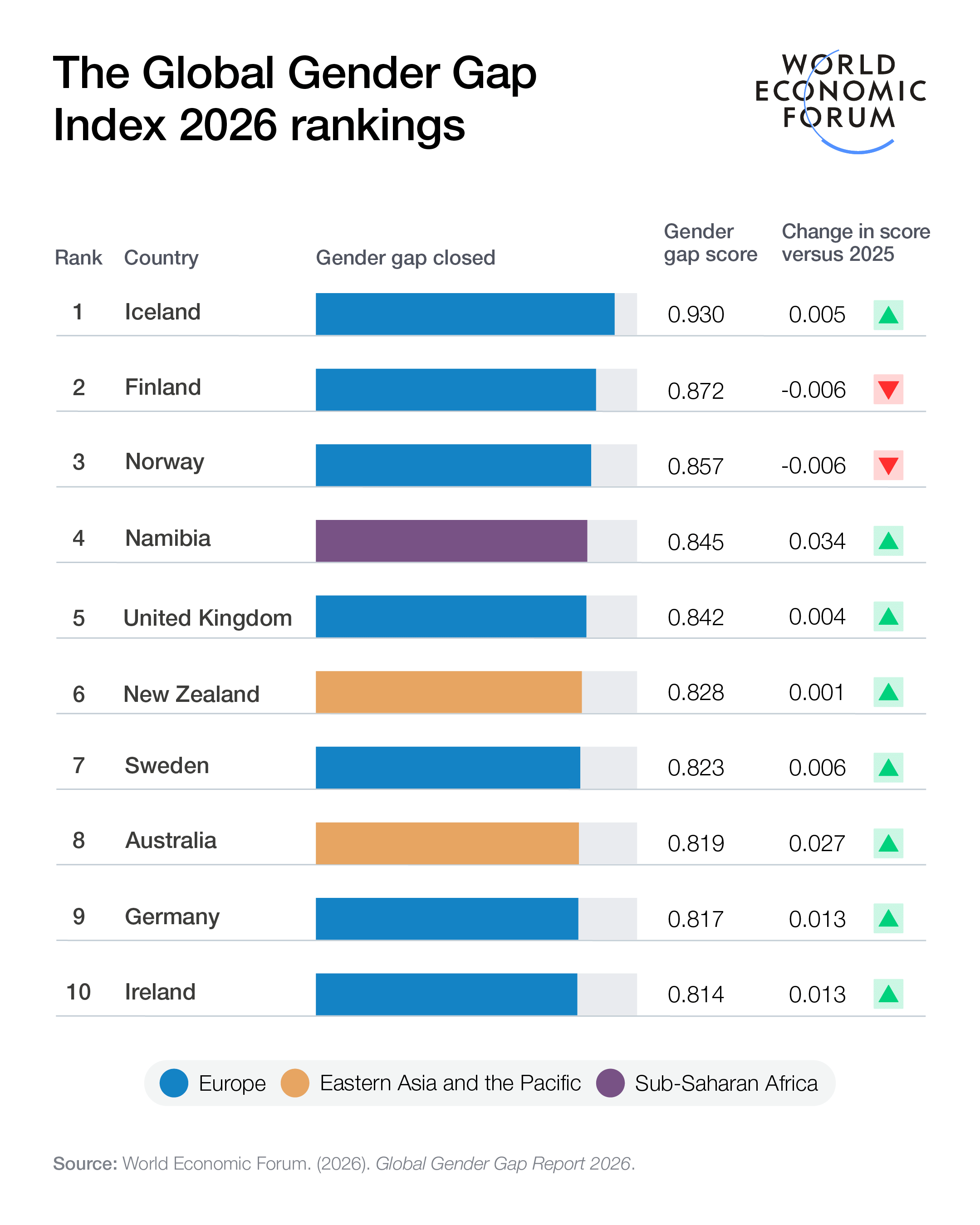
The Global Gender Gap Report 2026, released Wednesday, covers 145 countries. Iceland is still the world’s number one, with 93 percent of its gender gap closed. India stands at 131st spot, with 64.5 percent.
The WEF uses ‘gender gap’ as a composite statistical measure. It measures the relative difference between women and men across four areas— economic participation and opportunity, educational attainment, health and survival, and political empowerment.
For each indicator, the WEF compares outcomes for women with those for men. A 100 percent score would mean gender-parity has been achieved. A score of 70 percent means women, on average for that measure, women are at 70 percent of the corresponding male outcome. A 100 percent would mean complete parity.
Finland and Norway follow with 87.2 percent and 85.7 percent respectively. Namibia is fourth with 84.5 percent, followed by the UK, New Zealand, Sweden, Australia, Germany and Ireland. Australia cracked the top 10 for the first time.
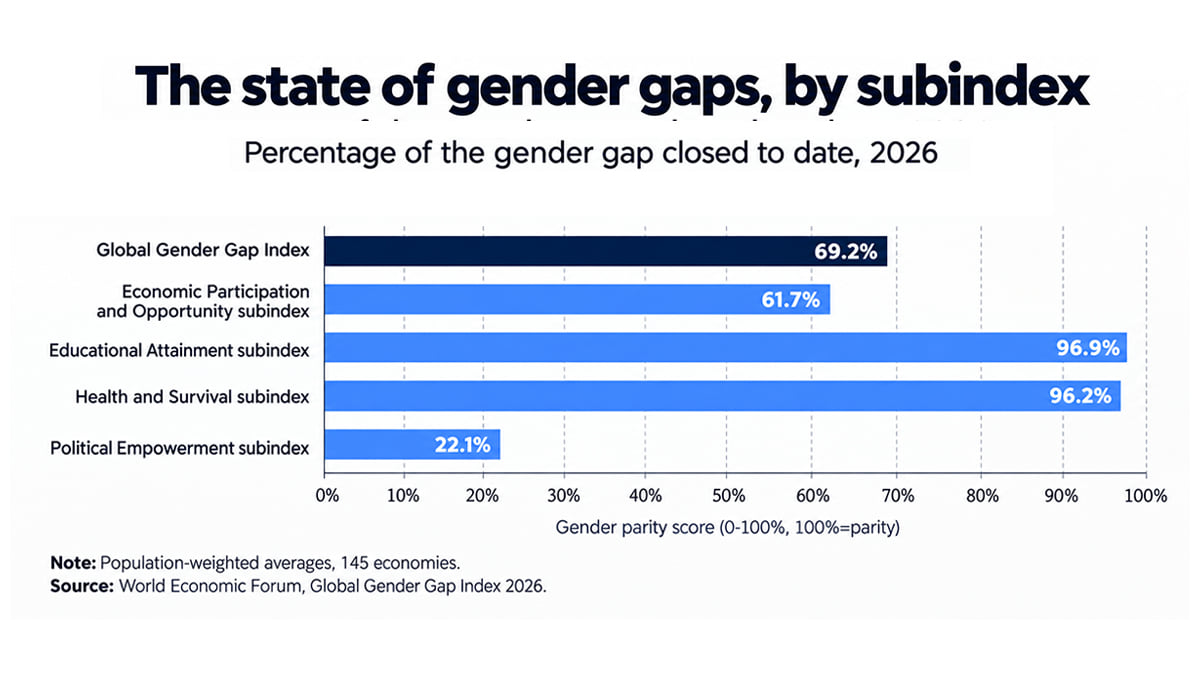
According to the 2026 report, across the four dimensions, the world has achieved 69.2 percent parity, a slight increase from 68.8 percent in 2025.
But if the 97 economies tracked consistently since 2006 continue to progress at their historical pace, full gender parity is still 120 years away, the report says.
“Twenty years after the World Economic Forum first measured the global gender gap, the world is closer to parity than ever, but progress is fragile, with gains reversing in some areas,” the WEF said in a media brief.
World Economic Forum Managing Director Saadia Zahidi said twenty years of data show that gender parity is achievable. “Economies at every income level have made progress, so the barrier is not a lack of resources.”
“Parity is a foundation for growth and competitiveness, but it is not inevitable. To accelerate, governments and employers need to learn from the policies that work and apply them faster. A new economy demands a new approach to talent,” she said.
Across the 143 economies covered in both the 2025 and 2026 editions, the overall score increased by 0.4 percentage points. Education recorded the largest increase year on year, rising from 95.3 percent to 96.9 percent.
Economic participation score increased from 61.3 percent to 61.7 percent and health and survival improved from 96.1 percent to 96.2 percent. Political empowerment, however, moved in the opposite direction, sliding down from 22.5 percent to 22.1 percent.
Also read: Andhra’s gender equality & inclusion push in classrooms—girls playing football, woman bus conductor
Where does India stand
India has closed 64.5 percent of its gender gap and is ranked 131st out of 145 economies. Since 2006, its overall score has risen by 4.3 percentage points, with education accounting for much of the long-term progress.
But India’s economic participation score is still low at 41.2 percent. It climbed only 0.5 percentage points from last year, and remains 3.5 percentage points below its 2013 all-time high of 44.6 percent. More broadly, the report observes that changes in India’s economic parity score have stalled over the past two decades to just 1.5 percentage points.
The employment indicators reflected improvements. The share of professional and technical workers at parity almost doubled from 26.6 percent in 2006 to 49.9 percent in 2026.
But women make only about 13.1 percent of the total legislators, senior officials and managers, though that is up 10 percentage points since 2006. “Labour-force participation parity at 44.1 percent”.
India’s education report card remains most positive with a parity score of 96.6 percent. There is full parity in secondary and tertiary enrolment, and adult literacy parity is 82.5 percent. Parity in health and survival also improved to 95.6 percent.
For India, political empowerment is the highest-ranked sub-index at 67th, but the gap remains wide. India has closed 24.5 per cent of its political gender gap, reaching about one-fourth of gender parity on the WEF index. Parliamentary parity is 16.1 percent (women hold 16 seats per 100 seats held by women) and ministerial parity is 5.9 percent, below the high of 30 percent in 2019.
The task
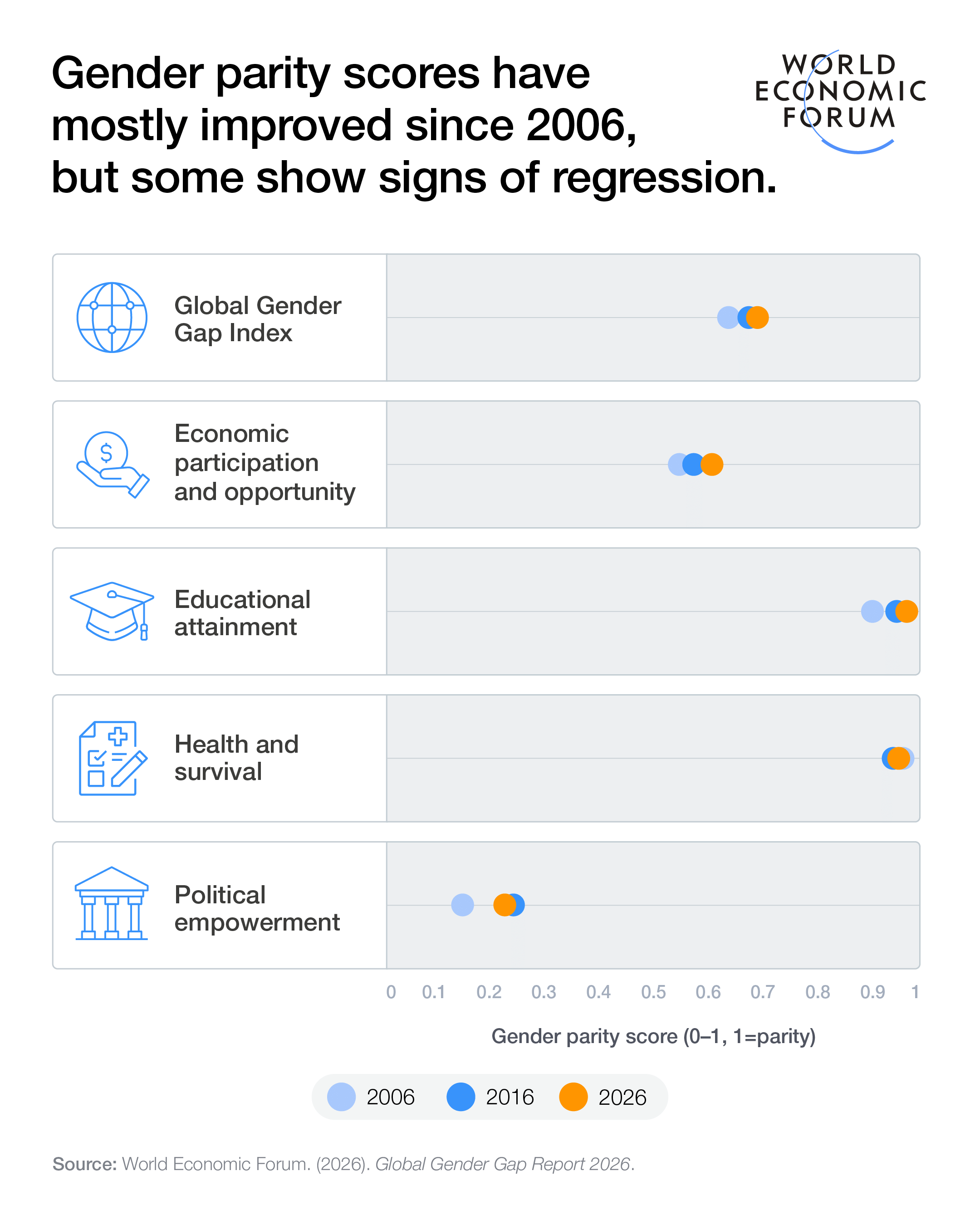
According to the report, the overall world score has improved on core measures over two decades, but if progress continues at historical pace the remaining gap would take about 120 years to close.
The picture is more mixed in the longer run. Among the 97 economies tracked continuously since 2006, the overall parity score increased from 64.2 percent to 69.4 percent—a rise of 5.2 percentage-points and the highest level recorded for this group.
But political empowerment, while showing the most improvement over 20 years, is still the dimension with the biggest gap. At the current rate, political parity will take 194 years to achieve, according to the WEF.
There are more women in senior business and government positions today than in 2006, but they remain under-represented in posts with the highest economic and political influence, says the report.
Women occupy 19.1 percent of CEO positions, and about a quarter of chief financial officer and chief operating officer positions, according to the WEF. In politics, only one in 10 ministerial portfolios held by women is a high influence portfolio.
In today’s AI race, fewer than one in five AI engineers are women.
The patchy progress is reflected in the regional rankings as well. Europe came in first in 2026 as a region, having closed 75.7 percent of its gender gap, followed by Northern America (75.2 percent and Latin America and the Caribbean (74.5%). Southern Asia bridged 64.5 percent of its gap.
(Edited by Ajeet Tiwari)
Also read: General’s letter on women officers was flawed, not ‘patriarchal’. There was truth to it
Stop looking around for validation from the world.
What’s wrong with Indians nowadays? All they do is look around and shed tears on how the world looks at them or rates them.
It look like we Indians are desperately on the prowl for the white man’s validation.