


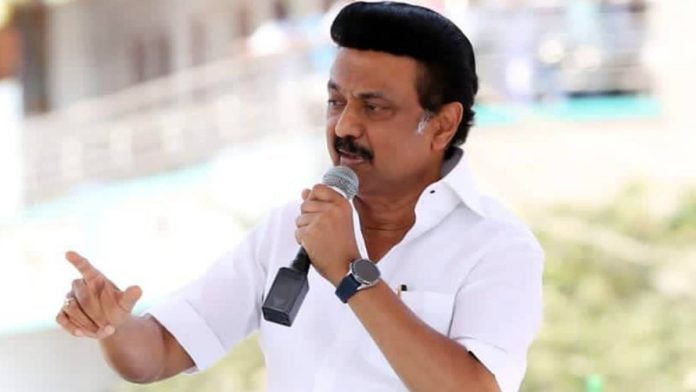
Chennai: The Dravida Munnetra Kazhagam (DMK) parliamentary members’ meeting, held under the chairmanship of party president M.K. Stalin Saturday, unanimously adopted a strong resolution opposing any reduction in Tamil Nadu’s representation in Parliament.
The DMK’s all MP meeting condemned the recent attempts by the Congress party to dilute the firm stand against any reduction in Tamil Nadu’s current 7.18 percent share of representation in Parliament. It described the shift from “Fair Delimitation” to “No Delimitation” as an opportunistic U-turn that would harm the interests of the southern states.
The resolution reaffirmed the party’s long-standing position that the freeze on the number of Lok Sabha and Rajya Sabha seats based on the 1971 Census must be extended. The meeting noted that the Dravidian movement has always been at the forefront of protecting state rights. The party recalled that Periyar, Anna and Kalaignar had always opposed any attempt to alter the federal structure in a manner that would harm the southern states.
With criticism of the DMK softening its stance on the issue, the party clarified that the demand for “Fair Delimitation” has been consistent since the beginning of the Dravidian movement and was reiterated in the Joint Action Committee as well. However, Congress termed the DMK’s “u-turn” laughable to the people of Tamil Nadu.
Accusations of change of stance
After the 2026 elections, Congress attacked the DMK, claiming its language had softened and that the DMK had betrayed the people of Tamil Nadu by supporting the BJP’s attempt to silence the voices of the State. The former DMK allies CPI, CPI(M) and VCK are already unhappy and even called the decision shocking.
“The DMK is a sensible political party, a time-tested political party. What can I say about them? If this Bill gets passed, then even the Constitution won’t survive later on. That’s why the DMK should think and act. This is our demand, our appeal to the DMK people,” CPI MP P. Santosh Kumar told the media.
The CPI(M), which has remained critical of the TVK government despite extending outside support, is also unhappy with the DMK’s backing of delimitation. CPI(M) state secretary P Shanmugam sought clarification from Stalin on the basis for the DMK’s support to the BJP’s delimitation exercise. “What assurance has the Centre given that Tamil Nadu’s share of parliamentary representation will not be reduced?” he asked.
VCK Chief Thirumaavalavan said that he finds DMK’s stand on delimitation more shocking than the Deepam verdict and also warned that the party’s position could have consequences far beyond Tamil Nadu. The critics have expressed disappointment over the support to the bill.
Congress MP Shashi Tharoor said that accepting a mere proportional increase is a “specious” argument that plays into a larger agenda of shifting the balance of power northward. Using a corporate analogy, Tharoor noted that a 50 percent raise for both a managing director and a driver still leaves the former far richer in absolute terms. He described the reported DMK position as an “abdication of responsibility” to the people the party claims to represent.
DMK’s defence
However, DMK has defended its stance. DMK spokesperson Saravanan Annadurai stated on X that a complete freeze, the so-called “no delimitation” position, would itself be disastrous. He said that if the exercise is not carried out now, the 84th Constitutional Amendment would force the use of the 2011 Census as the base for the next delimitation, potentially locking Tamil Nadu into a greater relative disadvantage for decades. “No Delimitation scenario will be totally disastrous to the State of Tamil Nadu,” Annadurai said, questioning why critics of the current process remained silent on this risk.
DMK leaders maintain that the core demand has never changed and Tamil Nadu must not be punished for controlling its population and advancing socio-economic development.
“We never said ‘No Delimitation’; we only asked for ‘Fair Delimitation’. It was Congress leader Venugopal’s demand that there should be universal 50 percent increase, and now that is being accepted. We said that if the government was going to undertake Delimitation based on the population, we will oppose it. Therefore, the BJP has conceded to the demands of DMK now and we are now supporting fair Delimitation,” State Deputy Secretary, DMK Media relations SAS Hafeezullah told ThePrint.
DMK’s stance against Delimitation from 2024 to now
The DMK Assembly resolution of 14 February 2024 already stated that if the number of seats in the Assembly and Parliament is to be increased based on population, the inter-state ratio of seats from the 1971 Census must be maintained in both State Assemblies and both Houses of Parliament.
Stalin had described the impending exercise as “a sword hanging over the head of Tamil Nadu” and a conspiracy to reduce the political voice of southern states that had successfully controlled population growth. The resolution, which also warned against penalising Tamil Nadu for its socio-economic development and welfare schemes over five decades, was adopted.
The resolution emphasised that Tamil Nadu and other southern states that successfully implemented population control measures should not be penalised. It pointed out that the legislative intent behind the 42nd, 84th and 87th Constitutional Amendments was to protect and incentivise states that had effectively controlled population growth, and that the goal of national population stabilisation has not yet been achieved. Therefore, the freeze on parliamentary constituencies based on the 1971 Census should be extended by another 25 years.
The meeting recalled the all-party meeting convened by the Tamil Nadu government on 25 February 2025 and the subsequent all-party meeting held on 5 March 2025, in which leaders of all parties in the state participated and expressed their views.
The resolutions called for extending the 1971 Census-based freeze for another 25 to 30 years, ensuring that Tamil Nadu’s 7.18 percent share of Lok Sabha seats is not reduced under any circumstances, and treating any expansion of the House as an opportunity for proportional increase rather than a relative loss.
The resolution also noted the letter written by then Chief Minister and DMK president M.K. Stalin on 7 March 2025 to the Chief Ministers of the seven States that would be affected by delimitation, as well as to political party leaders. A Joint Action Committee of southern parties was formed, and the DMK continued to mobilise opinion through 2025 and early 2026. Stalin repeatedly called population-based delimitation a conspiracy to throttle southern voices and vowed to fight it at any cost.
The resolution made it clear that the DMK’s stand remains unchanged, and any delimitation exercise undertaken by the Union government to improve the content and character of democracy must be carried out transparently, and Tamil Nadu’s present share of representation must not be reduced on any account.
Ahead of the 2026 assembly elections, when the Delimitation bill was introduced for the first time, DMK leaders organised black flag protests and publicly burned copies of the proposed legislation. Stalin had also released a video statement describing it as a stern final warning to the Modi government against pushing the Constitutional amendment on delimitation. He said any move that harms Tamil Nadu or disproportionately benefits northern states would lead to a massive statewide agitation, with every family “taking to the streets”.
Stalin pointed to Tamil Nadu’s compliance with the family planning measures promoted by the Centre in the past. He asked, “When the Union government urged people to control population growth, to have smaller families and follow family planning measures, Tamil Nadu complied, is this now the punishment for having followed those instructions with discipline?”
The DMK also accused the Centre of acting unilaterally without consulting the states, ignoring appeals from southern states, and undermining federalism. Stalin vowed to lead protests in the spirit of the DMK’s historic self-respect and anti-Hindi movements of the 1950s and 1960s, calling it a fight for principles and state rights rather than electoral power.
However, in April 2026, the government’s Constitution (131st Amendment) Bill and related delimitation proposals failed to get the required two-thirds majority in Parliament. In response, DMK leaders, including MP P. Wilson, introduced a private member’s bill to implement women’s reservation immediately within the existing 543 Lok Sabha seats, without linking it to delimitation or a new Census. DMK MPs like Kanimozhi strongly criticised the linking of the two issues, calling it a trap and an assault on the federal structure.
Also Read: How 4 national delimitation exercises since Independence impacted ruling party’s electoral fortune
History with the BJP
The softening of DMK’s stance against the BJP on the issue has a more complex past. In the late 1990s the party was a key partner in Atal Bihari Vajpayee’s National Democratic Alliance. After the AIADMK withdrew support and brought down the Vajpayee government in 1999, the DMK stepped into the vacuum. It contested the 1999 elections as part of the NDA, won seats, and held important portfolios, including Commerce under Murasoli Maran and Petroleum and Natural Gas under T.R. Baalu.
At the time, the coalition arithmetic with the BJP made the partnership workable for the DMK. The relationship lasted until late 2003, when the DMK walked out of the NDA, though it continued to offer issue-based support for a period. After switching to the Congress-led UPA in 2004, and particularly after Narendra Modi became Prime Minister in 2014, the ideological and political distance grew sharply.
The DMK has since framed the BJP as a threat to federalism, secularism and Tamil identity, especially regarding the imposition of the Hindi language. This criticism of BJP was far less prominent during the Vajpayee government. After being on crossroads with the BJP for more than 10 years, the stance of the DMK has even led to speculations of a DMK-BJP alliance in the future.
Political calculations and TVK
Political observers agree to the softened stance but call an alliance self-harm to DMK and that it would never do anything to lose the domestic political momentum. Moreover, DMK leader Thangam Thennarasu, while talking to the media, on Saturday stated that DMK will not go for alliance with BJP.
Academician and political commentator Ramu Manivannan says that now that the DMK is not with the India Alliance, and the support to Delimitation is more of a move to get back to Congress.
“The demand for a 50 percent increase in seats has not been unilateral. The DMK-BJP talks on these issues within the two parties have been ongoing for quite some time but DMK is looking at what benefits their political strategy. They do not seem to be in any mood of reconciliation or dialogue with the Congress, this gives room for TVK and Congress to attack the DMK over the Delimitation issue. The DMK might say that they are at equidistant from the NDA alliance as it is from the Congress because DMK will not walk into the alliance just because it is debating the Delimitation Bill,” he told ThePrint.
Talking about TVK using the opportunity to attack DMK over the issue, he said that TVK does not seem to be in a position to question the ideologies of DMK when it itself does not seem to have a clarity on the ideologies and policies. “Given there are a few more years to the elections, TVK’s position can only get clearer in the coming days,” he added.
Political observers say that the narrative of the DMK softening on Delimitation, especially by Congress, will be countered by repeating that there is no change in its position.
“The DMK knows that softening on this issue will draw criticism, this is why it has repeatedly communicated that its stance has not changed. The anti-BJP sentiment helped DMK’s vote bank earlier and they had no national ambitions. However, after the 2026 elections, the DMK has seen TVK repeating its stances on major political and State issues, shifting the dynamic from DMK versus BJP to TVK versus BJP. In such a scenario, the DMK is left with no option but to ensure that it remains politically relevant,” says political analyst Sri Kumar Kannan.
He says that since TVK has no say in the case of Delimitation, the DMK wants to sail with the Centre. “There are so many issues keeping TVK in conflict with the Center, and this is the time the DMK would like to use the opportunity to utilise its capacity to stay relevant,” he added.
TVK would also not miss to attack the opposition on Delimitation while it currently has no power to support or oppose the bill.
Within Tamil Nadu, the ruling TVK has accused the DMK of backing the Centre. With the DMK now in opposition, any perceived accommodation with the BJP-led Union government can be portrayed by rivals such as TVK as a betrayal of Dravidian principles for short-term advantage, whether to secure Central support against the state government or to protect the party’s 22 Lok Sabha seats. However, observers say that DMK has multiple justifications.
“With the increase in seats, the DMK is justifying that its demands for fair Delimitation have been met and that the BJP has bowed down to its demands. In the future as well, the DMK would defend its stance that they have not only safeguarded seats not only for Tamil Nadu but for other states as well. Even the left parties are likely to back the DMK in such circumstances, given the State rights and the demands for an increase of seats and a freeze for 25-30 years,” says political analyst Sunil Kumar.
(Edited by Anupama Yadav)
Also Read: Delimitation Bill: Modi govt just a whisker away from 2/3 majority in Lok Sabha, 3 parties hold key