



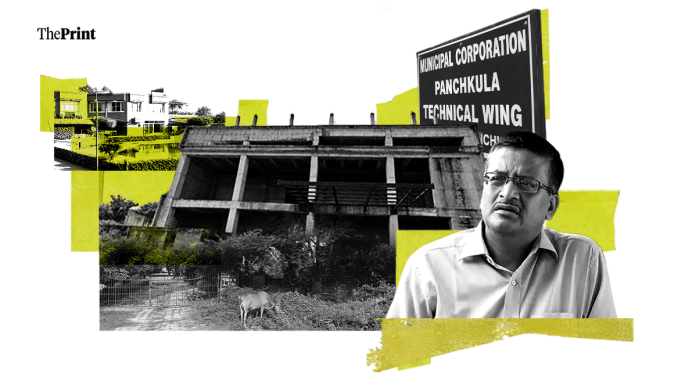
New Delhi: Retired IAS officer Ashok Khemka has sought a CBI probe into approvals granted by senior Haryana government officials for the transfer of 15 acres of prime land worth around Rs 300 crore to a hotel promoter in Panchkula.
In an August letter to Haryana Chief Minister Nayab Singh Saini, Khemka demanded that the central agency be roped in to get to the bottom of what he described as an “illegal” order passed by the Panchkula collector in January 2024 and confirmed by the Ambala divisional commissioner in May this year.
The order in question transferred ownership of the land—which Khemka has alleged was identified as shamlat deh (common land of villagers) in revenue records—in Panchkula’s erstwhile Chowki village (now known as Sector 32) to Polo Hotels and its promoters as private property.
The Panchkula collector had concluded that Polo Hotels had proven its ownership with historical evidence predating the cut-off date of 26 January 1950 for deciding the nature and ownership of village land under the Punjab Village Common Lands (Regulation) Act, 1961. This decision was re-affirmed by the Ambala Divisional Commissioner in May.
In contrast, Khemka argued that it is the Panchkula Municipal Corporation (PMC) that owns the land after Chowki village merged into the civic body in March 2010. He also questioned what he called the PMC’s weak defence of land ownership during civil suit proceedings.
ThePrint has reached Arun Kumar Gupta, principal secretary to CM Saini via WhatsApp and calls for comment on Khemka’s letter and whether the CMO had taken any action. A response will be added when it is received.
When ThePrint reached out to him, Polo Hotels owner Abhey Ram Dahiya said the Haryana government itself had compensated his predecessors and several other land owners of Chowki for the acquisition for adjacent plots, which demonstrates that the land in question was never common village land. “90 percent of land in Chowki was shamlat deh and our land was exempted from it and that’s how a CLU (change in land use) was done…This is a far-fetched attempt by Khemka.”
Shamlat deh—the central question
At the centre of Khemka’s letter and the decisions of the collector and divisional commissioner is the definition of shamlat deh and what does not fall under this category of land.
Shamlat deh—according to the 1961 Act—is supposed to be common village land. Khemka in his letter to Saini has explained in broad terms why the 15-acre land plot was shamlat deh under provisions of the Act and that its ownership lies with the PMC.
He argued broadly that there was neither any proof of partition of land nor of the purported sellers being in individual cultivating possession of the partitioned land before 26 January 1950—for getting an exception from shamlat deh under the 1961 Act.
Under the Act, land that has been partitioned and brought under cultivation by individual landholders before the 26th January 1950 are categorised as exceptions, and do not constitute shamlat deh.
Relying on the same parameters, the retired IAS officer cited an August Supreme Court judgement in a similar case, that restored roughly 280 acres of land in Haiderpur village to the Gurugram municipal corporation.
In the Polo Hotels case, the collector, Khemka contended, had not summoned key evidence, such as Sharat Wajib-ul-Arz—an official document that details existing agreements regarding land use and management of a particular village—to reach a conclusion in the absence of the missing key revenue records.
Also Read: A big win for Ashok Khemka: Why HC ruled in favour of Haryana IAS in empanelment tussle with Centre
The land use dispute
The dispute over land use dates back to 2023 when A.R. Dahiya, the promoter-owner of Polo Hotels, approached the Panchkula collector in 2023 after the PMC rejected his plea to update the ownership details in the revenue records to reflect his name in place of his predecessors.
The Dahiyas had acquired Polo Hotels from its previous promoters, V.P. Garg and V.K. Garg, in 1999.
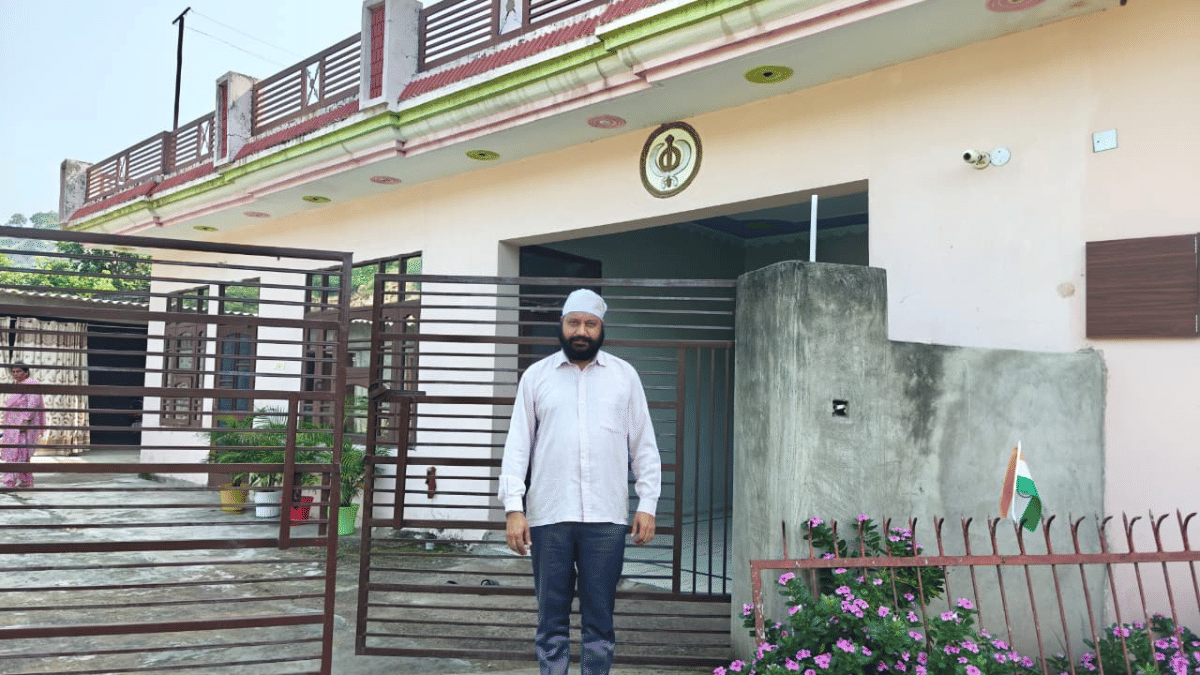
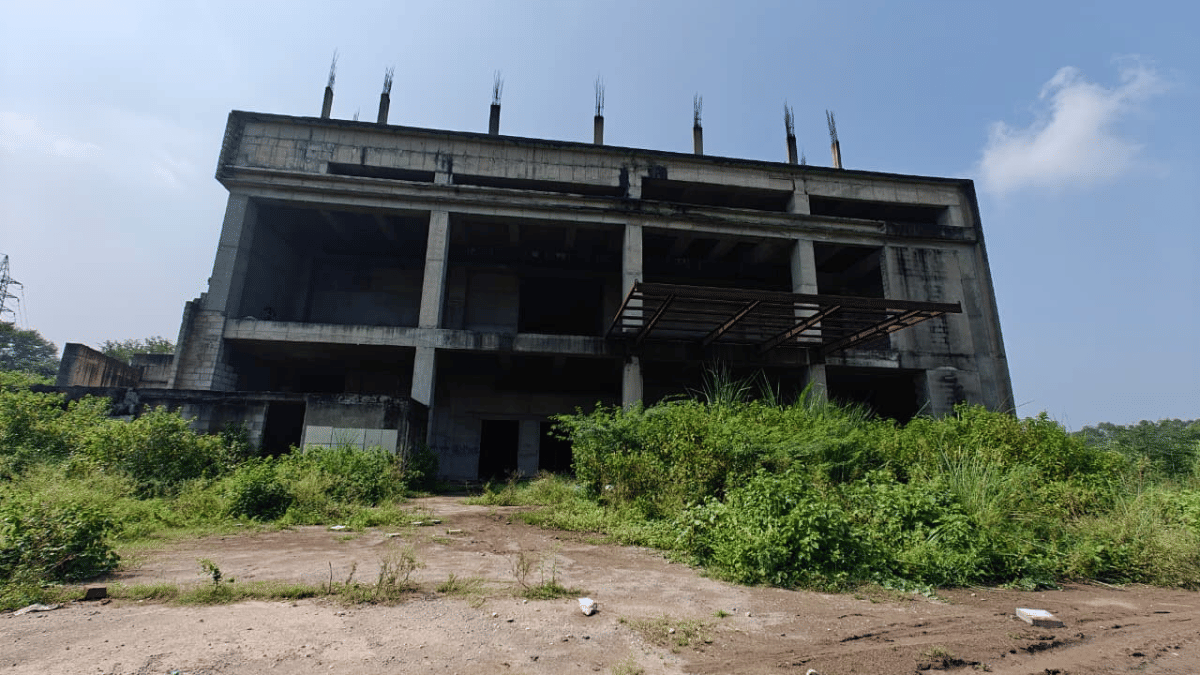
Former Chowki village sarpanch Balveer Singh has seen the meteoric rise and fall of the Polo Hotels’ empire. “It was the most famous and the biggest hotel in the neighbourhood and had huge demand,” the 50-year-old told ThePrint at his residence.
Balveer recalled that the previous owner acquired the land from nearly a dozen villagers. Though he mentioned some names, he could not provide details of the whereabouts of their descendants.
According to Dahiya’s submissions to the collector during the civil suit proceedings, Polo Hotels’ predecessor acquired the land from Chowki villagers.
Dahiya submitted that the suit was necessitated after the PMC did not hear the plea to record his and the company’s names as owners of the land, on which Polo Hotels earlier ran North Park Resort.
Dahiya argued that they were the land owners and cited revenue records dating back to 1942-43 and as late as 2019-20. He claimed the land was never a shamlat deh under the 1961 Act, adding that neither the erstwhile gram panchayat nor the municipal corporation had any historical ownership interest in the land.
He also argued that the land was “wrongly” entered in the possession of the gram panchayat via a mutation in April 1957 on the government’s orders. Hence, the land reverted to its predecessor through another mutation that came into effect from FY 1974-75, he contended.
His counsel claimed that the owner’s predecessor had been in possession of the land much before 26 January 1950.
However, the PMC counsel argued that the land parcel was never partitioned—one of the conditions for exception from shamlat deh status—before the 1950 deadline, and was owned by the village panchayat before it went to the municipal corporation.
‘Presumption is not proof’
On his part, Khemka reiterated that there was no proof of partition of the parcel before 1950, which would have exempted the land from the definition of shamlat deh.
He flagged a key observation in the collector’s order—missing revenue records for more than a decade, from 1962-63 to 1974-75. He also cited the collector’s observation that there was no Record of Rights (RoR) for the land on 26 January 1950 as well as the collector’s presumption of ownership from the last recorded revenue records in 1942-43.
“A presumption is not proof, least of all where the burden lies on the party invoking it,” Khemka wrote, questioning the foundation of the collector’s order.
In the absence of specific revenue records, Khemka said the Sharat Wajib-ul-Arz governing the shamlat deh’s ownership should have been sought to examine ownership claims.
However, it was not among the 100 documents used for consideration of the suit—neither produced by either party, nor summoned by the Panchkula collector before deciding the suit.
“Entries in it carry a statutory presumption of truth under the Punjab Land Revenue Act, 1887…,” Khemka said. “The single most important document (Shart Wajib-ul-Arz) was neither produced by the plaintiffs, nor summoned by the Corporation, nor called for by the Collector. It must now be obtained and read.”
Collector’s order & what Khemka flagged
In his order, the then Panchkula collector summarised the dispute into seven broad points, including whether the land was an asset of the gram panchayat before the merger with PMC.
These disputes were then decided through questions such as whether the land was indeed shamlat deh, as claimed by the municipal corporation. Khemka criticised putting the burden of proving these questions on the municipal corporation.
The PMC, the collector observed, failed to produce any record or register listing the properties held by the gram panchayat, as required under the Haryana Panchayati Raj Act, to support that the land belonged to it.
“In view of the above-mentioned circumstances, it is held that the land was not an asset/property of Gram Panchayat Chowki and defendant No.1 [PMC] has no right, title or interest in the land,” the collector said in the order.
The Ambala divisional commissioner affirmed the collector’s order, observing that the Polo Hotel owners’ ownership was validated. This was despite the municipal corporation submitting a June 1990 revenue record showing that the government acquired 9.7 acres of land, including 1.15 acres from the same parcel that was handed over to Polo Hotels.
Such inference, Khemka argued, inverted the application of the established law.
“The collector required the municipal corporation to prove that the land was a gram panchayat asset, faulting it for failing to produce the register of immovable property under Section 18 of the Haryana Panchayati Raj Act read with Rule 12 of the 1995 Rules. That inverts the statute,” he wrote.
“The absence of a panchayat asset register proves nothing except the poor state of panchayat records. The burden of establishing the exception lay, throughout, on the claimants [the Polo Hotels].”
The collector relied on revenue records from 1942-43, 1951-52, 1954-55, 1979-80 and 1984-85 to conclude that the predecessors of the Dahiya-led Polo Hotels were listed in the ownership column, an approach Khemka criticised for placing the pre-1950 and post-1950 revenue records on the same footing.
Khemka observed that the pre-1950 revenue records predated the consolidation of the land, while the post-1950 records referred to three sub-plots created after the 1950 consolidation, when, in undivided Punjab, scattered agricultural holdings were rearranged into compact, rectangular blocks of equal value.
“Unless the two sets are correlated through the Naksha Haqdarwar [a revenue document used during land consolidation proceedings] and the consolidation scheme, it is impossible to say that the persons shown in possession before 1950 were in possession of these parcels,” Khemka wrote. “This is not a technicality. Without the identity of the land, a pre-1950 fractional share cannot lawfully ripen into title to a specific post-consolidation parcel. The point does not appear to have been addressed.”
He also faulted the Panchkula collector’s examination of the revenue records, noting that the order still favoured Polo Hotels despite the absence of any records establishing the land status as on 26 January 1950.
“The record itself discloses that after the Jamabandi of 1942-43, no further Jamabandi was prepared before 26 January 1950, and that the Jamabandis from 1962-63 to 1974-75 are missing from the record room.”
Jamabandi is a document prepared as part of the record-of-right in every revenue estate.
He argued that the legally sound question was to find out the position on the crucial date. “It was answered by a presumption drawn backwards from 1942-43 and forwards from 1951-52.”
‘State’s obligation to ask why’
The PMC drew Khemka’s criticism for assigning a lone building inspector to defend the plot ownership before the collector.
“As a building inspector, I am discharging the duty of inspection of building plans submitted for approval and of inspection of unauthorised construction. I am not aware of the assets and properties of Gram Panchayat Chowki,” the PMC’s building inspector deposed before the collector during the hearing.
Worse, the building inspector conceded that he wasn’t versed with the 1961 Act and was unaware of the 1950 cut-off date for its application.
“I make no allegation of motive against any individual. But when land of estimated value 300-400 crores is lost in a contest in which the municipal corporation produced a building inspector who had not read the file, and every private party on the other side was represented by senior counsel, the State is obliged to ask why,” Khemka asserted.
Now, Khemka has suggested that the financial commissioner take suo motu cognisance and call for the records of the commissioner’s order, or that the PMC file a revision petition with the assistance of a senior counsel well-versed in revenue laws.
Till a pending decision, the Director, Town and Country Planning be directed to consider keeping the change-of-land-use and all consequential approvals in abeyance, Khemka urged the CM.
He suggested a probe to ascertain the circumstances leading up to the village panchayat giving up land ownership in January 2014.
“The government is therefore not powerless; it is simply required to act through the correct channel, and to act soon. Each additional month invites further construction, further transfers and further third-party equities, which is precisely how questions of title are converted into questions of hardship,” Khemka said.
(Edited by Tony Rai)
Also Read: How Supreme Court’s 1992 Bhajan Lal ruling led IAS officers’ cross-FIRs to anti-corruption court