



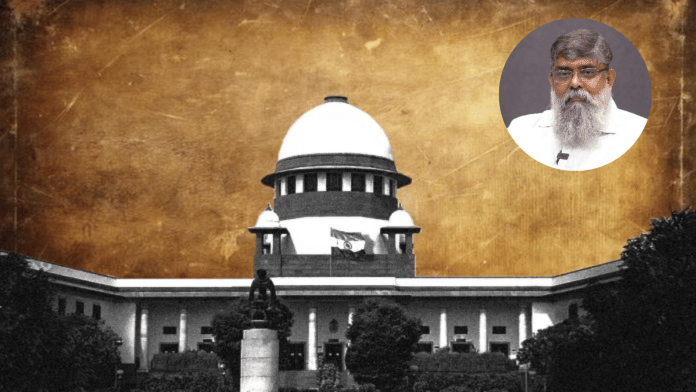

New Delhi: Journalist R. Rajagopal’s allegation that the Special Intensive Revision (SIR) of electoral rolls is affecting basic citizenship rights has reignited the debate on the constitutional implications of voter list revisions and the protection of democratic rights.
According to Rajagopal, former editor of The Telegraph, his passport renewal was stalled for over 100 days because his name had been struck off the West Bengal electoral rolls during the SIR exercise in the state.
A pertinent question emerges—can the absence of a name from an electoral roll be reason to deny citizen rights that are unrelated to an election?
The Supreme Court has already answered this question in terms that are far narrower than the surrounding political rhetoric.
In a May judgement, the SC upheld the Election Commission of India’s (ECI) authority to conduct SIR of electoral rolls to verify the validity of voter names, but it also drew an important line—the SIR is an electoral exercise and not a conclusive adjudication of citizenship. Exclusion from the roll, therefore, does not by itself amount to a final declaration that a person is not Indian.
The SIR exercise is meant to identify inaccuracies in the voter list, such as duplicate entries, deceased persons and entries requiring verification due to “logical discrepancies”.
The latest SIR exercise began with Bihar in June 2025, ahead of assembly polls in the state. Subsequently, it was extended to poll-bound West Bengal and other states. Electors are re-verified against the electoral rolls from 2002 since a similar exercise was last conducted that year.
In West Bengal, over one crore cases were flagged for “logical discrepancies”—a category the ECI introduced for entries that could not be cleanly matched with the 2002 rolls. While this is often because of spelling variations, missing parental records, or simple administrative gaps from over two decades ago, more than 91 lakh names were finally removed from the state’s rolls.
Civil society groups, the Association for Democratic Reforms (ADR), activist Yogendra Yadav, and several opposition leaders moved the Supreme Court, arguing that the SIR effectively functioned like citizenship screening dressed up as a routine roll revision, and that the ECI had no statutory power to conduct such a sweeping exercise.
The ECI has defended the exercise as necessary to ensure clean rolls and free and fair elections, and the Supreme Court has broadly accepted that rationale.
Also Read: 4 legal questions that shaped SIR verdict and how Supreme Court answered them
‘Limited enquiry into citizenship’
On 27 May, 2026, a bench led by Chief Justice Surya Kant ruled in the case titled Association for Democratic Reforms vs Election Commission of India that the SIR exercise was constitutionally valid.
The court held that the ECI’s power under the Constitution’s Article 324 to superintend elections, read with the Representation of the People Act, was enough to justify the revision. Further, the exercise was not rendered illegal due to a departure from the ordinary, periodic method of revision.
The court also rejected the argument that excluding ration cards and existing voter ID cards from the list of acceptable documents was arbitrary, holding that the choice of evidentiary documents falls within the ECI’s discretionary domain, subject only to a reasonableness review.
Interestingly, the court highlighted the passport as strong proof of citizenship and said that “it may not be out of place to note that a Ration Card, unlike a Passport or a Birth Certificate, is certainly not a conclusive proof of citizenship”.
But the judgement drew a sharp line on the SIR’s effect upon citizenship, recognising that voter eligibility and citizenship are governed by entirely different legal frameworks.
The court held that the ECI is empowered to examine citizenship-linked questions only for the limited purpose of deciding inclusion or exclusion from the electoral roll and not to make a final determination of a person’s citizenship.
The court was explicit on there being no link between SIR deletions and citizenship in general, stating that a deletion “…does not amount to a declaration that the individual is not a citizen of India; it merely reflects the commission’s inability to be satisfied, for electoral purposes, that the statutory conditions are met”.
“The consequence of such a determination is correspondingly limited. It affects the individual’s entitlement to be included in the electoral roll, and thereby their right to participate in the electoral process. It does not, however, operate to divest the individual of claims of citizenship, nor does it foreclose a determination of that question by the Competent Authority under the Citizenship Act”.
The SC also outlined procedural safeguards to prevent arbitrary exclusion—reasons recorded by adjudicating officers must be disclosed to affected voters and deletions can be enacted only after a show-cause notice. Further, the court reaffirmed Aadhar as an acceptable identity proof.
In parallel proceedings specific to West Bengal, the court directed that appeals against deletions would be heard by appellate tribunals headed by retired high court judges, with the Calcutta High Court roped in to draft additional judicial officers given the sheer volume of “logical discrepancy” cases.
“Viewed thus, we are of the considered opinion that the commission is empowered, in the exercise of its constitutional mandate, to undertake a limited enquiry into citizenship for the purpose of satisfying itself as to eligibility for inclusion in the electoral roll. Such an enquiry does not amount to a determination of citizenship in the strict sense, and any action taken pursuant thereto is confined to electoral consequences alone,” the court ruled.
In Rajagopal’s case, his passport renewal was delayed because Kolkata Police’s verification report flagged the deletion of his name from the Ballygunge electoral roll, even though the exclusion itself is under challenge before an appellate tribunal.
The Editors Guild of India’s intervention in Rajagopal’s case—it said the case “highlights the misery that millions of Indians are being put through” because of the SIR—and the court’s own separate direction to another petitioner to approach the Calcutta High Court over a similar ration card denial, reflects an underlying problem—administrative agencies extending the consequences of an unresolved, contested roll entry far beyond what the Supreme Court’s judgement permits.
(Edited by Nida Fatima Siddiqui)
Also Read: Supreme Court upholds validity of SIR, says EC competent authority to conduct exercise