




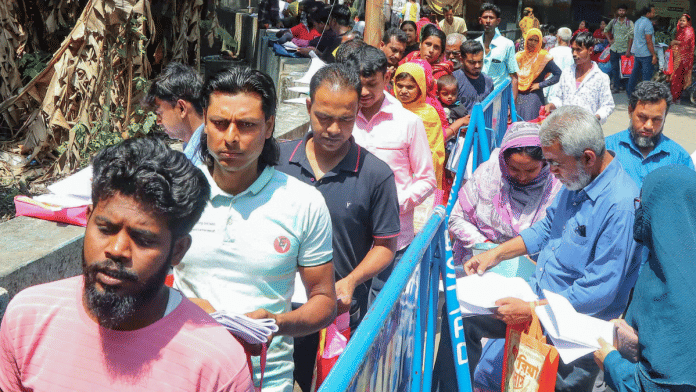


New Delhi: In declaring the Special Intensive Revision (SIR) legally valid, the Supreme Court Wednesday upheld the Election Commission of India’s (ECI) authority to exclude ration cards and existing voter identity cards from the list of acceptable documents to establish identity and subsequent inclusion in the new electoral roll.
A bench of Chief Justice Surya Kant and Justice Joymalya Bagchi pronounced its ruling on a batch of petitions against the Special Intensive Revision of electoral rolls, which commenced from Bihar in July last year, months before the assembly elections were held.
The exercise was extended to other poll-bound states after the top court refused to interdict it.
In its 124-page judgement Wednesday, the top court held the SIR had direct nexus to the constitutional goal of a free and fair election, which does not merely rest upon the mechanics of polling, but equally depend upon the “integrity, accuracy and purity of the electoral roll which forms the foundation of the democratic process.”
On the ECI’s power to refuse acceptance of certain documents, the bench said the panel is not obliged to accept “every document that may have a probative value.”
“It is entitled to exclude those which, in its considered view, are either insufficient for the purpose at hand or are susceptible to misuse in a manner that would undermine the integrity of the process,” said the bench, underlining the exclusion of the two documents was founded upon rational considerations and connected with the object of the SIR exercise.
Hence, it cannot be characterised as arbitrary, as was sought by the petitioners.
The fact that the last SIR in Bihar was conducted in 2003 and the summary of revision rolls in the state were without a strict degree of verification weighed heavily with the court, as it backed the intensive exercise for bringing integrity to the electoral roll.
The arguments put forth before the court stood at the intersection of two constitutional concerns.
First, that no eligible citizen should be excluded from the electorate; second, the electoral roll must continue to reflect the true composition of the political community.
The judgment broke down the issues presented before it into four legal questions, all of which were answered in the ECI’s favor.
ThePrint explains the four questions and the court’s response to them.
(i) Whether the Election Commission of India has power to conduct the impugned Special Intensive Revision?
As per the petitioners, the ECI had arbitrarily invoked section 21(3) of the Representation of the People (RP) Act to carry out the SIR, which, they argued, can be done for any constituency or part of a constituency and not for the entire state.
The ECI, they contended, could have only revised the roll in terms of section 21 (2) of the RP Act by reference to a qualifying date.
The ECI rebutted this submission by quoting Articles 324 and 326.
While Article 324 vests complete superintendence, direction, and control of elections in the ECI, Article 326 guarantees universal adult suffrage. The ECI contended that it draws its power from Article 324 to execute a mandate given under Article 326.
In rejoinder, the petitioners had said the ECI’s power under Article 324 is residuary, meaning the body was bound to work in accordance with the RP Act, a parliamentary legislation approved under Article 327.
However, the court declared the statutory framework provided for a situation where the ECI may direct a special revision under Section 21(3), which is contingent to a reasoned order.
It touched upon the interplay between Articles 324 and 327 to hold they were not competing, but complementing.
Parliamentary legislation cannot be interpreted in such a manner to paralyse the core constitutional functions vested in the ECI under Article 324, the court said, as it held that the Commission’s supervisory authority is inherently expansive.
It was not a residuary reservoir of power, which evaporates upon enactment of a law, but plenary powers afforded to the apex poll body that may be essentially administrative and marginally even judicative or legislative.
The court also upheld the Commission’s “absolute constitutional mandate to step into vacuous areas left unoccupied by legislation.”
However, it cannot be deployed to override an express statutory prohibition. Conversely, the Parliament cannot be deployed to extinguish an overriding constitutional mandate, the court said, asserting the underpinning constitutional equilibrium.
On this note, the court approved the SIR, observing the RP Act reflected a clear legislative intent to confer a wide procedural latitude upon the Commission, enabling it to shape its course to further its constitutional mandate of ensuring free and fair elections.
(ii) Is SIR founded on a legitimate purpose? If yes, whether the ECI adopted measures that were proportionate to the object sought to be achieved?
As per the petitioners, the SIR exercise was bereft of any legitimate purpose, besides being an arbitrary invocation of power. Even assuming the existence of a legitimate objective, the means adopted were disproportionate, excessive, and exclusionary in their operation.
It was also contended that less intrusive alternatives, such as targeted revisions confined to identified areas of irregularity, were available but not explored.
The ECI justified SIR by placing reliance upon a set of structural and long-standing concerns affecting the integrity of the electoral roll.
According to it, the cumulative effect of large-scale migration, both intra-state and inter-state, non-reporting of deaths, and instances of multiple enrolments resulted in gradual but significant erosion in the accuracy of the electoral roll.
The court emphasised that the SIR exercise had a direct nexus with its objective – which was to ensure inclusion of all eligible electors in the electoral roll and to ensure the exclusion of all ineligible persons.
An electoral roll is not a static document and its preparation and maintenance are a dynamic and continuous obligation. A wrongful inclusion or exclusion would directly impact the principle of electoral equality, the court added.
Hence, the objective sought to achieve, which is the restoration of accuracy, completeness, and integrity of the electoral roll, is not only legitimate but is integral to the constitutional mandate entrusted to the ECI.
With this the court also examined the means that were employed to pursue the ends, and concluded that the measures were not only logically connected to the stated objective, but were, in fact, intrinsically designed to achieve it.
These measures included house-to-house verification, requirement of submission of enumeration forms that ensured uniform scrutiny across constituencies and procedural safeguards.
On whether ECI had other options, which were least restrictive, the court said the method chosen was not disproportionate or manifestly excessive, and was within constitutional bounds.
Since the scale of the problem identified by the Commission was systemic in nature, piecemeal solutions or constituency-specific approach, as suggested by the petitioners, would not remedy the structural deficiencies that pervade the entire roll, the court observed.
The court also held a view that the exercise did not have a disproportionate impact on the voter as maintenance of an accurate and credible electoral roll is of foundational importance to the democratic process and integrity of elections. Any systemic distortion therein strikes at the very root of representative governance.
Though the right to vote is a valuable constitutional right, it’s not absolute or unregulated. But any measure that has the potential to impact its exercise must be scrutinised with care, the court said.
In case of SIR in Bihar, the bench held that the safeguards introduced struck a fine balance between the need for electoral integrity and the imperative of inclusion.
(iii) Is the SIR procedure adopted by the ECI contrary to the RP Act or the rules?
The petitioners argued enrolment in an existing electoral roll carries with it the presumption of eligibility. Therefore, to ask them to re-establish their credentials through a fresh and onerous process effectively reversed this settled presumption and imposed upon the elector a burden to prove their citizenship afresh.
But the court did not find this argument valid. It said the exercise requiring electors to furnish supporting material in the course of such an exercise did not amount to the negation of the presumption; rather, it was to reaffirm or, where necessary, correct existing entries.
“The presumption continues to operate, but it does not obviate the possibility of verification (or rebuttal),” the court said.
A holistic examination showed that the comprehensive framework for SIR provided for wide dissemination and transparency. More importantly, the court said, SIR had operationalised the Rules under the RP Act.
The prescription of a documentary regime was accepted by the court, which added, it was a tool to “ensure administrative consistency and evidentiary reliability.”
Specifically, on the exclusion of two documents- ration card and voter ID – the bench said, “The choice of proposed documents for verification of electoral rollsand their evidentiary standards necessarily fall within the discretionary domain of the Commission which may not be substituted subject to reasonableness.”
The Commission was entitled to exclude documents, which in its considered view, was either insufficient for the purpose at hand or susceptible to misuse in a manner that would undermine the integrity of the electoral revision process, observed the court.
(iv) Is the ECI empowered to scrutinise the citizenship status of persons seeking inclusion or continuation in the electoral roll?
As per the petitioners, SIR enabled a broad-based scrutiny of the citizenship of persons already included in the electoral roll, which, they said, was against the constitutional scheme.
The court, however, held that the Commission was both legally and constitutionally dutybound to prepare and maintain electoral rolls comprising persons who are qualified to be registered as electors.
Since the RP Act explicitly disqualifies non-citizens from being registered in the electoral roll, the Commission was, therefore, obliged to satisfy itself that persons included therein meet this threshold requirement.
Hence, the Commission, in the course of preparing or revising electoral rolls, is undoubtedly empowered to examine questions bearing upon citizenship, but only from the standpoint of inclusion or exclusion, said the court.
(Edited by Ajeet Tiwari)
Also Read: Supreme Court upholds validity of SIR, says EC competent authority to conduct exercise