





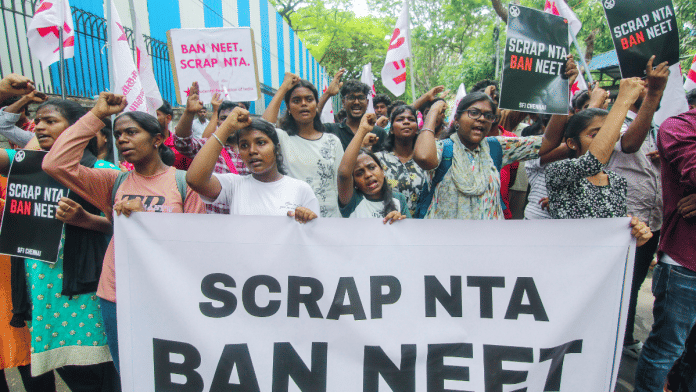


New Delhi: After Education Minister Dharmendra Pradhan announced Friday that NEET-UG will move to a Computer-Based Test (CBT) format from 2027, the Federation of All India Medical Association (FAIMA) said the change alone would not address concerns over the integrity of the exam.
FAIMA noted that instances of paper leaks and irregularities have been reported even in CBT formats, including the alleged involvement of private institutes and consulting services in conducting exams.
“Before going to CBT, the government should form a proper high-power committee constituting a retired Supreme Court judge, a cyber security expert and a forensic expert,” said Dr Atharva Shinde, FAIMA national spokesperson.
During the press conference, Pradhan accepted responsibility for “a breach in command chain” and announced a re-examination on 21 June 2026.
“The government should focus on fixing systemic loopholes and restructuring the National Testing Agency (NTA), because repeated paper leaks point to deeper issues in how exams are being conducted,” Dr Shinde told ThePrint, reacting to the announcement of the fresh exam.
The reactions come after the NTA cancelled NEET-UG 2026 on 12 May 12—10 days after the exam was held on 3 May—following confirmation from central agencies that the question paper had indeed leaked on WhatsApp and Telegram groups before exam day. The CBI, which registered a case the same day, has since told a Delhi court that the leak traces back to a source inside the NTA itself.
Over 22.7 lakh candidates who appeared for the exam now face a re-test on 21 June.
On 13 May, FAIMA, which claims to be the largest national body of resident doctors in India, had filed a writ petition in the Supreme Court under Article 32, arguing that the NTA is “structurally incapacitated” to conduct a secure re-exam, asking the court to appoint its own oversight committee before the 21 June re-test.
The petitioner’s lawyer, Tanvi Dubey, said that the announcement comes without the precautions on issues the students are actually worried about.
“Just conducting an exam online won’t really help unless they follow all the directions which have been given by the Supreme Court (in 2024),” she told ThePrint.
Dubey pointed to pending petitions in the Supreme Court alleging score tampering in NEET-PG—which is already a computer-based exam—as evidence that the format alone is not a safeguard.
Story so far
NEET-UG 2026 was conducted on 3 May across more than 5,400 centres, with approximately 22.7 lakh candidates. Within days, a ‘guess paper’ circulating on WhatsApp and Telegram was found to have matched the questions in the exam.
The Rajasthan Police’s Special Operations Group (SOG), which kicked off the investigation after a circulated document surfaced in Sikar, found material containing around 410 questions—of which nearly 120 allegedly matched the biology and chemistry sections. The petition notes that questions worth nearly 600 out of 720 marks may have been in circulation.
The material was distributed as “important questions” or “VIP sets” through coaching networks across Nashik, Gurugram, Jaipur, and Sikar. Candidates were reportedly charged in lakhs for access to these papers.
The NTA cancelled the exam on 12 May after receiving inputs from central agencies. The CBI registered a case the same day.
What the petition argues
FAIMA, which represents doctors, resident doctors, and medical students across the country, moved the Supreme Court on 13 May, naming the NTA, the Union government, and the CBI as respondents.
At the heart of its plea is the claim that the NTA never implemented the key recommendations of the Radhakrishnan Committee, a reform panel constituted after the 2024 paper leak controversy and headed by former ISRO chief K. Radhakrishnan. The committee had proposed a fundamental overhaul of the examination’s security architecture.
The committee’s core recommendation included encrypted question papers transmitted digitally to centres for on-site printing shortly before exam time, eliminating vulnerability in physical transportation. The committee also called for exams in multiple shifts, Aadhaar-linked biometric verification in place of manual checks, a “Digi-exam” system to track candidate identity end-to-end, and advanced cryptographic safeguards with continuous vulnerability testing through a “Red Team/Blue Team” model—where ethical hackers actively probe systems for weaknesses. It drew on global practices from the US-based Educational Testing Service.
None of this was implemented, the petition alleges.
Instead, it argues, the NTA continued to rely on a “massive, outdated physical chain of custody”, outsourcing logistics to private contractors and leaving question papers exposed during transit and storage. Measures like GPS tracking and signal jammers were “cosmetic”, the petition says, once papers had already been leaked online. The agency also “completely ignored” recommendations on digital watermarking and advanced data security, the petition alleges.
Significantly, the petition points out that the breach was not detected by the NTA’s own systems—it was uncovered by the Rajasthan Police’s Special Operations Group. This, the plea argues, reveals the total absence of internal audits or vigilance mechanisms within the agency.
Drawing a parallel with the Medical Council of India, which was dissolved in September 2020, the petition argues, “The repeated digital breaches and administrative paralysis of the NTA unequivocally demand the application of the same judicial remedy.”
“When an administrative body discharging a massive public function demonstrates a systemic and structural collapse, the court has the constitutional precedent of superseding its management to preserve the sanctity of the system,” the petitioners wrote.
The Supreme Court backdrop
The current litigation sits against a specific judicial backdrop. In Vanshika Yadav vs. Union of India (2024), the Supreme Court found the paper leak geographically contained and declined to cancel that year’s exam.
But it issued a warning that the NTA “cannot afford to misstep, take an incorrect decision, and amend it at a later stage”, and that “flip-flops are anathema to fairness”.
The court had also issued detailed directions on strongroom security, transportation of exam materials, oversight of invigilators, and OMR sheet submission timelines. Those directions, in turn, formed the basis for constituting the Radhakrishnan Committee and its subsequent October 2024 report.
The FAIMA petition argues that none of those directions were implemented and that the 2026 breach is therefore not an independent failure but the predictable consequence of the 2024 judicial directions being ignored.
The writ petition is pending for listing before the Supreme Court.
Why was CBT plan deferred
The plan to move NEET-UG to a computer-based test has been discussed for years, but never implemented. The latest announcement for 2027 has brought back the question of what caused the delay.
“We will conduct the exam in CBT mode if the health ministry gives us in writing that they want us to conduct the exam in CBT mode,” the NTA Director General Abhishek Singh told the Hindustan Times newspaper Thursday.
The Radhakrishnan Committee had recommended shifting to digital exams, saying pen-and-paper tests create multiple points where leaks can take place. But the transition has been held up mainly because of scale. With over 22 lakh candidates, the NTA would need to conduct the exam in many shifts.
However, the health ministry preferred a single-shift exam to avoid disputes over fairness.
“We do not want problems later arising from complaints that one set of questions was different from another or that an earlier paper was easier. To rule out issues related to normalisation, the health ministry had suggested conducting the examination in a single shift,” a senior official told HT.
However, handling roughly 2.2 million candidates would require around 20 shifts, necessitating score normalisation across sessions to ensure fairness—a process the agency already uses for JEE Main.
However, infrastructure realities underpin the challenge. NTA currently accommodates about 1.5 lakh students per shift in its CBT exams. Scaling the format to NEET’s much larger pool would demand significantly greater logistical capacity.
The Radhakrishnan panel had outlined a practical roadmap. “It is possible to integrate such testing centres… to establish a nationwide network of about 400-500 testing centres within a time frame of a year or so, which will provide about 2-2.5 lakh testing capacity for conducting CBT in one session nationwide,” the committee recommended.
“Eventually, one could envisage that every district headquarter in the country should have a standardised and well-equipped CBT centre,” it had added.
However, these recommendations were never implemented.
(Edited by Viny Mishra)
Also read: NEET paper leak came from a hole that wasn’t plugged in 2024. NTA is ignoring its problems