



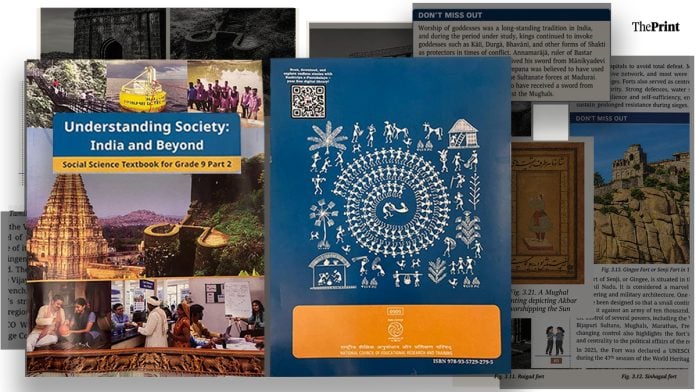
New Delhi: The new NCERT Class 9 Social Science textbook describes the “brutality of the Mughal state” against Sikh Gurus as having “few comparisons in history,” specifically referring to Guru Arjan Dev, Guru Tegh Bahadur and Guru Gobind Singh.
In this latest edition, NCERT shifts the focus of Class 9 history from the French Revolution, Russian Revolution and socialism in Europe to India’s own past—regional kingdoms, struggles for sovereignty, alliances and confederacies, forts, temples, and resistance to expansionist powers on the rise, particularly the Delhi Sultanate and the Mughals.
The book, Understanding Society: India and Beyond, Part 2, which hit the stands Tuesday, has a chapter titled “Resistance and Resilience” that covers India between 1000 and 1700 CE. It begins by noting that, from the 7th century onwards, the Indian Subcontinent witnessed successive invasions driven by “territorial expansion and religious motives”.
The account of the period places particular emphasis on resistance to the Delhi Sultanate and Mughal expansion—from the Rajputs, Ahoms and Marathas to Sikhs and Jats.
The new textbooks, released under the new National Curriculum Framework (NCF) since last year, present the Mughals in a very different light. For instance, the Class 7 textbook released last year no longer mentions the Mughals, while the topic is taken up in Class 8, where the textbook describes the “brutality” of the Mughal state.
The Class 9 NCERT textbook released Tuesday takes this further, devoting a chapter to the resistance of kingdoms and communities against the expansion of the Delhi Sultanate and, later, the Mughals, under the theme “Safeguarding Sovereignty: Resistance, Alliances, and Confederacies”.
It also includes a chapter detailing how temples shaped the economic, political, social and cultural life of their regions. The previous Class 9 Social Science textbook had chapters on the French Revolution, socialism in Europe and the Russian Revolution, and Nazism and the rise of Hitler, rather than beginning with medieval Indian history.
Also Read: SC closes NCERT ‘corruption in judiciary’ chapter with a note on ‘criticism & uninformed assertion’
‘Brutality’ against Sikh Gurus, Jat resistance to Mughal rule
The textbook’s account of resistance against the Mughals turns next to the Sikhs, beginning with what it describes as growing Mughal intervention in the affairs of the Sikh Gurus from the early 17th century. It cites the execution of Guru Arjan Dev and detention of Guru Hargobind under Jahangir, and the execution of Guru Tegh Bahadur under Aurangzeb.
Describing these episodes, the book says the “brutality of the Mughal state” against Sikh Gurus had “few comparisons in history”.
It argues that the persecution and political pressure contributed to the Sikhs’ shift towards collective organisation and armed resistance. Guru Hargobind’s establishment of the Akal Takht and the concept of miri-piri, representing spiritual and temporal authority, are discussed in this context. The chapter then traces the formation of the Khalsa under Guru Gobind Singh in 1699 and the emergence of armed groups known as misals. These, the book says, eventually developed into confederacies that united Sikhs against the Mughals.
It also notes that people from peasant communities joined these forces and fought the Mughals in Punjab.
The Jats of the Ganga-Yamuna Doab form another part of the chapter’s account.
The book attributes their resistance to heavy taxation and exploitation under Mughal rule, alongside what it describes as Aurangzeb’s religious policies. It cites Gokul Jat’s rebellion in 1669 and another uprising in 1686 under the zamindars of Sinsani and Sogar. While Mughal forces gained the upper hand by 1691, the NCERT textbook says Jat resistance continued.
Mewar, Ahoms, Marathas: Resistance to Delhi Sultanate, Mughals
The chapter traces resistance to the Delhi Sultanate to several kingdoms and chieftains across the Subcontinent. It says the Sultanate’s centralised administration, including the iqta system—under which land revenue assignments were given to officials in lieu of cash salaries—placed a greater burden on peasants, while its military campaigns involved demolition of sites sacred to local communities. Among those that resisted, the textbook lists the Yadavas of Devagiri, Kakatiyas of Warangal, Hoysalas of Karnataka and several Rajput dynasties.
The narrative then moves to the Mughal period, beginning with Rana Sanga of Mewar, who, the book says, led a Rajput confederacy against Babur at Khanua in 1527.
It also points to differences in how Rajput kingdoms dealt with Mughal expansion: while Mewar resisted Mughal authority, the Kachhwahas of Amber entered into cooperative arrangements with the Mughals.
Mewar’s resistance under Maharana Pratap gets particular attention in the book.
The Ahoms are presented as another major example of resistance. The NCERT textbook traces their repeated clashes with Mughal forces, culminating in the Battle of Saraighat in 1671, where Lachit Borphukan, a military general and commander-in-chief of the Ahom Kingdom in Assam, defeated the Mughal fleet.
It attributes the Ahoms’ ability to resist to their strategic alliances, guerrilla tactics, knowledge of the terrain, the paik system and naval strength.
For the Marathas, the book places front and centre the idea of swarajya, or self-rule. It highlights Shivaji’s use of forts such as Raigad and Sinhagad, along with guerrilla warfare and strategic alliances, in the Marathas’ battles.
‘Swords from Goddesses’
The textbook also highlights the role of goddess worship and Shakti traditions in accounts of resistance. It states that kings during the period invoked goddesses such as Kali, Durga, Bhavani and other forms of Shakti as protectors during times of conflict.
It cites traditions surrounding Annamaraja, ruler of the Bastar kingdom, who is believed to have received his sword from Manikyadevi (Danteshvari), and Kumara Kampana, who reportedly used a goddess-given sword against Sultanate forces at Madurai.
Similarly, the book mentions that Shivaji is believed to have received a sword from the goddess Tulja Bhavani, which he weilded in his resistance against the Mughals.
Temples as centres of resilience
The chapter’s idea of resistance extends beyond battles and political struggles to the survival and restoration of institutions and traditions, with temples given a central role.
Under “Temples: The Resilience of Sacred Sites”, the textbook describes temples as institutions that shaped the economic, political, social and cultural life of their regions. They were not only places of worship but also major landholders and employers, receiving donations, endowments and land grants and providing work to architects, artisans, sculptors, priests, musicians and administrative staff.
The book also says temples functioned as financial institutions, extending credit to cultivators, village assemblies and merchant groups. In some cases, they collected local taxes and exercised quasi-judicial authority. Temple patronage, it adds, was also a source of political legitimacy for rulers.
The chapter acknowledges that many temples were plundered or destroyed from the 11th century onwards, particularly during Ghaznavid and Ghurid invasions. From the 12th century onwards, it says, some temples and mathas were destroyed or converted into mosques.
It then turns to the continued construction and restoration of temples. The book cites the Jagat Shiromani Temple at Amer and the Jagdish Temple built by Maharana Jagat Singh in Udaipur, describing such projects as expressions of religious and political assertion.
The NCERT textbook also draws a contrast with the construction of the Jama Masjid in Delhi under Shah Jahan, noting that Maharana Jagat Singh’s architectural projects, including the Jagdish Temple, were seen by scholars as a religious and political response to Mughal authority.
(Edited by Amrtansh Arora)
Also Read: ‘Honest history, not ideology’—NCERT social science panel chief on changes in Class 8 textbook