





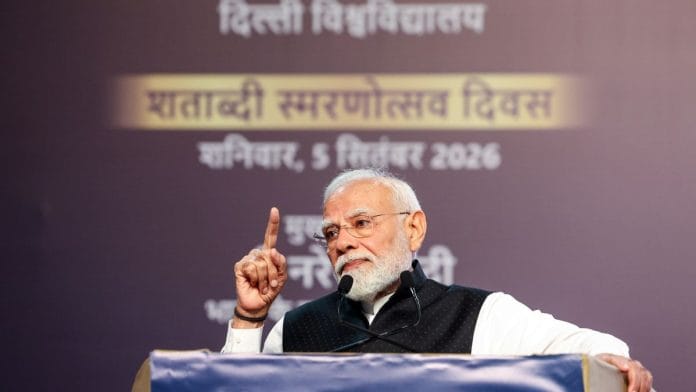

New Delhi: Taking forward the BJP’s ongoing outreach to the new generation of voters, Prime Minister Narendra Modi Saturday addressed students at Delhi University’s Shri Ram College of Commerce (SRCC), using Gen Z lingo and calling the institution’s alumni its “OGs”, while highlighting India’s economic and social progress under his government.
Modi was speaking at the college’s 100th anniversary celebrations.
Thirteen years after his first visit to the college as Gujarat chief minister, Modi returned as Prime Minister, bringing back his “glass full” metaphor and his “dimagi naxal” remark. The 2013 visit had come just months before he was named BJP’s PM candidate for the 2014 general election, with his address then centred on youth, aspiration and India’s possibilities.
The return is politically significant as the Bharatiya Janata Party seeks to expand its outreach among Gen Z and Gen Alpha.
Modi’s use of youth slang, alongside his emphasis on India’s achievements, marks a renewed pitch to young Indians—many of whom were children or not yet born, when he had made his first visit to SRCC.
‘OGs’, ‘dhoom’ & ‘dhurandhar’
Listing SRCC’s prominent alumni, including former finance minister Arun Jaitley and economic adviser Sanjeev Sanyal, Modi said “The alumni of SRCC have also been very special. In your language, I would say the alumni here are the OGs.”
He added that people who studied at SRCC had made a mark in almost every field. While he himself is not an SRCC alum, the PM said, he had definitely created a sensation at the college—“Dhurandhar na sahi, dhoom macha hi di.”
He also told students that India was moving ahead with a “different mindset”, pointing to railway electrification as an example. Less than 30 percent of India’s railway lines had been electrified before 2014, he said, compared with nearly 100 percent now.
India’s speed of policymaking and decision-making was being noticed around the world, Modi remarked, adding that new markets and lower tariffs were creating “a new sky of opportunities” for the country’s youth.
Modi’s ‘report card’
The prime minister asked students to look up the headlines from 2013, when, he said, “there was nothing but disappointment and despair”.
He recalled Indian soldiers being killed along the Line of Control, weak GDP growth, a record current account deficit, inflation of around 10 percent, an industrial slowdown, corruption scandals and bomb blasts. “Growth was at the bottom, while inflation was at the peak,” he said, adding that India was then counted among the world’s “Fragile Five” economies.
He contrasted this with India’s position today, saying that the country had moved on to become the world’s fastest-growing major economy. He said he has returned to the campus with his “report card” now.
“Those responsible for pushing the country into ‘Fragile Five’ are now unable to digest India’s 7.8 percent growth,” he said.
He also pointed to the change in India’s response to terrorism, saying that when Pakistan now makes a “napak harkat” (impure act), Indian forces enter its territory and strike back.
‘Dimagi naxal’ to ‘Naraz fufa’ jibe
Modi further said that there are two kinds of people outside the SRCC campus: those who turned the strength of society into the strength of the nation, and those who became a “naraz fufa” (angry uncle) whenever any work was started.
“Their favourite thing is to oppose everything. They have only one dialogue: What is the need for this?” he said.
Modi said he had used the term “dimagi naxal” in his Independence Day speech at the Red Fort, describing it as a “homeopathic pill” that had triggered a reaction from those he was referring to.
“When I gave the ‘dimagi naxal’ homeopathic pill from the Red Fort, all the ‘dimagi naxals’ started coming out one after another”, he said, emphasising that such people will always see “glass half full”.
Modi also appeared to take a swipe at the Opposition’s use of educational institutions as political platforms, saying that although he himself was in the Opposition in 2013, he had chosen not to use SRCC to attack the then government. Instead, he said, he had “presented a vision” and “spoken positively”.
He added that compared to 2013, the country is economically and socially much more secure today. “But seeing this, the restlessness of some people is increasing.”
(Edited by Mannat Chugh)
Also read: Two Modi govt ministers arrive on Substack as BJP dips its toes in a Gen Z stronghold