





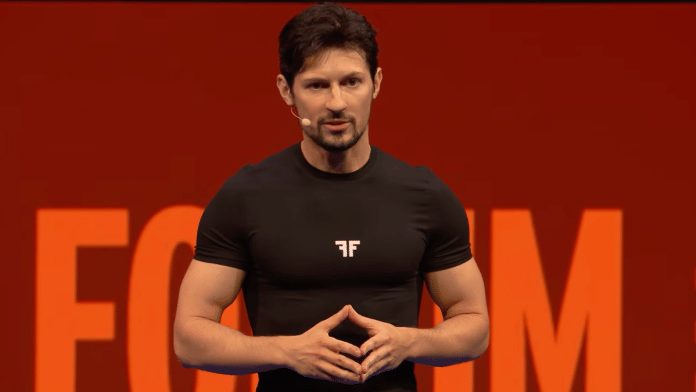

New Delhi: Hours after India banned Telegram Tuesday, the Dubai-headquartered messaging app’s founder and CEO Pavel Durov accused one of the country’s largest corporations Reliance of allegedly disrupting access to his platform for users across the world, and hinted that a rival company with a financial stake in that corporation may have lobbied for the ban itself.
The platform also approached Delhi High Court on Wednesday challenging the Centre’s order, with Justice Tejas Karia agreeing to hear the matter urgently.
“Indian telecom Reliance is sabotaging access to Telegram for millions of users outside India via a rogue method called BGP (Border Gateway Protocol) hijacking,” Durov wrote on X. “The sabotage seems intentional, as Reliance has ignored multiple reports. This may be part of a competitive war, as Reliance is partially owned by Meta, the company behind WhatsApp.”
He also alleged that Reliance and WhatsApp may have lobbied to ban Telegram in India, and urged network operators globally to reject unauthorised routing announcements from Reliance’s network, identified by its technical identifier AS18101.
ThePrint reached out to Reliance Communications representative via message, call, and email. However, the representative refused to comment on the matter saying that it must remain “confidential”.
What is BGP hijacking
Every network on the internet constantly broadcasts to other networks that it’s the best path to reach certain destinations. When a network falsely claims to be the fastest route to a destination, other networks start sending traffic through it. That traffic can end up lost, delayed, or simply dropped. Users in countries that never banned Telegram, including the UAE, would then find the app suddenly unreachable, with no government order explaining why. Durov’s allegation is that Reliance’s network was broadcasting false routing information for Telegram’s servers, effectively cutting users off in places where the ban didn’t apply.
Mark Zuckerberg’s Meta doesn’t hold a stake in Reliance Industries itself, but through its subsidiary Jaadhu Holdings, Meta holds a minority position in Mukesh Ambani’s Jio Platforms, Reliance’s digital and telecom holding company. Facebook, as it was then called, invested $5.7 billion for a 9.99 percent stake in Jio Platforms in 2020, making it the largest minority shareholder at the time.
It’s also worth noting that the Reliance entity Durov is pointing at, the one operating network AS18101, is Reliance Communications, not Reliance Jio. The two are different companies. Reliance Communications, once run by Anil Ambani, has been in financial collapse for years. It filed for insolvency in 2019 and has been undergoing liquidation proceedings since.
This isn’t the first time Durov has taken aim at a national government over the platform’s treatment. He has repeatedly clashed with the Vladimir Putin-led Russian government, which banned Telegram in 2018, before lifting the ban two years later after failing to actually block it.
Durov, who is Russia-born but holds French and Emirati citizenships, left Russia in 2014 after the government pressured him to hand over user data from VKontakte, the social network he had founded. He refused and walked away from the company. In 2024, French authorities arrested him at a Paris airport and investigated him for allegedly allowing criminal activity on Telegram, including drug trafficking, fraud, and child abuse content. He then spent months in France before investigators let him return to Dubai.
The messaging app’s ban, which has over 150 million users in India, highest across the globe, is a fallout of a crisis that has been building for months.
India’s medical entrance examination NEET-UG took place on 3 May for over 2.27 million candidates. A week later, the National Testing Agency, in-charge of conducting the exam, cancelled it after investigations showed overlaps between a pre-circulated guess paper and the actual question paper. The Central Bureau of Investigation (CBI) registered the case and made arrests across Delhi, Jaipur, Gurugram, Nashik, Pune, Latur, and Ahmednagar.
Education Minister Dharmendra Pradhan acknowledged a breach in the command chain and announced NEET would move to a computer-based format from the next academic year.
The re-examination. now scheduled for 21 June, has put Telegram under the government’s scanner. Hundreds of channels on the platform allegedly began claiming they were selling the question paper in advance. Investigators said these channels were running a scam built around Telegram’s message-editing feature, which lets administrators edit any previously posted message without subscribers seeing the original. People allegedly posted blank messages before the exam, edited them afterward to insert questions, then circulated screenshots as false proof of a pre-exam leak.
The NTA called both measures last resort actions, saying they were taken “in response to the organised use of the platform by cheating rackets to defraud candidates” after takedowns of individual channels proved insufficient.
Durov wasn’t convinced. “This punishes 150 million ordinary Telegram users in India, not the insiders who leaked the exam materials. The leaks just moved to other apps,” he wrote.
Telegram’s official X account took an even harsher tone than its own CEO’s. Replying to Congress MP Karti Chidambaram, who had questioned whether banning Telegram was really the government’s idea of preventing paper leaks, the account wrote: “You should also shut down all the shopping malls since there might be a theft in one of them. And close the roads because I heard someone was speeding.”
The Internet Freedom Foundation said the government had exceeded its legal powers, arguing that Section 69A and the blocking rules of 2009 permit blocking specific information on a platform, not shutting down an entire intermediary. “They do not extend to switching off an entire intermediary, still less to ordering a company to redesign its product by removing a feature for a whole country,” it said in an official statement.
Dhruv Garg, tech lawyer and founder of Indian Governance and Policy Project (IGAP) said the restriction needs to be read in the context of exam integrity. “For an exam of this scale, the state has a legitimate interest in acting against fake paper leak claims and organised cheating networks,” he said. But he raised the question of proportionality too. “Restricting access to Telegram affects many ordinary users who have nothing to do with the misconduct,” he said, adding that paper leak rumours don’t travel only on Telegram.
“If Telegram is being singled out, the justification should be Telegram-specific,” he said. Garg pointed to countries like South Korea, Brazil, and Indonesia, arguing that large exams need a pre-built integrity architecture, not platform-level restrictions. “Every leak rumour or edited screenshot can become an argument for restricting a platform used by millions who have nothing to do with the misconduct,” he said.
A lawyer speaking on condition of anonymity said,”There is no way of knowing whether Reliance is doing this on purpose or not. It seems unlikely as the company is already going through liquidation process. Unless, Reliance issues a statement… we would not know what the real problem is.”
(Edited by Viny Mishra)
Also read: Fake papers, Telegram & stolen logins: How fraudsters use tech to make a killing out of NEET anxiety
There is no doubt that all shady characters use telegram. Not to say all of the users are shady and have criminal intent but I don’t give a damn about a foreign platform.