



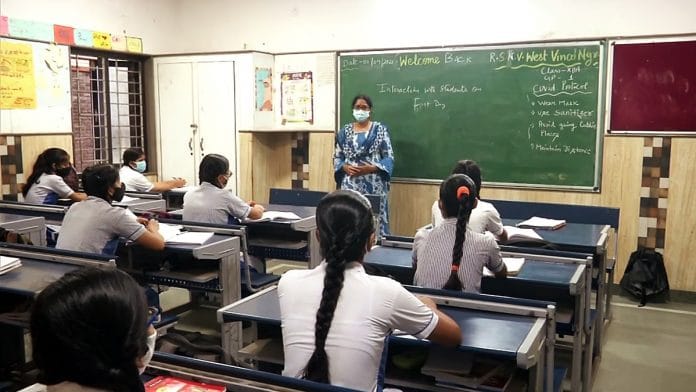
New Delhi: The Indian Association of Preventive and Social Medicine (IAPSM), an umbrella body of 550 medical colleges, has strongly recommended the reopening of schools and pre-schools in India.
In a 30-page document titled ‘Advisory for Reopening of Schools & Pre-school Facilities’, the association noted that it is safe for schools for all age groups to reopen “with appropriate precautions such as improved ventilation, physical distancing and masking”.
The IAPSM undertook an extensive review of disease epidemiology in children, global evidence on resumption of schools and also examined the risks and benefits associated with physical classes that have been detailed in the document.
Several epidemiologists such as Dr Suneela Garg, the national president of IAPSM, Dr Chandrakant Lahariya, a public health expert, and Dr J.P. Muliyil, former principal of Christian Medical College in Vellore, among others were involved in drafting the document.
“Focusing on education in particular, around 65% of the Indian students are enrolled in the public sector institutions and a major proportion live in rural areas, where access to online platforms is limited, both for students as well as teachers,” noted the IAPSM document released Sunday.
It added, “Thus, a pertinent risk of reversal of several decades of progress in equity, education, child nutrition and development glooms (sic) over us if schools are not opened immediately.”
Also read: 37% students in rural areas not studying at all as schools remain shut, survey finds
Children largely asymptomatic or mildly symptomatic
According to the document, available medical evidence indicates that children are infected with Covid-19 at a similar rate to adults.
“However, a large proportion of children remain asymptomatic/mild symptomatic. SARS-CoV-2 infected children seldom need intensive care as compared to adults,” the document read.
It added that data from the fourth national sero survey, conducted this June and July, indicated that children had already been infected at a higher rate than adults. Serological surveys estimate the extent of infection in a community by assessing the presence of antibodies.
IAPSM also quoted various studies, including one by researchers from the US, to highlight that children are less frequently symptomatic.
Highlighting the risk that the current situation poses to the psycho-social development of children, the document stated, “Children learn most when with other children in schools, which contributes to their social, emotional and mental well-being and impart skills such as communication and negotiation, to list a few.”
Educational institutions are also a source of nutritious meals to many children, it added.
Children less likely to die of Covid
The association further noted that there was no need to wait for vaccinations for children since “children and adolescents tend to have milder disease compared to adults”, according to the World Health Organisation.
“Schools are open in most of the countries of the world even if none of the countries have vaccination for children younger than 12,” argued the IAPSM.
The document recommends a range of Covid-appropriate behaviour while reopening schools, including physical distancing and hand washing, training teachers in identifying respiratory symptoms, alternating in-person and virtual classrooms on different days of the week or limiting school hours, and vaccinating staff members among others.
(Edited by Rachel John)
Also read: What’s the impact of Covid on mental health? Your hair holds the answer, new study says