





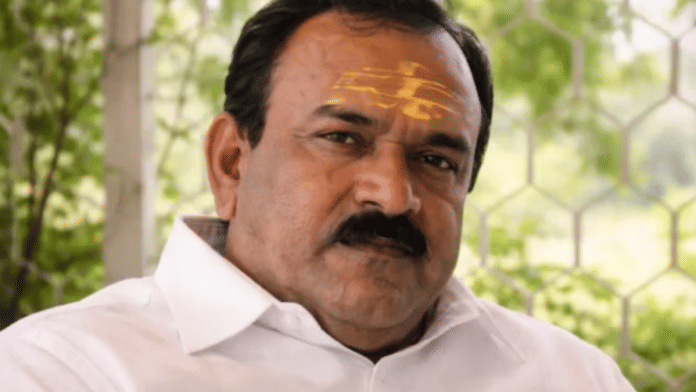

New Delhi: Foreign trips to 21 countries costing about Rs 1 crore, advanced medical treatment at Mayo Clinic in the US for nearly Rs 30 lakh and around Rs 3.5 crore spent on constructing a farmhouse in Nashik’s Mirgaon—these were the expenses self-styled Maharashtra godman Ashok Kharat made one of his disciples bear, according to the Enforcement Directorate.
Mayo Clinic provides a wide range of medical services, including hair and skin care treatment. However, the agency hasn’t disclosed the nature of treatment he underwent.
According to the agency’s prosecution complaint, all these expenses were borne by Pune-based businessman Rajendra Jasud, a director associated with multiple companies spanning real estate, construction, transport and recycling.
In his statement to the agency, Jasud allegedly revealed that he accounted for these expenditures under “travelling expenses” and “miscellaneous expenses” in the account books of his firms, the agency said.
Kharat initially came under the scanner of law enforcement agencies, and Nashik police arrested him in March this year following a complaint by a woman who alleged he had raped her several times over three years.
As the number of cases piled up, the Maharashtra government formed a Special Investigation Team (SIT) to probe all FIRs against him. Taking cognisance of these FIRs, the ED opened a money laundering probe and arrested Kharat in May.
The agency filed a prosecution complaint last month, and a Mumbai court took cognisance of the complaint on Saturday.
ThePrint reached Kharat’s counsels, Niranjan Mundargi and Keral Mehta, via WhatsApp messages and this story will be updated if and when they respond.
Web of accounts
According to the agency, Kharat admitted in his statement to the investigators that he had been engaged in the property business and provided consultation and advice on numerology since 2005.
In its money laundering probe, the ED has relied upon a statement under Section 50 of the Prevention of Money Laundering Act, 2002, of a former employee, who had alleged his wife was sexually assaulted by Kharat. Statements recorded under Section 50 are admissible as evidence in a court of law.
The former employee allegedly told the agency that when his wife informed him that Kharat had sexually exploited her, he secretly installed CCTV cameras inside Kharat’s cabin.
The cameras allegedly recorded “more than 30 incidents of sexual exploitation involving female visitors.” The collection of that footage, handed over to the police, led to registration of a fresh FIR against Kharat.
In his statements to the agency, the former employee alleged that Kharat earned more than Rs 50 crore between 2019 and 2024 through his consultations and that at least 30 clients visited his office daily during that period.
The number of visitors, he alleged, increased to up to 50 on weekends, with most visitors seeking guidance on astrology, numerology and personal issues.
The statement of the former employee, who worked closely with Ashok Kharat between 2019 and 2024, corroborates that Kharat earned approximately Rs 4 to 5 lakhs on ordinary weekdays and up to Rs 10 lakhs on Saturdays through his office, making earnings exceeding Rs 50 crore during these five years alone from office activities, the ED alleged in the prosecution complaint.
The agency alleged that these earnings were in addition to “substantially larger amounts” generated through his farmhouse and Tshaneshwar Temple at Mirgaon.
The agency further alleged that since Kharat has admitted to having been engaged in the business since 2005, the scale of earnings through these activities would be far larger than the income detected for the 2019-24 period.
“All of those aspects are subject to further investigation currently underway,” an ED official told ThePrint.
However, Kharat did not carry out these high-value transactions through his own bank accounts. Instead, he created a complex web of bank accounts to layer the funds, according to the ED.
For this purpose, Kharat allegedly used two cooperative credit societies—Samata Nagari Sahakari Patsanstha and Jagdamba Mata Gramin Bigar Sheti Sahakari Patsanstha—as the principal vehicles to layer the proceeds of crime.
The agency has allegedly identified at least 60 fraudulent Savings and 48 Special Savings Accounts with Samata Nagari Sahakari Patsanstha in the names of his followers, associates, or family members, based on documents they sought for pilgrimage purposes.
According to the agency, a detailed scrutiny of the KYC documents revealed that at least 40 of them were registered to Kharat’s mobile number—a fact Kharat admitted during his questioning by the investigators.
Huge amounts of cash totalling Rs. 21.25 crore were deposited, and withdrawals totalling about Rs. 23.87 crore were made from these accounts, with individual transactions deliberately kept below Rs 2 lakh to evade KYC reporting thresholds, the agency alleged in the prosecution complaint.
For the second mechanism, operated through Jagdamba Mata Gramin Bigar Sheti Sahakari Patsanstha, Kharat allegedly “abused his influential position” as vice-chairman and, subsequently, as chairman, of the society to create another network of allegedly benami financial accounts, the agency said.
Through his route, the ED alleged, a total of 34 Fixed Deposit and Current Accounts were fraudulently opened in the names of various persons, all of which were controlled by Kharat. Approximately Rs 1.86 crore in cash was deposited into these accounts, and maturity amounts of around Rs 3.18 crore were withdrawn in cash and returned to Kharat.
The ED has submitted statements from at least 24 account holders, including Rajendra Jasud, who allegedly stated that he had submitted his identification documents to arrange VIP darshan at Tirupati Balaji temple, as promised by Kharat.
“Under the pretext of arranging pilgrimage tours, VIP temple darshan, religious rituals, charitable activities or travel bookings, Ashok Kharat collected Aadhaar Cards, PAN Cards, photographs and other identity documents from numerous followers. These documents were thereafter utilised for opening bank accounts without their knowledge or authorisation, while Ashok Kharat’s own mobile number was linked to such accounts, thereby enabling him to exclusively operate them,” the agency alleged.
“During investigation, the majority of the account holders were examined under Section 50 of the PMLA, 2002 and they consistently denied having voluntarily opened the accounts, denied signing any account-opening forms, denied operating the accounts and denied having any knowledge of the substantial financial transactions reflected therein.”
(Edited by Sugita Katyal)