



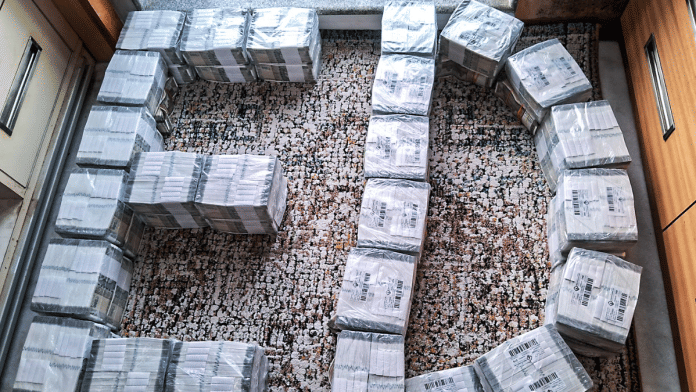
New Delhi: The Enforcement Directorate (ED) has frozen 1,424 bank accounts and arrested 18 people following raids at 38 locations across Assam, Mizoram and Manipur as part of a probe into a cross-border drug-smuggling network operating between India and Myanmar.
Codenamed “Operation Trident”, the operation on 23 October also led to the attachment of properties worth Rs 17.82 crore, the seizure of 500 detonators and Rs 12 lakh in cash, according to the agency.
The ED’s investigation has uncovered what it describes as a “two-way street” smuggling route centred on Zokhawthar, a border town in Mizoram’s Champhai district.
The network allegedly channelled more than 40 tonnes of chemical precursors from Gujarat to Mizoram for onward smuggling into Myanmar, where they were used in the manufacture of narcotics. Heroin, brown sugar and methamphetamine tablets produced in Myanmar, were smuggled into India through the same route, the agency said.
The ED arrested one Ahmedabad-based chemical trader, Kashyap Thakkar, after finding that his firm, Krishiv Enterprises, allegedly dispatched about 32 tonnes of Caffeine Anhydrous in 15 consignments between March and November 2024. These shipments were disguised as genuine sales to small retail pharmacies and a general store in Aizawl through regular e-way bills and GST invoices.
Additionally, the firm had allegedly sold around 10 tonnes of Aluminium Chloride Anhydrous to retailers in Mizoram’s capital city Aizawl and the state’s border region, despite having no manufacturing or processing facilities of its own.
“From these front consignees, the chemicals are moved onward across the border to the tablet-pressing units in Myanmar, where Caffeine Anhydrous is used to bulk and cut methamphetamine into the Yaba tablets,” an agency spokesman said in the statement.
In the second route of the drug cartel, the agency alleged that Myanmar-based organisers, namely Runthanchhungi alias Nu Sungi and Chintuang, hire local carriers in Zokhawthar town and transport heroin, brown sugar and methamphetamine tablets across the Tiau river before subsequent transportation of narcotics hidden in concealed soap cases, taxis, motorcycles and truck convoys with escort vehicles.
ED conducted coordinated PMLA searches on 23.10.2026 across Mizoram and Manipur in three money-laundering cases linked to cross-border drug trafficking from Myanmar and narco-hawala operations, in coordination with NCB and Mizoram Police.
ED froze 1,424 bank accounts,… pic.twitter.com/5yC49N4Wjb
— ED (@dir_ed) October 25, 2026
All these operatives are paid in cash collected through a web of bank accounts rented from shop owners and associates—meaning drug cartels used such bank accounts to receive, transfer or move money generated from drug sales, in exchange for a fee or commission—in Mizoram’s border region, according to ED probes.
The findings came to light after the ED joined sister agencies, the Narcotics Control Bureau and the Mizoram Police, in conducting sweeping raids across 38 locations in Assam, Mizoram and Manipur on 23 October, leading to the freezing of the bank accounts and the arrests.
Also read: HC orders Punjab govt to pay Rs 55k for warrant officer’s appointment to review ED’s GMADA raids
Accounts-on-rent
The ED’s probe into the drug cartels stemmed from the three separate but interconnected recoveries of narcotics between March last year and July this year, when the Manipur Police recovered 2.41 kg of brown sugar hidden in the form of 186 soap cases.
Further probe took the investigators to a supplier in Churachandpur district from whose place they allegedly recovered Rs 31.43 lakh in cash. The probe revealed that the cash was collected by the accused for transfer to suppliers in the smuggling chain.
The other money laundering probe was initiated on the basis of recovery of 49 kilograms of methamphetamine tablets and 40 grams of Heroin by the NCB from a convoy on a national highway in Mizoram in August last year.
The agency had found that a Myanmar national, Thancintuang alias Chintuang alias Tiuanga, was the kingpin of the syndicate. He was arrested in Delhi in May this year.
The third case was related to the recovery of 4.74 kilograms of Heroin by the Mizoram Police, hidden in 440 soap cases at the Zokhawthar town in March last year. The police had found that the consignment was being carried from the border town to the capital, Aizawl, for a Myanmar-based supplier.
The agency said that probes into these interconnected cases revealed that the same set of bank accounts—owned by individuals in three Mizoram districts Champhai, Aizawl and Lawngtlai—received drug money generated from sales of contraband in the North Eastern states.
The proceeds from the sale of drugs are collected in cash and then transferred into bank accounts owned by people in the border district of Mizoram before they settle the funds in Myanmar’s local currency, Kyat.
Citing an example, the ED alleged that one Nengzatuan Valte, alias Tuanpi, in Manipur’s Churachandpur district, collected cash and handed it over to cash handlers like Zenngaihniang, alias Taniang, who further integrated those funds into banking channels through the help of mini-ATMs and customer service points in the region.
“Taniang delivered up to Rs 1 crore per day at M/s Go Alpha Trip, a Mini-ATM and money-transfer counter in Churachandpur run by H. Gouzalal, along with a list of beneficiary accounts. Recording her under the code name “NUNIANG”, the counter made 2,947 transfers aggregating Rs 175.03 Crore between 2024 and June 2026 to traders, pharmacies and individuals in Zokhawthar, Champhai, Lawngtlai and Aizawl, routing part of the money through other Churachandpur counters and front entities to break the trail,” an agency spokesman said, explaining the flow of drug money.
The agency traced transfers from Go Alpha Trip in the Mizoram accounts already under probe in the two separate cases related to drug smuggling and its money trail, establishing that even the drug money collected in Manpur was being routed via bank accounts in a Mizoram border town.
Sources in the agency identified Manipur‘s Churachandpur and Aizawl as the hubs of this cartel, as among 1,424 bank accounts frozen during probe, approximately 1,000 were receiving funds from the district while 700 of these accounts were opened in the name of Aizwal residents.
“The ledgers of Go Alpha Trip, Churachandpur, matched the credits in the Mizoram accounts under investigation in the two Aizawl cases-Thangkhuala and his wife (Rs. 2.22 Crore), Zuali Drugs Store (Rs. 2.67 Crore), Fung Than Kimi (Rs. 2.05 Crore), Lalbiakhluna Lalduhawma (Rs. 1.82 Crore) and Lalrampari – establishing that the drug cash collected in Manipur was being settled through the same Champhai hawala accounts that service the heroin and methamphetamine networks of Mizoram,” the agency spokesman said.
These funds were further routed to pharmacies, general stores, and individuals at a commission of Rs 500 per lakh of transaction and the money was passed on to money exchangers in the border district of Champhai within days. The agency found use of an account opened in the name of a Mizoram homemaker, which allegedly received funds amounting to Rs 15.48 crore against a family income of about Rs 27,000 per month.
The funds finally reached a shop in Mizoram, JTS Store run by Lalrampari and her husband, Lalliansanga, which doubles up as a money-exchanger, and allegedly received Rs. 268.80 crore, including Rs. 125 crore in cash from Assam, Nagaland, West Bengal, Tripura, and Delhi, the agency said.
The ED also traced fund flows through hawala operators and shell companies. Lalrinkima allegedly received Rs 2.14 crore from shell companies based in Kolkata, while Taniang, a Churachandpur-based operative of the syndicate, received Rs 10 lakh from shell companies in Howrah.
(Edited by Ajeet Tiwari)
Also read: Motivational speaker to KPSC paper leak accused: Karnataka IAS Gyanendra Gangwar’s fall from grace