





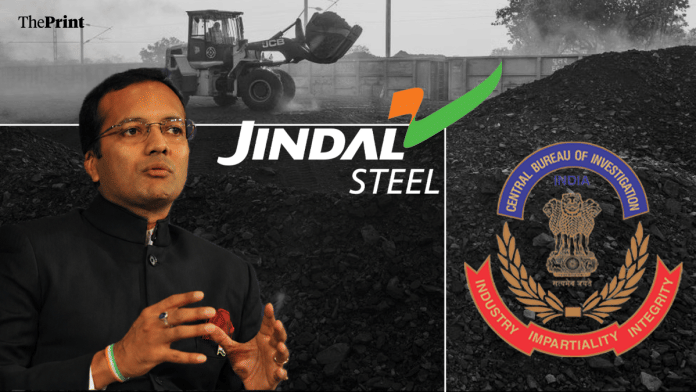

New Delhi: Two weeks before the 27th meeting of the Screening Committee for allocation of coal blocks in March 2005, Naveen Jindal, MD of Jindal Steel & Power Limited (JSPL), met the then Union Coal secretary. The purpose of this meeting, the Central Bureau of Investigation (CBI) has alleged in its chargesheet, was to seek expedited approval of the mining plan and regularisation of a coal block in Chhattisgarh’s Raigarh.
After the meeting, the screening committee, which had not included matters related to JSPL in its agenda for the meeting scheduled on 1 March 2005, decided in favour of JSPL, the agency further alleged.
It also said that there was no discussion or deliberation on mining plans proposed by JSPL, and the decision regarding the coal block in Chhattisgarh was taken in the absence of any state officials. The CBI further alleged that decisions of the then Congress-led UPA government enabled JSPL to carry out excessive mining to the tune of 3.72 million tonnes.
Naveen Jindal made his political debut in Haryana’s Kurukshetra Lok Sabha constituency in 2004 as a Congress candidate. He quit the Congress before the 2024 Lok Sabha elections and went on to win from the same parliamentary constituency, this time on a BJP ticket.
Details of the CBI chargesheet against Jindal, JSPL, and former coal secretary P.C. Parakh were made public for the first time Monday, when a Special CBI court took cognisance of the chargesheet filed last September. The agency filed the chargesheet under sections 120B (criminal conspiracy), 409 (criminal breach of trust by public servants) and 420 (cheating) of the Indian Penal Code and provisions of the Prevention of Corruption Act.
The CBI had booked Jindal, JSPL and an unknown public servant in 2014.
In its chargesheet—running into more than one lakh pages, with 778 attached documents and 234 listed witnesses—the CBI cited a delay in grant of sanction for prosecution of government officials as the reason for the delayed probe.
ThePrint reached Naveen Jindal for comment via phone calls and text messages but had not received a response by the time of publication. This report will be updated if and when a response is received. ThePrint also reached a spokesperson of JSPL via e-mail but had not received a response by the time of publication.
Responding to ThePrint’s request for comment via email, former coal secretary Parakh wrote: “I have not yet received any summons from the court and it will be inappropriate to make any comments on a matter that is subjudice.”
The screening committee was instituted by the Ministry of Coal in 1992, chaired by the ministry’s secretary and comprising representatives from other ministries, including Power and Railways, as well as PSUs such as Coal India and its subsidiary, the Central Mine Planning & Design Institute (CMPDI).
Government officials from the state where coal blocks are up for allocation were mandated to be part of the committee meetings to recommend allocation to public or private companies. The Supreme Court had, in 2014, scrapped nearly all of the 218 coal blocks allocated through the screening committee, calling the process arbitrary and illegal.
Also Read: OP Jindal wanted to be a wrestler. Then he saw steel pipes marked with ‘made in England’
CBI’s findings in case against JSPL
The CBI traced the origin of the case to May 1993, when the parent company of the OP Jindal group, Jindal Strips Ltd, approached the Ministry of Steel, requesting that it take up the issue of coal block allotment for a then-upcoming sponge iron plant in Madhya Pradesh’s Raigarh district. The company was setting up the plant with a capacity of 2 lakh tonnes per annum and planning to expand it to 6 lakh tonnes per annum.
Raigarh became part of Chhattisgarh after the formation of the state in 2000.
The company was granted the Gare coal block in Raigarh at the 10th Screening Committee meeting held in April 1996, according to CBI’s chargesheet.
It then approached Raigarh district administration for a mining lease covering up to 841.538 hectares. But, the Madhya Pradesh government allowed a mining lease for only 705 hectares, excluding agricultural land and residential areas.
“There is evidence on record that mining has been done in 88.947 Ha outside the coordinates and 35.355 Ha area is overlapped with the area earmarked to Chhattisgarh Mineral Development Corporation,” the CBI alleged in the chargesheet.
The agency also alleged that while the mining lease and all permissions were issued in favour of Jindal Strips, all mining operations were carried out by JSPL—without any transfer of the mining lease as mandated under provisions of Rule 37 of the Mineral Concession Rules (MCR), 1960, which governs the transfer, assignment, or subletting of mining leases.
“Investigation revealed that the annual Production by M/s. Jindal Steel & Power Ltd in Gare-IV coal block was more than the annual Scheduled Production of different years. In some years, the Annual Production exceeded the Peak Rated Capacity (PRC). As such, M/s JSPL has done excess mining to the tune of 3.72 million tonnes,” the CBI alleged.
JSPL was renamed as Jindal Steel Ltd on 22 July 2025.
Additionally, the CBI also alleged that JSPL sold products extracted from the site and during the process of mining, such as coal fines, pond fines, washery rejects, middlings, wash coal fines, washery middlings of washed coal fines, etc., to its sister concern, Nalwa Steel & Power, as well as other firms for nearly a decade between 2001-02 and 2011-12.
This report has been updated to include former coal secretary P.C. Parakh’s response.
(Edited by Amrtansh Arora)
Also Read: Why ED has moved SC to stall trial court order in PMLA case involving coal blocks allocation