





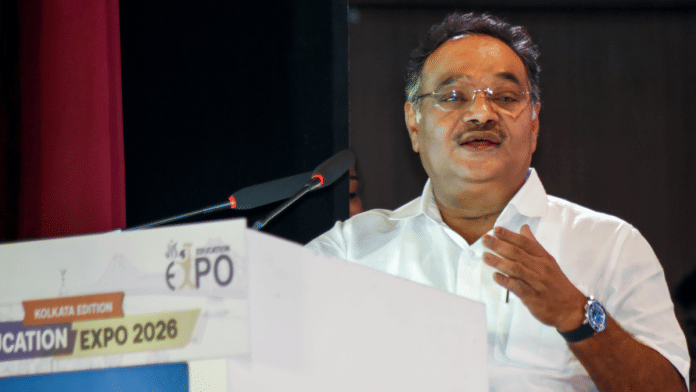


New Delhi: As West Bengal’s first BJP government scouts for investments to revive the state’s industrial growth after two decades of decline, state BJP chief and Rajya Sabha MP Samik Bhattacharya has said business houses, including the Birlas and the Tatas, have shown interest in investing, but they await the new industrial policy to be announced in a few days.
“Our government, led by chief minister Suvendu Adhikari, has reached out to several industrial groups including the Birlas and Tatas. The CM has spoken to the Ashok Leyland group. The Lulu group, headquartered in Abu Dhabi, is investing in Rajarhat. I can’t tell you all the names, but discussion is going on with them,” the Rajya Sabha MP told ThePrint in an interview.
Asked if the Tatas would come back to Singur, Bhattacharya said, “I cannot say at this moment if they will come and set up a car manufacturing unit or something else. But we have reached out, and discussions are happening.”
Bengal’s industrialisation hit the pause button after the 2008 land agitation drove away the Tata Nano project from Singur in Hooghly to Gujarat. The agitation, with Trinamool leader Mamata Banerjee as its face, brought her party to power in the state, ending the CPI(M )’s three-decade rule.
The West Bengal BJP chief acknowledged that land was an emotive issue in Bengal, and industrial houses were in wait-and-watch mode to see how the government addresses the challenge.
“Right now, there is no comprehensive land policy in the state. The new industrial policy will address some of the vexatious land-related issues. It will also incentivise industries to come and invest in the state,” Bhattacharya said.
The previous Trinamool Congress government had announced the withdrawal of all industrial incentives in 2025, much to the consternation of industrialists.
Also Read: West Bengal’s new industrial moment—From decline to revival
Challenges galore
The BJP government, Bhattacharya added, is also re-examining Bengal’s Urban Land Ceiling Act, 1976. The present law caps private ownership of vacant land in urban areas, which hampered industrialisation.
West Bengal Finance Minister Swapan Dasgupta, while presenting the BJP government’s first Budget in June, announced that the Urban Land Ceiling Act, 1976 would be re-examined.
Bhattacharya conceded it was a difficult task, but the government was working to address the challenges.
“For instance, there are so many PSUs, which have been idle for long. Right now, there is encroachment there. We have to remove it first. It is a difficult task, but we are working on it,” he said.
The problem, Bhattacharya said, was compounded because the Trinamool government, instead of creating awareness about the benefits of setting up industries and manufacturing units in the state, instigated people not to give up their land.
“The Trinamool government’s only policy was ‘jo jeeta wahi sikandar.’ Extortion and the culture of cut money drove away businesses and industries from Bengal. Industrialists were wary of investing. Because of all this, our present generation is facing problems,” he added.
He said that not only was there a tremendous financial crunch in the government, but the state debt had also risen manifold.
“As far as capital expenditure is concerned, they (TMC government) did nothing. We have taken charge at a very crucial time. It will take time. The conversation has already started,” he said.
The state BJP chief also highlighted how qualified, educated youngsters do not have jobs in the state.
“Is it desirable? Our girls and boys are going outside the state to work because we do not have industry… We have to create job opportunities for them. At the same time, we want qualified people to come and set up manufacturing units here.”
‘Just wait for 10 months’
Bhattacharya – who, as the BJP West Bengal chief, is also working behind the scenes, meeting industrialists and business houses and convincing them to invest in the state – said the government is not only focusing on bringing new-age industries like semiconductors and data centres to the state, but also trying to promote labour-intensive units like jute, textiles, hosiery industries and MSMEs.
“People are showing interest from different sectors, not only from India but also from Nepal, Israel, Japan, the US’ Silicon Valley, Germany… They are now ready to come to West Bengal,” he said.
Bhattacharya said that the government was also focusing on developing North Bengal, which the previous government “neglected”.
“We are in talks with hospitality groups to set up hotels and resorts in North Bengal. Just wait for another 10 months… Let the government complete one year, you will see a new West Bengal,” he said.
“Our government will ensure this,” he added.
(Edited by Sugita Katyal)
Also Read: Bengal was the undisputed industry leader in India. Why did it lose its way? asked Vajpayee